Sep 18

Global M&A Activity

Versailles Group September 18, 2013

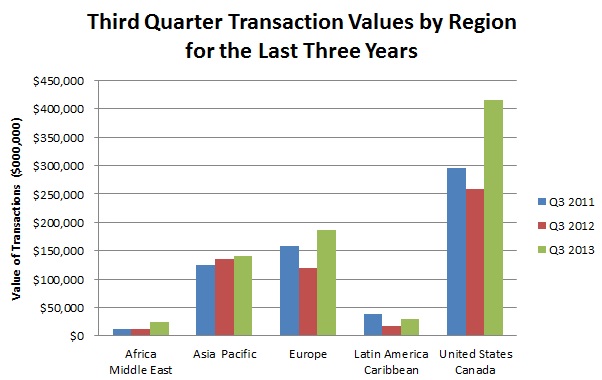
Year-to-date, M&A activity has been robust, as reflected in the chart below. Despite a modest start to the year, the value of M&A transactions is up, over the same time period last year, in all regions except for Asia Pacific.


Versailles Group Blog August 2013

Low interest rates, willing lenders, buyers with large cash balances, and other strong fundamentals are contributing to M&A activity around the world. And, it appears that deal multiples are increasing due to competition between private equity firms and strategic buyers. One of the strategies of both of these types of buyers is to enhance shareholders’ wealth via the acquisition of companies.

There are two questions that every business owner or CEO should ask, at least annually: when should we acquire a company and when should we sell either all or part of the company. The answer is not always straightforward, but the question is worthy of significant attention. With over 30 years of M&A experience, I have personally seen many businesses miss valuable opportunities by hesitating to consider a transaction.

Aug 14

Global M&A Activity - Last Six Months

Versailles Group August 14, 2013

Over the last six months, global M&A activity has steadily increased as the US and other economies have continued to rebound. This increased activity spiked in July as buyers and sellers have moved quickly to close transactions.


Versailles Group Blog August 2013

Shrewd owners, managers, and companies are seizing opportunities at a rapid rate. Cheap financing is still widely available; however, not all buyers are using credit facilities. Warren Buffet’s team have concluded over 12 middle market transactions in the first six months of 2013. These were not billion dollar mega-deals; they were smaller transactions concluded to fulfill particular strategies.

In this environment, every business owner or manager should be considering their options for buying or selling. Growth via acquisition can be productive whether it is offensive or defensive. Selling can be useful to shed divisions or subsidiaries that are either unwanted or underperforming. Owners should also consider selling the entire business for a variety of strategic, tax, and other reasons.

Jul 10

Global M&A Activity - Through Q2 2013

Versailles Group July 10, 2013

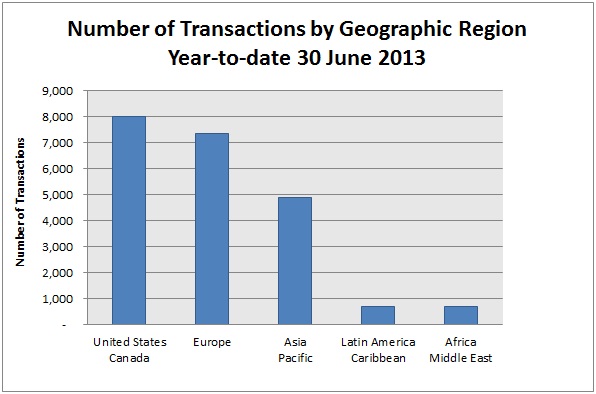
There were 21,605 M&A transactions announced, worldwide, in the first half of 2013. The totals by geographic region were as follows:

Versailles Group Blog July 2013

Versailles Group Blog July 2013

The US is continuing to lead the volume of M&A transactions with Europe not too far behind. While everyone is continuing to debate whether there is a recovery and if there is a recovery how strong it is, smart companies are completing transactions to fulfill management and shareholder objectives. And, they will benefit from these transactions in both the near and long terms.

With all these transactions taking place, the obvious question is what is the right time to undertake a divestiture or acquire another company? There are many correct answers to that question; however, the real answer is that it depends on your objectives. Most of the time, people/companies wait too long to pursue a transaction; consequently, they miss many viable and valuable opportunities.

Jul 05

M&A Transaction Structures: Asset Purchase vs. Stock Purchase

Versailles Group July 5, 2013

Merger and acquisition transactions present an opportunity for a seller and buyer to complete a transaction that will benefit both parties. That being said, the objectives of the buyer and seller need to be in alignment for a transaction to close. Finding a proper deal structure is a critical component in promoting the feasibility of a merger or acquisition. Generally, there are two primary structures for M&A transactions: an asset purchase or a stock purchase.

In an asset purchase, the purchaser will provide consideration in exchange for the assets (both tangible and intangible, e.g., goodwill, intellectual property rights, etc.) of the target company. Somtimes, the acquirer will assume selected liabilities of the company.

The assets purchased are at the buyer’s discretion and what buyer and seller agree upon. Most often, all of the assets are acquired and the selling company is left with the consideration, usually cash, and any remaining liabilities. The seller then either changes the name of the company and uses that entity for another purpose or liquidates the entity.

Most of the time, an asset purchase is favored by the buyer as it mitigates the possibility that prior, and perhaps unknown, liabilities from the selling company will be their responsibility. In particular cases, the avoidance of liabilities is not clear cut. For example, in certain jurisdictions, certain liabilities, e.g., environmental issues may penetrate any structure of an M&A transaction.

A stock purchase is much simpler than an asset purchase. The buyer simply purchases the stock of the selling company directly from shareholders in exchange for cash, the acquiring company’s stock, other consideration, or a combination of the three. The corporate status of the target company remains unchanged except that the stock is now owned by the buyer. In this case, the acquirer acquires all of the assets and all of the liabilities of the target company, unless agreed otherwise by the buyer and seller. And, in some cases, if the seller has valuable tax attributes, e.g., tax loss carryforwards, the purchaser may be able to utilize them.

Each structure contains advantages and disadvantages for both companies. The major concerns include tax considerations, liabilities, and the ease of completing the transaction. Other concerns will arise depending on the nature of the industries and companies involved. Typically, both parties will seek the advice of their tax accountants, lawyers, and investment bankers to determine the best and most efficient structure for a particular transaction.

Apr 29

Global M&A Activity - A Review of Q1

Versailles Group April 29, 2013

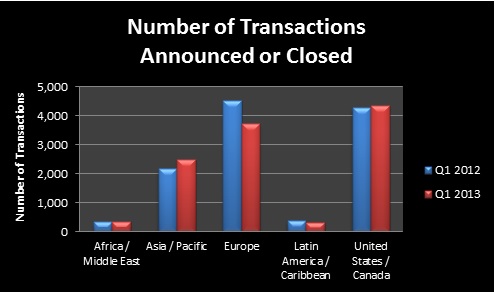
In the first quarter of 2013, M&A activity in Asia/Pacific and United States/Canada increased by 15% and 2%, respectively.


Versailles Group Blog April 2013

The remarkable surge of activity in Asia/Pacific is proof that an increasing number of companies are using their large cash positions, along with access to cheap debt, to expand in this region. In the United States/Canada, M&A experienced modest growth as financial and strategic buyers still view it as an excellent place to make opportunistic acquisitions.

Financial buyers are continually looking for companies that are poised for growth. Similarly, strategic buyers are looking to deploy large cash balances in an effort to expand geographically, increase distribution, and enter new markets.

Given these factors, it is highly likely that M&A activity will experience significant growth in the next three quarters.


Mar 25

Q1 Global M&A Activity

Versailles Group March 25, 2013

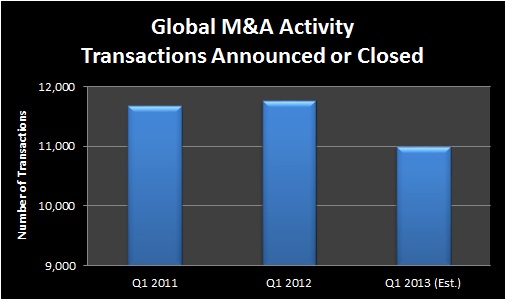
Global M&A activity in Q1 2013 is projected to be lower than Q1 2012. As you will note in the chart below, it is also expected to be lower than Q1 2011. Q1 2013 was impacted by several events including the overhang U.S. election, fiscal cliff, and the continued Eurozone crises.


Versailles Group Blog

We expect the pace of M&A transactions in general, and the middle market in particular, to increase dramatically over the next three quarters. Companies are continuing to make strategic and tactical acquisitions for numerous reasons including the simple fact that they can get a faster return with less risk via a successful acquisition than by making capital expenditures.


Feb 20

M&A Activity by Geographic Region

Versailles Group February 20, 2013

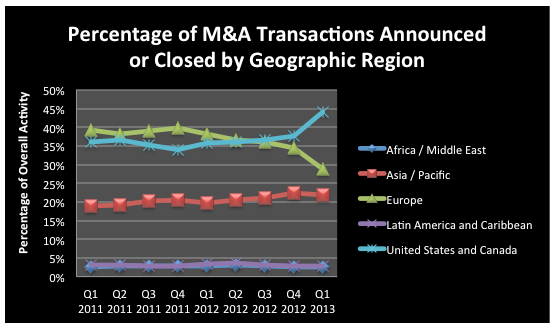
Over the past few years, the M&A landscape has changed quite dramatically from a geographic standpoint. As we’ve mentioned in the past, M&A activity in Europe has seen a quite precipitous decline, with associated increases in M&A activity in the United States / Canada and Asia / Pacific regions, and we fully expect this trend to continue in the near term.

The one region that has failed to receive much M&A attention is Africa / Middle East, which, in the chart above, follows nearly the same path as that of the Latin America and Caribbean region; however, it appears that there may be a sharp increase in M&A activity in Africa over the next three to five years.

Africa has a plethora of natural resources, such as oil and natural gas, iron ore, copper, etc. Many Chinese companies have already recognized the value and invested in these areas. As companies with large cash positions from other regions of the world start to deploy their capital to develop these natural resources, there will be a noticeable uptick in M&A activity in Africa.

Versailles Group Blog

Aug 15

Latin America & Caribbean M&A Activity

Versailles Group August 15, 2012

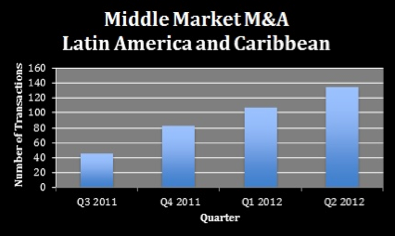
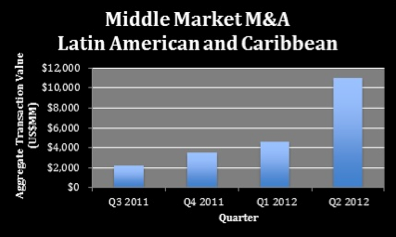
Over the past four quarters, there has been significant growth in M&A activity in the middle market of Latin America and the Caribbean. Both the number of M&A deals, aggregate value, and average value of M&A transactions in these regions have increased substantially.

The number of deals have increased in each quarter, from 45 in Q3 of 2011, to 83 in Q4 of 2011, to 107 in Q1 of 2012, and finally to 135 in Q2 of 2012.

Versailles Group Blog

Additionally, the aggregate value of these transactions increased substantially, from US$2,203MM in Q3 of 2011 to US$11,043MM in Q2 of 2012.

Versailles Group Blog

In terms of the average value per transaction, the first three quarters mentioned had fairly consistent figures (US$48.9MM, US$41.9MM, and US$43.6MM). However, Q2 of 2012 saw an 87% increase in the average value per transaction, jumping to US$81.8MM. A portion of this spike can be attributed to the M&A activity in energy and consumer staples, which experienced exponential increases.

As a result of these drastic increases in M&A activity, Brazilian middle market M&A now represents 31% of all middle market M&A deals in Latin America and the Caribbean. There are a number of reasons for this, including currency factors, changes in antitrust laws, growth in infrastructure projects in Brazil related to the impending Olympic Games and World Cup events, etc.


Jul 01

Q2 M&A Activity

Versailles Group July 1, 2012

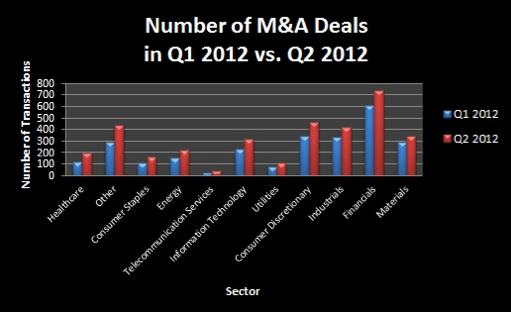
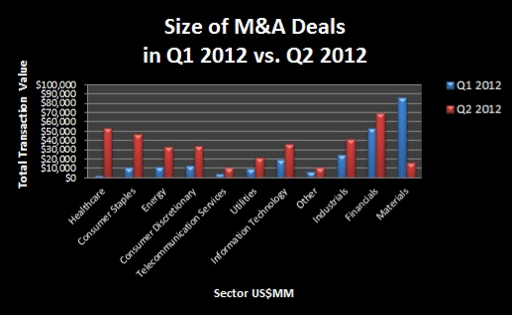
There has been a substantial increase in M&A activity from Q1 to Q2 of this year. There were 3,482 deals announced this past quarter, which translates into a 33% increase from the 2,613 deals announced in Q1. Additionally, the total transaction value has increased nearly 54% from US$243,961MM in Q1 to US$374,962MM in Q2. This surge has also resulted in strong growth in the average value per deal, up over 15% from US$93.36MM per transaction to US$107.68MM per transaction.

In terms of the number of M&A transactions, every sector saw an increase from Q1 to Q2. The most significant growth was seen in the healthcare and consumer staples sectors, with 68.1% and 42.3% increases respectively. With regard to the change in the total transaction value, all but one sector saw a surge (materials).

The following graphs further highlight the changes between the two quarters in each sector.

Versailles Group Blog

Versailles Group Blog

All signs indicate that M&A growth will continue in subsequent quarters. The largest companies still have significant cash reserves and financial buyers are eager to deploy their capital. Additionally, technology trends such as cloud computing and social media will force larger companies that cannot keep up with innovation to target smaller companies with cutting-edge technology.


Jun 01

Average Transaction Value - Strategic vs. Financial Buyers

Versailles Group June 1, 2012

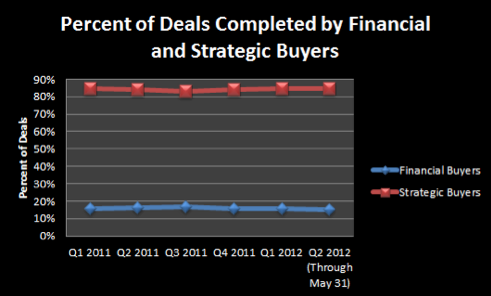
Since the beginning of 2011, the proportion of deals completed by Strategic buyers versus Financial buyers has stayed fairly constant as demonstrated by the chart below.

Versailles Group Blog

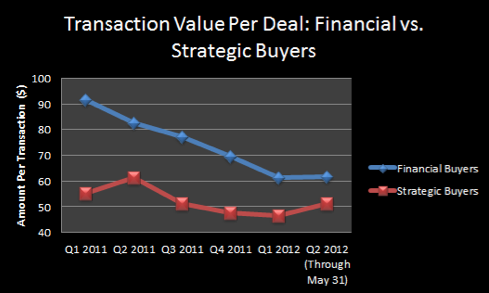
One statistic that has changed, however, is the total transaction value per deal, which started to decrease after reaching a high in Q2 2011. The record low for the last 17 months was in Q1 2012.

If one analyzes average transaction value by type of buyer, for Financial buyers, it has decreased from $91.76MM to $61.82MM over the last 17 months. For Strategic buyers, average transaction value has decreased by a much smaller amount, from $55.16MM to $51.32MM in the same time period. As you can see from the chart below, this statistic is trending upward over the last few months for Strategic buyers, but remaining flat for Financial buyers.

Versailles Group Blog

Financial buyers are paying less per transaction now versus 17 months ago. We believe that this trend is the result of credit markets that remain unstable, causing leveraged buyouts to be more expensive and complex. Typically, Financial buyers pay less because they have to generate a return on invested capital, without the benefit of synergies. The chart above also demonstrates that the average value that Strategic buyers are paying per transaction is not decreasing because of companies’ desires to either make offensive or defensive acquisitions and because of their ability to derive synergies.

When Strategic buyers make acquisitions, they are often able to recognize both revenue and cost synergies. Revenue synergies occur when the buyer can sell its products through the target’s sales force, and vice versa. Cost synergies occur when the buyer can reduce costs of the combined companies by eliminating redundant costs.

As a result of the trends mentioned above, we expect the average price per deal will increase over time. Strategic buyers will continue to use their large cash balances, which are reported to total US$850 billion for US companies, to make opportunistic and synergistic acquisitions, and Financial buyers will need to pay more for deals, or they will risk losing an increasing number of deals to Strategic buyers.