


Apr 10

The Advantages and Disadvantages of Cross-Border M&A Transactions

Donald Grava April 10, 2026

Cloud Gate, Chicago, Illinois, United States

Cross-border mergers and acquisitions are playing an increasingly central role in corporate growth strategies. For middle-market companies in particular, these transactions offer compelling paths to expansion, diversification, and long-term value creation. Yet, while cross-border M&A can unlock transformative opportunities, it also introduces significant complexity.

Navigating different legal systems, regulatory regimes, and business cultures requires strategic planning and careful execution. Success depends not just on identifying the right target or buyer, but on managing integration, risk, and stakeholder alignment from day one. With the right guidance, however, these challenges can be converted into a competitive advantage.

Versailles Group specializes in advising middle-market companies on cross-border M&A transactions, helping business owners realize their international ambitions. This article explores the advantages and the disadvantages of cross-border M&A and outlines how these complex deals can be structured for success.

What Is a Cross-Border M&A Transaction?

A cross-border M&A transaction involves the acquisition, merger, or joint venture between companies located in different countries. In contrast to domestic deals, cross-border transactions must account for multiple jurisdictions, foreign investment controls, regulatory clearances, and other international considerations.

These transactions may take the form of a full acquisition, a partial equity investment, or the creation of a new jointly owned entity. While deal structures vary, they all involve some transfer of control, influence, or shared governance across borders.

For middle-market and founder-led businesses, cross-border M&A is increasingly used to support succession planning, enable international expansion, or optimize a portfolio by divesting non-core operations. These transactions are often driven by a need to unlock new capital sources, access unique capabilities, or achieve valuations not possible within the domestic market.

The Key Advantages of Cross-Border M&A

Cross-border deals can be transformative for companies seeking to scale, innovate, or reposition themselves in a globalized economy. The benefits often extend well beyond immediate financial gain.

Access to New Markets and Customers

One of the most powerful advantages of cross-border M&A is immediate entry into new geographic markets. Acquiring or merging with a company abroad provides instant access to established customer relationships, local distribution channels, licenses, and brand recognition.

Rather than building a presence from the ground up, companies gain a functioning platform with local talent and infrastructure already in place. This allows for faster revenue generation, accelerated growth, and reduced execution risk compared to organic market entry.

For owner-led companies, this strategic leap can be the difference between incremental expansion and a credible international footprint.

Diversification of Revenue and Risk

Cross-border transactions enable companies to diversify beyond the economic, regulatory, and political risks of their home market. Exposure to new customer segments, industries, or currencies provides a more balanced and resilient revenue stream.

This kind of geographic diversification can be particularly useful for companies heavily reliant on a specific market or industry vertical. By entering regions with different growth cycles or regulatory dynamics, businesses can offset cyclical downturns and stabilize earnings over time.

This broader footprint also enhances appeal to investors and lenders who value diversified cash flows and global scale.

Access to Talent, Technology, and Innovation

Many companies pursue cross-border M&A to acquire capabilities not available in their domestic markets. Whether it’s advanced R&D, proprietary technologies, or skilled labor, these assets can dramatically accelerate innovation and strengthen a company’s competitive position.

Cross-border deals often involve management teams with deep local knowledge and functional expertise. For founder-led businesses, this influx of talent can professionalize operations and provide the leadership needed to scale more effectively.

In industries undergoing rapid technological change, acquiring innovation rather than building it internally may be the most efficient and strategic path forward.

Economies of Scale and Operational Efficiencies

When structured thoughtfully, cross-border combinations offer opportunities for cost reduction and operational efficiency. Shared services, centralized procurement, logistics optimization, and facility consolidation can all deliver meaningful savings.

In addition to reducing costs, cross-selling opportunities can be unlocked by combining complementary product portfolios or introducing one company’s offerings into the other’s markets.

Together, these efficiencies can enhance profitability, improve margins, and create a more compelling platform for future growth or exit.

Strategic Positioning and Global Competitiveness

Cross-border M&A also plays a critical role in strategic positioning. Establishing a presence in key international markets allows companies to compete more effectively with global incumbents, gain access to scarce resources, and shape competitive dynamics before rivals can respond.

Private equity sponsors and family offices pursuing platform strategies often use cross-border acquisitions to consolidate fragmented industries or secure differentiated assets in high-growth regions. For many, it is a proactive way to shape the future competitive landscape.

The Key Disadvantages and Risks of Cross-Border M&A

While the rewards of cross-border M&A can be significant, the risks are equally real. These transactions demand careful analysis and experienced execution to avoid value erosion.

Regulatory and Legal Complexity

Navigating multiple legal systems is one of the most challenging aspects of cross-border M&A. Transactions must comply with local competition laws, foreign investment restrictions, labor regulations, sector-specific rules, and tax regimes, each of which may differ significantly across jurisdictions.

In some cases, government approvals are required to complete the deal. Regulators may impose conditions, delay proceedings, or block transactions on grounds ranging from national security to market concentration.

As a result, cross-border transactions often involve longer timelines, higher advisory costs, and elevated execution risk. Early assessment of regulatory exposure and careful deal structuring are essential to preserving momentum and value.

Cultural and Organizational Integration Challenges

Cultural differences can undermine even the most financially sound deals. Differences in national values, corporate culture, and leadership style can affect communication, decision-making, and trust, all of which are key factors in any integration process.

Poorly managed cultural integration can lead to the loss of key employees, a decline in productivity, and the erosion of customer relationships. This risk is particularly acute for founder-led companies where the business culture is often closely tied to the owner’s identity.

A well-thought-out integration plan that respects cultural differences and builds alignment is crucial to unlocking operational value and maintaining performance post-close.

Political, Economic, and Currency Risk

Cross-border transactions expose businesses to political and economic risks beyond their control. Changes in foreign government policy, trade restrictions, sanctions, or taxation laws can significantly alter the financial attractiveness or feasibility of a deal.

Currency fluctuations and inflation add further risk. Volatile exchange rates can impact both deal pricing and future earnings when cash flows are converted into the buyer’s base currency.

Without adequate hedging or contractual safeguards, these risks can materially affect valuation, leverage ratios, and return expectations.

Tax, Structuring, and Compliance Challenges

International transactions require careful tax planning. Multiple tax regimes, withholding taxes, transfer pricing, and bilateral treaties must all be considered. Poor structuring can result in double taxation, inefficient capital flows, and unexpected liabilities.

Furthermore, compliance obligations, ranging from data privacy laws to ESG disclosures and anti-corruption standards, vary across jurisdictions. Ensuring compliance often requires significant upgrades to internal systems, controls, and governance frameworks.

These hidden costs and obligations must be accounted for upfront to avoid erosion of value over time.

Valuation and Due Diligence Complexity

Differences in accounting standards, disclosure practices, and market transparency make it harder to accurately assess the performance and value of foreign companies. The risk of information asymmetry is higher, particularly in less-regulated or unfamiliar markets.

Thorough financial, legal, operational, and cultural due diligence is required. This often necessitates the use of local advisors with deep knowledge of the regulatory environment and business culture. Their insights are essential to validating assumptions, uncovering liabilities, and negotiating protections.

Making Cross-Border Deals Work

Despite these challenges, cross-border M&A can be executed successfully when approached with discipline and forethought.

Strategic Preparation and Clear Deal Thesis

The most successful cross-border transactions are aligned with the company’s long-term strategy. Whether the goal is market entry, scale, or innovation, each deal should be evaluated against defined objectives and measurable outcomes.

Value drivers must be identified early, with a clear understanding of how they will be achieved and over what timeline. This discipline prevents overpayment and supports accountability post-close.

Robust Cross-Border Due Diligence

Effective diligence must go beyond the financials. Regulatory risk, political exposure, cybersecurity, and ESG factors should all be assessed with the help of local experts.

Understanding the target’s relationships, contracts, and cultural dynamics provides a fuller picture of its value and potential pitfalls. This level of insight can shape deal terms, protect against downside, and uncover opportunities for value creation.

Thoughtful Structuring, Financing, and Risk Mitigation

Tax-efficient structures, currency hedging, and contingent payment mechanisms like earn-outs or seller financing help balance risk and reward.

Financing strategies should account for currency composition, interest rate exposure, and covenant flexibility. Governance frameworks, including decision rights and incentive plans, must be tailored to accommodate cross-border coordination and integration.

Integration Planning from the Start

Integration must begin long before the deal closes. A detailed plan covering systems, talent, communication, and cultural alignment ensures momentum is maintained and disruption minimized.

Sequencing integration steps, appointing an experienced integration leader, and involving cross-functional teams across geographies improves execution and safeguards performance.

Where Versailles Group Adds Value

Versailles Group, Ltd., headquartered in Boston, is a global boutique investment bank with four decades of experience advising on mergers, acquisitions, divestitures, company sales, and buy-side transactions. We specialize in serving middle-market companies, entrepreneurs,  and corporate clients across a wide range of industries and geographies.

With deep expertise in cross-border M&A, we provide end-to-end strategic guidance from initial target identification and valuation through deal structuring, regulatory navigation, negotiation, and post-closing integration planning. Every engagement is led by senior professionals and executed with strict confidentiality, personalized attention, and a singular focus on maximizing long-term value for clients worldwide.

A Call to Action for Middle-Market Decision-Makers

For business owners and leadership teams considering cross-border M&A, early engagement with a specialized advisor can make all the difference.

Whether you’re exploring international growth, preparing for succession, or seeking to optimize your portfolio, Versailles Group offers the insight, relationships, and execution expertise needed to unlock the full value of a cross-border transaction.


Written by Don Grava

10 April 2026


About Versailles Group, Ltd.

Founded in 1987, Versailles Group is a boutique investment bank that specializes in international mergers, acquisitions, and divestitures. Versailles Group’s skill, flexibility, and experience have enabled it to successfully close M&A transactions for companies in the middle and lower-middle market. Versailles Group has closed transactions in all economic environments, literally around the world.

Versailles Group provides clients with both buy-side and sell-side M&A services and has been completing cross-border transactions since its founding in 1987.


Speak Confidentially with Versailles Group

If you are considering selling or acquiring a company, we welcome the opportunity to discuss your objectives and offer a clear perspective on your options.
Request a Session >>


May 23

M&A Activity - Private Equity

Donald Grava May 23, 2016

Quarterly M&A Comparison

Globally, both the volume and value of M&A transactions slowed in the first quarter of 2016.  Private Equity transactions were not exempt from this slowdown, which is being caused by tightening credit to finance transactions, election uncertainty, and lower confidence in the economy.

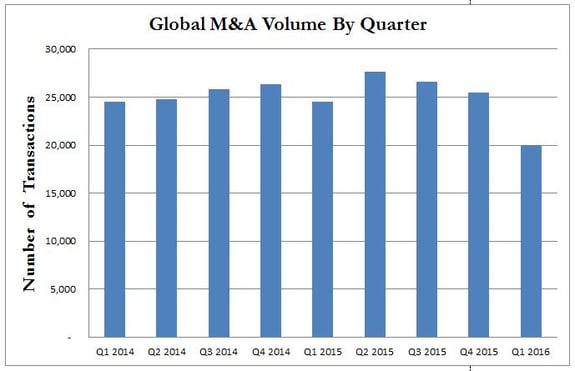
With regard to the volume of Private Equity transactions, the following chart depicts the Q1 2016 slowdown.  More specifically, Q1 2016 was almost 17 percent lower than Q1 2015.

Versailles Group - M&A Quarterly Comparison 

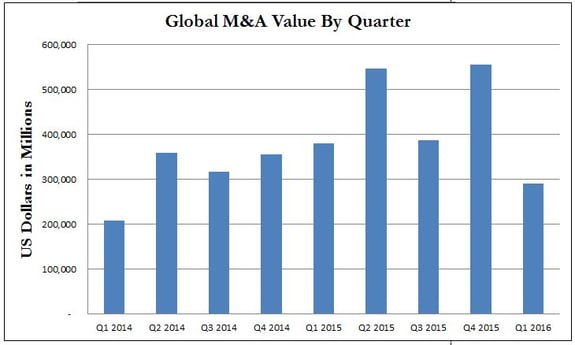
With regard to the value of Private Equity transactions in the first quarter, the slump in the number of completed transactions was even more apparent.  The value of transactions in Q1 2016 versus Q1 2015 decreased by 34 percent.  The major factor contributing to this was the simple fact that there was a dramatic slowing of very large transactions.

 Versailles Group - Quarterly M&A Comparison


Private Equity buyers still have plenty of “dry powder” and continue to look for transactions across all sectors.  Their investors are always looking for good returns, which can only happen if the Private Equity firm is invested.  In addition, while Private Equity buyers frequently don’t outbid strategic buyers, they do offer competitive valuations.  Furthermore, they provide business owners that are selling a very viable alternative with lots of other benefits.

The key to closing a successful transaction, particularly if the goal is to do that in 2016 is to explore the topic and develop definitive objectives.  Many sellers wait too long or have this fuzzy notion that a qualified buyer will seek them out.  Neither scenario achieves the best value.  

Versailles Group is a 29-year-old Boston-based investment bank that specializes in international mergers, acquisitions, and divestitures.  Versailles Group’s skill, flexibility, and experience have enabled it to successfully close M&A transactions for companies with revenues between US$2 million and US$250 million.  Versailles Group has closed transactions in all economic environments, literally around the world.

Versailles Group provides clients with both buy-side and sell-side M&A services, and has been completing cross-border transactions since its founding in 1987.  More information on Versailles Group, Ltd. can be found at www.versaillesgroup.com.

For more information, please contact

Donald Grava

Founder and President

+617-449-3325

 May 23, 2016 

May 18

M&A - Financial Vs. Strategic Buyers

Donald Grava May 18, 2016

M&A - Financial Versus Strategic Buyers

Versailles Group M&A - Financial versus Strategic Buyers

M&A - Financial Versus Strategic Buyers

M&A buyers are usually classified as either strategic or financial buyers.  Strategic buyers are companies actively pursuing opportunities to grow or diversify their revenue sources in the seller’s market.  Strategic buyers represent about 70 percent of the total M&A market.  Usually, a strategic buyer will have something in common with the selling company; they can be competitors, suppliers, customers, or even an unrelated company with a complimentary product looking to gain access to the seller’s industry, market, or business. Ultimately, they are looking for a company with attributes that can be integrated into their established business strategy to create synergy - the concept that the value of two companies combined is greater than the sum of the separate individual parts.  (Sometimes, strategics make acquisitions to diversify.)

Financial buyers look for good businesses they can build up over a few years and then sell to make a profit.  Private equity, venture capital, family offices, and some hedge funds are good examples of financial buyers.  Their acquisitions comprise the remaining 30 percent of the M&A market.  They look for growth prospects, good management, and future exit opportunities.  Rather than integrate the company into their own, they work with the seller’s management team to understand what resources they need and help obtain them, in an effort to foster growth.

During the Transaction 

Understanding the end goals of both financial and strategic buyers is essential to understanding how and why their approaches differ.  After the transaction, a strategic buyer will consolidate the target business with their business systems, controls, and management to recognize synergies from the integration of the two organizations.  If it’s a total integration, this may present a challenge for a seller that is looking to remain active in the company.  In this case, the best alternative is a financial buyer, who typically allows the company to run as a stand-alone entity.  In contrast, the financial buyer’s goal is to improve the business operations in order to make the company a more attractive investment to a future acquirer. 

Efficiency of the Transaction

Typically, a financial buyer has completed many deals before and has developed a kind of “playbook” to follow making the process flow along more efficiently than an inexperienced strategic buyer.  However, financial buyers tend to be more thorough in their diligence, for a couple reasons.  First, they have to take the time to learn about the industry they will be entering, whereas a strategic buyer generally has strong industry knowledge and has already developed an outlook for the future.  Additionally, things that may make sense to a strategic buyer may become an issue for a financial buyer who doesn’t understand industry norms.  

Secondly, a financial buyer is more likely to keep the current personnel in place than a strategic buyer.  Thus, the diligence process will have a stronger focus on the infrastructure of the target company.  Effectively, strategic buyers will focus on validation and the ability to integrate the target into their business model and financial buyers, in addition, will have to study the business model, the personnel, and much more.  

Consideration

One of the most important issues for sellers is the amount of consideration paid by each type of buyer.  Generally, a strategic buyer will offer greater consideration than a financial buyer.  In essence, financial buyers are purchasing explicitly what the company has to offer.  They buy the expected future earnings, in hopes to expand the cash flow beyond what the company has done previously, but they do not pay for that potential.  Usually, a strategic buyer will pay a premium to recognize the synergies that make the transaction attractive.  Almost immediately after closing, a strategic buyer will recognize synergistic benefits.  These benefits can be attributed to various factors that will depend on the organizations involved but can include greater market share, combined talent, and cost reduction.  Most importantly, the more realizable the synergies are, the more the purchaser will be willing to pay.  

There are also defensive reasons for a strategic buyer to pay a premium.  Suppose there are three companies who sell the same product; two with large distribution networks and significant market share.  The third company lacks the sales capability but they know how to produce the product for much less.  If the third company were to sell itself, it would make sense that the other two would pay a significant premium to prevent the other from acquiring the low cost producing seller.  In this scenario, a financial buyer would be outbid as they would be unwilling to pay a defensive premium. 

While the differences between strategic and financial buyers are evident, there is no clear answer as to what type of buyer is best for a seller.  The best way to discover what is right for the seller is to reach out to both strategic and financial buyers.  Understanding the characteristics and intentions of the target and acquiring entities is essential in making the right decision.  Aside from the obvious benefits of fostering competition, reaching out to both types of buyers present the opportunity for the seller to see more options and ultimately better understand what is in their best interest.  It’s also the best way to drive the highest possible valuation.

Versailles Group is a 29-year-old Boston-based investment bank that specializes in international mergers, acquisitions, and divestitures.  Versailles Group’s skill, flexibility, and experience have enabled it to successfully close M&A transactions for companies with revenues between US$2 million and US$250 million.  Versailles Group has closed transactions in all economic environments, literally around the world.

Versailles Group provides clients with both buy-side and sell-side M&A services, and has been completing cross-border transactions since its founding in 1987.  More information on Versailles Group, Ltd. can be found at www.versaillesgroup.com.

For more information, please contact

Donald Grava

Founder and President

+617-449-3325

May 18, 2016

May 11

Quarterly M&A Comparison

Donald Grava May 11, 2016

Quarterly M&A Comparison

Global M&A activity in the first quarter of 2016 decreased in comparison to the last eight quarters.

As depicted in the graph below, in terms of volume, Q1 2016 was the lowest in the past two years.  Despite the decrease, there were still approximately 20,000 transactions completed in just three months.

Q1 2016 M&A Volume


In terms of the aggregate value of M&A transactions, Q1 2016 was not the lowest in the past eight quarters.  Q1 2014 was actually lower.  The reduction of value reflects a slowing of mega-mergers, which sometimes skew the statistics particularly when one is focused on the lower middle market.

Q1 2016 M&A comparison


In the lower middle market, M&A activity remains robust, but it's important for both buyers and sellers to make sure that they are addressing the entire market.  For example, sellers should make sure that they are contacting buyers internationally.  Buyers should make sure that they are contacting targets in their entire marketplace to insure that they have the ability to comparison shop and complete the best possible transaction.

One of the biggest challenges to completing an M&A transaction is to make sure that the buyer or seller have engaged a well-experienced advisor that has experience in the international arena.  The world has gotten “smaller,” largely due to the improvements in communications.  In the “old” days, say prior to 1982, international telephone calls were extremely expensive, faxes didn’t exist, and telex was a worldwide standard, but slow and expensive.  To summarize, email, cheap telephone calls, etc. have made it easy for people to communicate worldwide.  But, many M&A advisors don’t have the experience to deal with people with different customs and cultures.  Versailles Group has nearly 30 years of dealing with buyers and sellers around the world.  We use a culturally sensitive approach that allows us to successfully complete transactions that increase shareholder value on both sides of the negotiating table.  Win win negotiating always works best!

May 11, 2016

May 03

M&A Negotiations

Donald Grava May 3, 2016

M&A Negotiations

M&A Negotiations


M&A Negotiations

In negotiating a merger, an acquisition, or a divestiture the ultimate goal is to structure a deal in which separate companies complete a transaction that generates shareholder value for both buyer and seller.

M&A negotiations are one of the more complex aspects of an M&A transaction and it’s always a good idea to have an experienced M&A advisor performing this task.   While there are some minor negotiations that occur in the earlier stages of the M&A process, the most important negotiations relate to the value and terms of the proposed transaction.  The value usually isn’t a complex concept, but earnouts, and other forms of consideration can be tricky, particularly for an entrepreneur who has not completed a large number of transactions.  There are many important items that need to be negotiated, for example, there is the issue of a holdback versus an escrow and what percentage of the transaction consideration this will be.  The holdback or escrow provides the buyer with protection against unforeseen liabilities.  Many sellers worry that they’ll never see this money; however, provided there are no hidden liabilities, the seller always gets their funds.

The selling firm can accept, reject, or attempt to negotiate any offer that is submitted for their company.  Most of the time, the offer price isn’t considered high enough or the other terms don’t coincide with the interests of the selling company’s shareholders.  However, if this can be overcome, more detailed negotiations will ensue, if both parties are willing.  Both parties always retain the ability to reject the transaction if it doesn’t meet their financial and other objectives.  Once the major deal terms are agreed, the parties will execute a Letter of Intent, which is a non-binding document, but captures the major terms and conditions of a potential transaction.

In order to complete a successful transaction, a large amount of collaboration and negotiation between the buyer and seller is required.  Most importantly, both parties must understand each other’s objectives and it’s always helpful if both sides believe in win-win negotiating. 

The importance of understanding each other’s objectives can be demonstrated by the following story.  Two sisters were fighting over an orange and in order to resolve the argument, their father cut the orange in half and gave one half of the orange to each of his daughters.   While this seems like the best solution, both sisters actually ended up with a bad deal.  One sister wanted the rind for cooking while the other sister wanted to eat the orange.  Hence, both of them actually lost.  Instead, if the two sisters had understood each other’s objectives, the orange could have been divided in a much better way, the rind to one and the contents to the other.  The moral of the story is to try to understand the other side’s needs and objectives with a view towards finding middle ground or a compromise.  An experienced M&A advisor will know how to conduct these M&A negotiations so that they are productive, efficient, and result in a successful transaction.

Versailles Group is a 29-year-old Boston-based investment bank that specializes in international mergers, acquisitions, and divestitures.  Versailles Group’s skill, flexibility, and experience have enabled it to successfully close M&A transactions for companies with revenues between US$2 million and US$250 million.  Versailles Group has closed transactions in all economic environments, literally around the world.

Versailles Group provides clients with both buy-side and sell-side M&A services, and has been completing cross-border transactions since its founding in 1987.  More information on Versailles Group, Ltd. can be found at www.versaillesgroup.com.

For more information, please contact

Donald Grava

Founder and President

+617-449-3325

May 3, 2016


Apr 26

The Importance of an M&A Advisor

Donald Grava April 26, 2016

The Importance of an M&A Advisor

The Importance of an M&A Advisor

The Importance of an M&A Advisor

While some debate the issue of whether to hire an M&A advisor or try to complete a transaction alone, it’s been well-proven that a good financial advisor can add value to completing a successful transaction.

M&A advisors play an integral role in orchestrating successful mergers, acquisitions, and divestitures.  The best M&A advisors are generalists as they have broad experience to draw on as they work through the process of completing a successful transaction.  Anyone interviewing an M&A advisor that receives the answer that the financial advisor knows exactly who will buy their company should keep looking.  Often, the best buyer isn’t known to the company, but is carefully cultivated through the process by the M&A advisor.

The M&A advisor’s role is to orchestrate the transaction.  One of our clients used the analogy of a choreographer.  In some ways, the M&A process is a ballet that needs to be carefully scripted if the best possible results are going to be achieved.  One of the most important objectives is keeping the process confidential.  The M&A advisor also plays an integral role in mobilizing information, organizing the auction, negotiating terms, managing the diligence process, and finding solutions to a multitude of issues during the process.

One of the first steps that a good M&A advisor will take is to identify the client’s objectives.  Next, there’s the discovery period where the advisor researches the client’s company in order to create first class documentation.  The M&A advisor will also do research to find every possible prospective buyer on the sell-side or identify possible targets on the buy-side.

On the sell-side, the M&A advisor will create an Offering Memorandum or Confidential Information Memorandum so that prospective buyers can obtain information in a logical order about the company.  More specifically, this document lays out information on the company’s operations and products (or services), industry analysis, financial background, forecasts, etc.

On the buy-side, it’s always good to have a well written document to give to potential sellers that outlines information on the acquiring company and their objectives.  This makes the sellers comfortable and accelerates the process.

Whether it’s on the sell-side or the buy-side, a good financial advisor will know how to draft these documents, which are pivotal in attracting potential buyers or sellers.  While some companies think they can do without a financial advisor, most entrepreneurs are ill-equipped to prepare these essential documents.

The M&A advisor is also very useful in the preliminary negotiations leading to an offer, structuring the transaction and negotiating and mediating throughout the process.  The client can benefit from this advice as the financial advisor can help keep their client level-headed by maintaining realistic goals and expectations as well as providing unbiased advice.  In addition, they can negotiate more effectively because they are removed from the inherent emotional complications, not to mention their expertise in the entire process.

Whether a client is looking to acquire or sell a company, they have the option of hiring a full service bank or a boutique bank as a financial advisor, which both inherently have their pros and cons.  While full service banks have a greater variety and depth of resources than boutique firms, their effectiveness is also hindered by possible conflicts of interest that don’t affect boutique firms as severely.  In a study done by Jie Wei, a financial economist working in the Office of the Controller of Currency in Washington, D.C., and Weihong Song, an assistant professor of finance and the University of Cincinnati, boutique banks on average are found to be less expensive overall and when used for financial advisory on the buy-side, the premium paid for an acquired company is less than using a full service bank.

For smaller middle-market companies, i.e., companies with less than US$250 million in revenues, a boutique firm can offer the client better service, specialized expertise, and better results than a larger full service bank.  Most importantly, M&A advisors, because of their experience and expertise, can do a far better job at navigating the M&A waters than an entrepreneur whose expertise is in their product or services.

Versailles Group is a 29-year-old Boston-based investment bank that specializes in international mergers, acquisitions, and divestitures.  Versailles Group’s skill, flexibility, and experience have enabled it to successfully close M&A transactions for companies with revenues between US$2 million and US$250 million.  Versailles Group has closed transactions in all economic environments, literally around the world.

Versailles Group provides clients with both buy-side and sell-side M&A services, and has been completing cross-border transactions since its founding in 1987.  More information on Versailles Group, Ltd. can be found at www.versaillesgroup.com.

For more information, please contact

Donald Grava

Founder and President

+617-449-3325

April 26, 2016

Apr 14

M&A Advisory - The Teaser

Donald Grava April 14, 2016

M&A - The Teaser

M&A - The Teaser

M&A - The Teaser

When selling a business, it is important to know how to appeal to buyers.  A key step, of course, is to make sure that the best parts of the business are displayed.  These items are what we call Unique Selling Points (“USP”).

A good M&A advisor will know how to portray the USPs so that a broad audience will be able to understand and value the business.  This is important as the best way to sell a business is to contact a large number of potential buyers, usually worldwide.  The buyer list should also include a variety of types of businesses, if possible.  There is no way to predict where a buyer will come from, why they will be interested in your company, or why they are looking to buy any company at all.  Because of this, casting a wide net in the search for buyers is the best chance at finding the “right” interested party.  The “right” buyer will always pay more for the company.

In addition to the formal Confidential Information Memorandum that buyers will receive after executing a Non-Disclosure Agreement, the company or its M&A advisor should create a one-page teaser.  The teaser should describe the company in enough detail, without disclosing confidential information, to get potential buyers interested.  In most cases, it will be a “blind” teaser in that the company’s name will not be disclosed.  It should also be written so that potential suitors won’t be able to figure out which company is for sale.

The teaser should include background on the company—the type of company, overview of its products/services, its history, location, etc.  The teaser should then go on to describe the customer base and why the business is a good investment.  The teaser should also have summary financial data, historical, current and projected.  To summarize, the critical part of the teaser is to make bold claims to drive interest.  At the same time, one needs to make sure that those claims can be backed up with facts.

The majority of people who receive the teaser will not end up being interested in purchasing the business.  However, knowledge is power.  It’s just as important to know that other companies are not interested.  It demonstrates to the seller how strong the market is for their company, which is very useful information.  Both the seller and the M&A advisor commence the process with the optimism that there will be many prospective buyers.  But, once buyers are contacted, the seller will have a very good idea of how many interested buyers there really are.  If the demand is modest, it doesn’t’ mean that the company can’t be sold for a good valuation.  But, it does mean that the seller needs to be careful with the buyers that do present themselves.

In conclusion, the key to the teaser is to give potential buyers enough information to pique their curiosity without releasing too many details about the company.  Interested buyers should then execute a Non-Disclosure Agreement and receive the Confidential Information Memorandum on the company.  From there, the M&A advisor should narrow down the interested parties to those that are serious and financially qualified.

Versailles Group is a 29-year-old Boston-based investment bank that specializes in international mergers, acquisitions, and divestitures.  Versailles Group’s skill, flexibility, and experience have enabled it to successfully close M&A transactions for companies with revenues between US$2 million and US$250 million.  Versailles Group has closed transactions in all economic environments, literally around the world.

Versailles Group provides clients with both buy-side and sell-side M&A services, and has been completing cross-border transactions since its founding in 1987.  More information on Versailles Group, Ltd. can be found at www.versaillesgroup.com.

For more information, please contact

Donald Grava
Founder and President
617-449-3325

April 14, 2016


Mar 23

Buy-Side M&A - Seller Employment

Donald Grava March 23, 2016

Buy-Side M&A - Seller Employment

Cross_Campus_Bench.jpg

Buy-Side M&A - Seller Employment

With regard to buy-side M&A, when purchasing a company, it is important to make an objective assessment of the seller as a potential employee.  Typically, these “employees” carry particularly high risk.  Unless the seller is truly essential to the running of the company, it is usually better to remove them from the company as soon as possible. If a seller is retained at the company needlessly, they will often be an obstruction to the future running of the business.

The reason that sellers often make poor employees is that it is difficult for them to remember that it is no longer their company.  They are accustomed to doing things their own way, working independently, and in some cases, they may have personal relationships with former customers that prevent them from effectively dealing with new clients that might be competitors of their old “friends.”  These types of events undermine the buyer’s ability to lead employees and take the newly purchased company in a new direction.  The buyer’s role must be unambiguous; therefore, employing a seller is a risk that should only be taken when it is necessary to do so.

If a seller has a vested interest in a business’ success, any continuing relationship between them and the company after closing is usually outlined in the sales agreement.  Of course, the nature of that relationship must match the nature of their interests, for example, performance based earnout payments, consulting agreements, etc.

Employment of the seller is not always the best way to enable the seller to monitor the status of their vested interest.  There are better ways to accomplish this task by sending the seller monthly or quarterly financial statements, providing audit reports, granting the seller rights to “audit” results, etc.

If employing the seller for an extended period of time is unavoidable, it is important to help him or her prepare for their new role.  It is quite common for sellers to unintentionally find themselves filling their former role.  For the buyer to be successful, this must be avoided. Some ways to gracefully usher the former owner aside include:

Having the new CEO move into the seller’s office.  As the employees are accustomed to the person in charge being there, this will also make it easier for them to see the buyer as that person.

Suggesting that the seller not take the lead in decision-making, and instead adopting a back-seat role.

Asking that the seller to redirect staff questions to the new CEO.

Use the seller as a source of advice, but demanding that the staff go to the new CEO when they need recommendations or decisions made.

Asking that the seller use the pronoun "we" when he or she talks to customers.

Giving the seller plenty of time off, especially during the transitional period immediately following the closing of the transaction.

However positive the buyer’s relationship with the seller is, he or she will eventually need to be removed from the company.  Very likely, the seller will be looking forward to this day as well, so it is useful to plan ahead when the buyer is preparing the consulting or employment agreement.  Thus, on the buy-side of MA, being stuck with a seller as an employee can be a major obstacle in the running of the business, so unless you have no choice, try to get them out as soon as you possibly can.

Versailles Group is a 29-year-old Boston-based investment bank that specializes in international mergers, acquisitions, and divestitures.  Versailles Group’s skill, flexibility, and experience have enabled it to successfully close M&A transactions for companies with revenues between US$2 million and US$250 million.  Versailles Group has closed transactions in all economic environments, literally around the world.  Versailles Group provides clients with both buy-side and sell-side M&A services, and has been completing cross-border transactions since its founding in 1987.  More information on Versailles Group, Ltd. can be found at www.versaillesgroup.com.

For more information, please contact

Donald Grava
Founder and President
617-449-3325

March 23, 2016


Feb 07

The Value of Customer Lists and M&A

Donald Grava February 7, 2016


The M&A Value of a Customer List

Library-of-the-Canadian-Parliament-Ottawa-Canada.jpg

With regard to M&A, what is the value of a customer list?

The most obvious step to take when growing a company is to acquire more business by adding customers. To many, it would seem like the larger the customer base, the better your company will look to potential buyers. However, it is important not to fall into the trap of taking on any and all customers that come your way. In the long run, having too many customers could be a strain on the company’s resources and profitability. The goal is to build and maintain a customer list that will add value to your company when you sell it.

When starting a business, it seems sensible to take on any and all clients. It is critical that one not maintain that attitude, though. While this is a great way to build a large customer base, it frequently results in a situation where each customer will only be generating a small percentage of the company’s income. On top of that, marketing and servicing a diverse set of customers is expensive and could have a negative impact on the company’s profitability. At the end of the day, the best strategy is to eliminate low margin customers. It can also be tempting to do things like take on both commercial and federal contracts to broaden your customer list. Depending on the product or service, this could be a mistake. Some buyers will not want to acquire a company with multiple types of contracts and customers with divergent goals and views of the world. Usually, it is more effective to choose one type of customer and work on developing and maintaining those customer relationships. It’s also more profitable, which will drive the valuation more than just a large list of customers.

Specifically, having a large customer list is not necessarily what will make your company appealing to potential buyers. Instead, one should work on developing long-lasting, large client relationships with clients that have shared needs and characteristics. Ultimately, having a smaller number of loyal customers will give your company a higher value in the eyes of prospective buyers. To be clear, profitability per customer is important. It’s also very important to avoid customer concentration, i.e., having one customer account for more than five or ten percent of total revenues. Thus, if your company doesn’t have customer concentration, has long term customers with steady contracts, and they provide above average profits for the company, you’ll have a very marketable company that will generate a high valuation.

Versailles Group, a 29-year-old Boston-based investment bank that specializes in international mergers, acquisitions, and divestitures. Versailles Group’s skill, flexibility, and experience have enabled it to successfully close M&A transactions for companies with revenues between US$2 million and US$250 million. Versailles Group has closed transactions in all economic environments, literally around the world. Versailles Group provides clients with both buy-side and sell-side M&A services, and has been completing cross-border transactions since its founding in 1987. More information on Versailles Group, Ltd. can be found at www.versaillesgroup.com.

For more information, please contact

Donald Grava
Founder and President
617-449-3325


Jul 02

Small Business Appraisals: Should You Just Hire an Investment Bank Instead?

Donald Grava July 2, 2015

Business Appraisal or Investment Bank?


business appraisal or investment bank?


Small Business Appraisals: Should You Just Hire an Investment Bank Instead?

How much is my company worth? Every business owner should be asking this question! Business owners usually plan to sell their company eventually, and understanding the business’ actual value is absolutely critical to planning a retirement strategy.

There are many valuation services that cater to small, privately-owned companies. These services can cost up to US$50,000 and will use a multitude of valuation techniques. The end product is an intricately detailed report that attempts to determine the intrinsic value of the company. Yet when it comes to selling a company, such services always overlook one important fact. At the end of the day, the most important determinant in a seller’s price is how much the buyer is actually willing to pay. Appraisals can be useful for getting a ballpark estimate of your company’s worth, but complex valuation models won’t change the fact that pricing mainly depends on the buyers, especially when the company isn’t publicly traded. This is why it is so important to have the right buyer.

The only time a business owner will ever get a completely accurate valuation of his or her company is when it is finally brought to market. Even if one chooses to get the business appraised beforehand, one would still need to find real buyers afterwards. Just because a valuation report claims that your company is worth US$20 million doesn’t mean that buyers will be willing to instantly hand you US$20 million in cash. The M&A process including painstaking negotiations are still necessary to secure a strong offer, especially if you have any specific preferences on deal structure (e.g., if you want to stay with your company after the sale). Most of the time, an auction process involving multiple bidders, will maximize the value of the business, and with the right buyer, you will receive an offer higher than the initial valuation.

That’s where a boutique investment bank like Versailles Group comes in. Versailles Group has nearly three decades of experience in searching for and negotiating with buyers from around the world. By applying its expertise and experience, Versailles Group will enable you to obtain the maximum value for your business. Hopefully, this will give the business owner some insight into the question: small business appraisal or investment bank?

Since 1987, Versailles Group's skill, flexibility, and experience have enabled it to successfully close M&A transactions for companies with revenues between US$2 million and US$250 million. Versailles Group has closed transactions in all economic environments, literally around the world, which is why it has won several M&A awards. Versailles Group provides clients with both buy-side and sell-side M&A services, and has been completing cross-border transactions since its founding in 1987.

If you are interested in buying or selling a business, please contact us for a free consultation.

Donald Grava
Founder and President
Versailles Group, Ltd.
617-449-3325

(Photo by Don Grava)