Apr 15

Q1 2014 M&A Activity

Versailles Group April 15, 2014

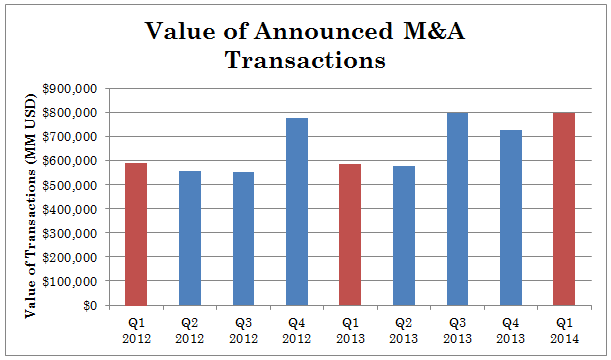
M&A activity in the first quarter of 2014 was quite strong. The value of transactions announced in the first quarter exceeded both 2012's and 2013’s first quarters. The value of announced transactions in the first quarter of 2014 also exceeded that of the last quarter of 2013, which is very dramatic as the fourth quarter is usually the busiest quarter of the year for M&A.

April Blog

They say that April showers bring May flowers. M&A is similar! Devising a strategy and working hard to ensure the proper execution always results in a superior transaction. 

Versailles Group's one of the key ingredients is careful thought to ensure that the strategy and tactics will achieve the desired result.

Mar 15

Building Shareholder Value Via Mergers and Acquisitions

Versailles Group March 15, 2014

With regard to building shareholder value, business owners and companies frequently ask themselves:

Is this the best time to sell my company or a part of my company?

Is this the best time to buy a company or part of a company?

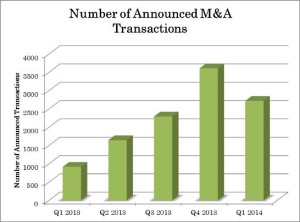
The charts below demonstrate from both a value perspective and the number of M&A transactions announced that now is the time to pursue these strategies.


March Blog3


March Blog1

The dramatic run-up of both deal value and number of transactions announced in Q1 2014 versus Q1 2013 is very evident, despite the fact there are still 15 working days left in March.

Feb 12

Completed M&A Transaction

Versailles Group February 12, 2014

Versailles Group is pleased to announce that Photon Technology International Inc., an electro-optical systems and components manufacturer with offices in the U.S., Canada, the U.K., and Germany, has been sold to Horiba Ltd., a world leader in analytical and measurement systems that is headquartered in Kyoto, Japan. Versailles Group represented Photon Technology International.

The text of the Press Release is listed below for your convenience.

BOSTON, Feb. 12, 2014 -- Versailles Group, Ltd. (www.versaillesgroup.com) announced today that Photon Technology International Inc. (www.pti-nj.com), with operations in the U.S., Canada, Germany, and the U.K., has been acquired by Horiba Ltd. (www.horiba.com) (TSE:6856). Versailles Group acted as exclusive financial advisor to Photon Technology International Inc. Terms were not disclosed. The transaction closed on Feb. 10.

Versailles Group, a Boston-based investment bank that specializes in international mergers, acquisitions, and divestitures, advised Photon Technology International Inc.'s shareholders on the transaction. Versailles Group works with companies in the U.S., Europe, Canada, Asia, and South America.

Founded in 1983, Photon Technology International Inc. ("PTI") is a leader in electro-optical systems and components technology. The company's light-based systems are used in laboratories for research, healthcare, industrial processes, quality control, biomedical, environmental science, and many other applications. PTI pioneered a line of proprietary and / or patented optical building blocks which form the basis of all light-based instrumentation. The company sells these building blocks as standalone units and uses these building blocks to develop its open architecture fluorescence systems. PTI is the world leader in microscopy-based fluorometers, especially for ion imaging, in part due to a long-standing research and development collaboration with a prestigious laboratory in the Faculty of Medicine and Dentistry of the University of Western Ontario in Ontario, Canada.

"The acquisition of PTI fulfilled the primary shareholders' desire for a liquidity event. It also provides a path for the majority owner to retire in the next few years," said Donald Grava, Versailles Group's founder and president. By utilizing Versailles Group's worldwide approach to finding the right buyer, PTI was sold to Japan-based Horiba. This will enable PTI the ability to sell its products via Horiba's worldwide sales organization. Furthermore, it provides Horiba access to PTI's fluorescence spectroscopy products and PTI's low-cost production capabilities in Canada.

Headquartered in Kyoto, Japan, Horiba Ltd. is the world leader in analytical and measurement systems in the fields of engine emissions, scientific analysis, industrial and process control, environment monitoring, semiconductor process control, healthcare, and biotechnology. Founded in 1945, Horiba is a global company that has offices in Asia, Europe, North America, and South America. The company is publicly traded on the Tokyo Stock Exchange and has annual revenues of approximately ¥118 billion.

Jan 30

5 Myths of International Mergers and Acquisitions

Versailles Group January 30, 2014

international mergers and acquisitions myths

There are many misconceptions about international mergers, acquisitions, and divestitures. The five biggest myths are:

That cross-border transactions are not worth the effort.

Cross-border transactions can be very productive and profitable whether you’re on the buy or sell side – depending on the opportunity. Many companies like to expand into new markets and do well; for example, Illinois Tool Works, the multi-billion dollar US company, has made over 30 acquisitions in Brazil alone. Obviously, they have the vision and resources to complete these deals and would have stopped long ago if they were unprofitable.

That foreign buyers always pay more when acquiring a company.

Foreign buyers sometimes pay more for an acquisition in a different country to buy their way into a market. But that’s not always the case. Many foreign buyers are careful buyers and only pay for value.

That cross-border transactions will take an impossibly long time.

Cross-border transactions can take extra time, as sometimes due diligence will be slowed down by the need to translate documents, to obtain the necessary approvals, understand local customs, etc. However, for an organized buyer, these extra steps only add a modest amount of time, not the unreasonably long time that many envision.

That foreign buyers or sellers are impossible to work with.

Many people believe that foreign buyers or sellers are difficult to work with. There is absolutely no truth to that. People are people, and that’s the same around the world. The percentage of people who are difficult to work with is probably the same in every country. That’s a simple fact of life. And, many foreigners doing international mergers and acquisitions are actually a pleasure to work with.

That foreign sellers always try to cheat the buyers.

Foreign sellers, despite some beliefs to the contrary, are not out to cheat the buyers of their companies. Many countries use different accounting conventions, which do not mean the accounting data has been “cooked.” Frequently, buyers think that whatever is happening in the transaction is directed towards them. Most of the time, it’s just that the buyer doesn’t understand the local customs.

As with any transaction, foreign or domestic, the key to success is thorough due diligence.

Jan 21

5 Questions to Ask in an M&A Software Transaction

Versailles Group January 21, 2014

m&a software transaction questions

Acquiring a software company is much like acquiring any company in that thorough due diligence needs to be conducted. That being said, there are five factors that are critical when examining a software company for acquisition.


M&A Software Transaction: 5 Questions to Ask

(1) Can the seller prove ownership of the source code? It’s important for the buyer to know that the source code is owned or was created by the seller.

(2) Will the software programmers that created the code stay with the company post acquisition? This is important, particularly with complex software programs as it’s difficult for outsiders to understand the architecture and features.

(3) Many times, sellers will offer their key employees, especially software programmers stay bonuses that match whatever time period the buyer is requesting. While that’s fine, many buyers have been quite surprised that after the magical time period that a majority of the employees leave. Therefore, it’s important for the buyer to know that any employee that has been offered a stay bonus may quit as soon as the time period is fulfilled. Such key employees may need additional incentives to stay beyond that bonus period. The best way to cover this is via a rep and warranty in the Definitive Agreement that reveals if stay bonuses are being paid and to whom.

(4) In any business, customers are critical as they provide the cash flow. The important question is how committed are they to the business being sold. If the customers are running important software programs and are worried that the new buyer won’t support them adequately, there might be a huge risk of them switching to another vendor.

(5) Another important point is to make sure that software license sales prior to closing don’t contain future obligations of updates or to maintain such software. That could be a very expensive obligation for a buyer.

Questions? Ask An Expert!
Jan 16

How to Vet Middle Market Investment Banks

Versailles Group January 16, 2014

If you’re considering hiring a middle market investment bank to either buy or sell a business, it’s important to check the firm out carefully. Successful transactions don’t just happen. To obtain the best result, transactions have to be managed carefully by seasoned professionals.

Photograph showing a magnifying glass placed on an open newspaper, focusing on a section about mortgages. The black-handled magnifying glass enlarges text beneath it.Middle market investment banks should have both domestic and international reach. That’s important for both buy and sell side transactions in M&A. On the buy side, one shouldn’t miss the chance to view every possible target in the defined geography. On the seller's side, it’s important that the seller not miss another possible buyer, who might have offered better terms and more consideration, just because they’re outside of the territory that is most familiar to a particular firm. In other words, one should hire a firm that can truly cover the world. There are always opportunities if one knows how to find them.

It’s also important for middle-market investment banks to have the ability to create excellent documentation. Those documents will be the first thing that the potential target or buyer will see about your company. As they say, “first impressions count.” If you take a moment to examine the documents that the prospective investment bank sent you, it’s a giant clue as to how they present their clients.

Another important element to check is the firm’s ability to structure and negotiate difficult transactions. The best way to ferret out this information is to ask about a complex transaction. Another way is to look at the firm’s “tombstones.” Are they all transactions between well-known buyers and sellers or are some of them cross-border and between companies that aren’t so obvious?

Staffing on any advisory engagement is important. How long have the principals of the firm been employed by that particular middle-market investment bank? What is their experience level? What are the chances that they will leave the firm mid-transaction? There have been many cases of clients being impressed with the individual handling their project, only to find that they took a better position across town. And, understandably, the transaction stays with the firm, not the individual. As we say, buyer beware.

To summarize, check out your middle market investment bank's experience level, years in business, credentials of the staff and ability to present well.

A little due diligence goes a long way to ensuring a successful transaction.


Speak Confidentially with Versailles Group

Versailles Group provides clients with both buy-side and sell-side M&A services and has been completing cross-border transactions since its founding in 1987.

If you are considering selling or acquiring a company, we welcome the opportunity to discuss your objectives and offer a clear perspective on your options.

Request a Session >>

Jan 15

Middle Market M&A Activity - 2014 Outlook

Versailles Group January 15, 2014

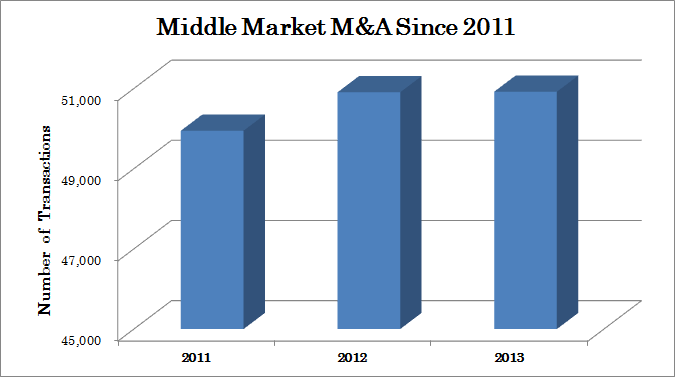
As you will see from the chart below, worldwide, middle market M&A activity has been steady for the last three years despite numerous worldwide economic ups and downs.


Jan Blog


Given the improving economic climate and the strong fundamentals supporting M&A, we believe that M&A transactions will increase in 2014.

Jan 07

3 Things to Know About Boutique Investment Banks

Versailles Group January 7, 2014

When hiring a boutique investment bank, it’s important to focus on three main areas:

How long has the firm been in business?

Often times, many boutique investment banks are in existence because the founder or founders are between positions at larger firms. Therefore, if the firm you are considering has been in business for less than five years, it begs the important question: Is this a part-time occupation or a serious business? Most sellers only have one company to sell, so it’s important that the advisor be serious and not in between lucrative positions. If the firm that you are considering has been in business for more than 10 or 20 years, you’re probably safe.

Boutique Investment Banks Things to Know

Who will work on the proposed transaction?

The staffing for the engagement is important. How much M&A experience do they have? How long have they been with the firm? Are they likely to leave the firm in the middle of your transaction? Experience is important as M&A transactions are never mundane. There are always twists and turns from all of the parties involved. A successful M&A transaction occurs when a series of challenges are solved fast enough to keep both buyer and seller engaged.

What are the capabilities of the boutique investment bank?

What types of deals has the firm completed to date? Do they have international capabilities, not necessarily international offices? In other words, have they completed cross-border transactions? Many firms claim to have that capability, but it’s limited to completing transactions to or from their home country. True cross border capabilities include the ability to complete transactions completely outside the firm’s home country. International capabilities are more important now than ever before. The world has gotten smaller and it’s expensive to miss opportunities just because they’re outside of your geography.

Questions? Ask An Expert!

photo credit: kenteegardin

Dec 24

Do I Need a Boutique Investment Bank?

Versailles Group December 24, 2013

Many buyers or sellers wonder if they need a boutique investment bank versus a large full service firm. If what you need is a successful M&A transaction, you’re typically better off with a firm that derives all or most of its revenue from M&A. That means you’ll receive the best and most attention.

Do I need a Boutique Investment Bank

Typically, boutique firms are more nimble and able to react faster than larger full service firms. Therefore, they’re much better at completing middle market transactions where the number of buyers or targets is quite large. Boutiques are adept at operating in this environment. Boutiques are also good at giving the entrepreneur or corporate client that hasn’t completed a number of transactions the necessary advice to “walk” them through a complex maze of finding the right buyer or seller, presenting the transaction, helping guide due diligence, structuring a transaction that will be mutually agreeable, and negotiating a Definitive Agreement. All of these steps involve lots of intricacies that need to be managed efficiently and effectively. To conclude, for most middle market transactions a boutique investment bank will probably provide the highest level of service and the best possible outcome for either a buy or sell side assignment.

Questions? Ask An Expert!
Dec 19

5 Questions to Ask Your Middle Market Investment Bank

Versailles Group December 19, 2013

Photograph of Chicago river scene featuring the red steel bridge "State Street" spanning across a waterway with boats and a white tour boat navigating below. Surrounding the river are tall modern and historic skyscrapers, highlighting a bustling cityscape with clear daylight and reflections on glass buildings.

Selecting a middle-market investment bank can influence buyer reach, valuation strategy, confidentiality, negotiating leverage, and the likelihood of closing. For many owners, especially founders and first-time sellers, the challenge is knowing how to evaluate an advisor before the engagement begins. Reputation and relationships matter, but execution matters more. A capable M&A advisor brings senior-level judgment, transaction experience, project management, and the ability to identify and engage parties most likely to create value.

Before hiring a middle-market investment bank, business owners should consider the following five questions.

Question 1: Who will actually work on my transaction?

In M&A advisory, the team that wins the engagement is sometimes different from the team that manages the assignment day to day. Owners need clarity on who will lead the mandate, prepare the materials, contact buyers or targets, manage negotiations, and communicate with the client throughout the engagement.

That clarity matters because middle-market transactions require judgment at every stage. A sale or acquisition involves positioning the company, anticipating buyer concerns, preparing management for difficult questions, and deciding when to press, pause, or adjust the strategy. Those decisions are shaped by experience, not by process alone.

For sellers, senior-level attention is especially important during buyer outreach, management presentations, letter of intent negotiations, due diligence, and closing. For buyers, it is critical during target identification, owner outreach, valuation analysis, and transaction structuring.

The answer should be specific. A business owner should understand the senior banker’s role, the responsibilities of each team member, and the firm’s expected communication rhythm from launch through closing. Vague assurances about “team support” provide little comfort when a transaction becomes complex.

Question 2: How much M&A experience does the firm have?

Experience in M&A should be measured by more than familiarity with a single industry. Business owners should ask how long the firm has advised on M&A. They should also understand the range of transaction types the firm has handled.

This depth matters because middle-market transactions often involve issues that reach beyond industry knowledge. A successful advisor must know how to prepare a company for market, identify credible counterparties, protect confidentiality, manage buyer or target outreach, negotiate letters of intent, respond to diligence pressure, and help move a transaction toward closing.

A firm with broad M&A experience can draw on patterns seen across many assignments. It may recognize how buyers evaluate risk, where negotiations tend to become difficult, how valuation expectations shift, and which deal terms can materially affect the outcome. That judgment is developed through repeated transaction experience, not through research alone.

The most useful answer will be specific. A qualified middle-market investment bank should be able to describe its history, transaction breadth, senior-level involvement, and ability to manage the practical demands of an M&A process from preparation through closing.

Question 3: How will you identify and approach buyers or targets?

The quality of the buyer or target universe often shapes the quality of the outcome. For a seller, the investment bank should explain how it will identify strategic acquirers, private equity firms, family offices, international buyers, and other qualified parties. The market map should include obvious candidates as well as less visible parties with strategic reasons to pursue the company. These may include industry adjacencies, consolidators, suppliers, customers, foreign acquirers, or companies seeking access to a new geography, product line, customer base, or technical capability.

For a buyer, the advisor’s role shifts toward target identification and discreet owner outreach. Many attractive middle-market companies are privately held and are not actively for sale. Effective outreach requires research, credibility, persistence, and judgment. 

In both cases, the firm’s outreach strategy deserves close review. The client should understand who will be contacted, how sensitive information will be protected, how interest will be tracked, and how the advisor will distinguish serious parties from casual inquiries.

A strong M&A effort balances coverage with discretion. Contacting a large number of parties without a thoughtful strategy can create noise and increase confidentiality risk. The objective is targeted coverage: reaching the most relevant parties while maintaining control of the engagement.

Question 4: How do you protect confidentiality during the process?

Confidentiality is one of the most important issues in middle-market M&A, particularly for sellers. Employees, customers, suppliers, competitors, and lenders may react poorly if they learn too early that a company is exploring a sale or strategic alternative. A leak can disrupt operations, weaken negotiating leverage, and create avoidable concern inside and outside the business.

A qualified investment bank needs a clear system for protecting sensitive information. That system may include blind teasers, staged disclosure, non-disclosure agreements, controlled access to confidential materials, buyer screening, and careful sequencing of outreach.

The advisor’s approach to direct competitors, strategic buyers, and other sensitive parties is important. In some cases, certain buyers may need to be excluded from the outreach universe or approached only after additional protections are in place. The advisor must generate market interest while limiting unnecessary disclosure.

Important questions include:

  1. What information will be included in the initial teaser?

  2. When will the company’s name be disclosed?

  3. Who approves the buyer list before outreach begins?

  4. How are competitors handled?

  5. How is confidential information controlled during diligence?

An advisor who treats confidentiality casually may expose the company to unnecessary risk.

Question 5: How do you manage valuation, negotiation, and closing risk?

A transaction succeeds when the process produces credible offers, preserves leverage, survives diligence, and closes on acceptable terms.

Business owners should examine how the investment bank manages valuation, negotiation, due diligence, and closing risk. The advisor’s answer should address how the firm will position the company’s financial performance, growth opportunities, customer relationships, management team, and strategic value. It should also show a working knowledge of how buyers evaluate EBITDA, working capital, addbacks, capital expenditures, customer concentration, and future growth assumptions.

In a sell-side process, the advisor’s role is to create a competitive environment and maintain leverage through each stage of the transaction. That requires careful timing, disciplined communication, and a clear understanding of buyer behavior. A good advisor knows how to compare offers beyond headline price, including structure, escrow, earnout terms, financing risk, closing certainty, indemnification, and post-closing obligations.

In a buy-side assignment, the advisor helps the client assess value, understand risk, and structure a transaction that supports the buyer’s strategic and financial objectives.

Business owners should also ask about regulatory structure where securities activities are involved. The advisor should be able to explain whether securities are offered through a FINRA-registered broker-dealer and whether the relevant professionals are properly licensed for the work being performed.

No reputable advisor can guarantee a specific valuation or closing outcome. The stronger answer is a clear explanation of positioning, negotiation strategy, diligence preparation, and closing discipline.

Choosing the Right Middle-Market Investment Bank

When considering hiring a middle-market investment bank, business owners must conduct a thorough evaluation. Key factors to assess include the qualifications and experience of the lead advisor, the strategy for developing the buyer or target universe, the measures in place to safeguard confidentiality, and the firm’s approach to managing valuation, negotiation, and execution risks.

A capable M&A advisor can answer those questions directly and explain the reasoning behind its approach. The conversation should give the owner confidence that the firm can manage both the strategic and practical demands of the transaction.


Speak Confidentially with Versailles Group

Versailles Group provides clients with both buy-side and sell-side M&A services and has been completing cross-border transactions since its founding in 1987.

If you are considering selling or acquiring a company, we welcome the opportunity to discuss your objectives and offer a clear perspective on your options.

Request a Session >>