




There are five different types of mergers, and the purpose of this blog is to describe these in more detail. This writing is not meant to be a comprehensive description of each, but rather an introduction.
A merger is an agreement that unites two existing companies into one new company. Generally, mergers are done to expand a company's reach, expand into new market segments, or gain market share. Most of the time, mergers and acquisitions are done for either offensive or defensive reasons.
Although the terms “merger” and “acquisition” are frequently used together, they do not mean exactly the same thing. A merger generally combines two companies into a single organization, while an acquisition occurs when one company purchases another. In practice, many transactions commonly described as mergers are legally structured as acquisitions.
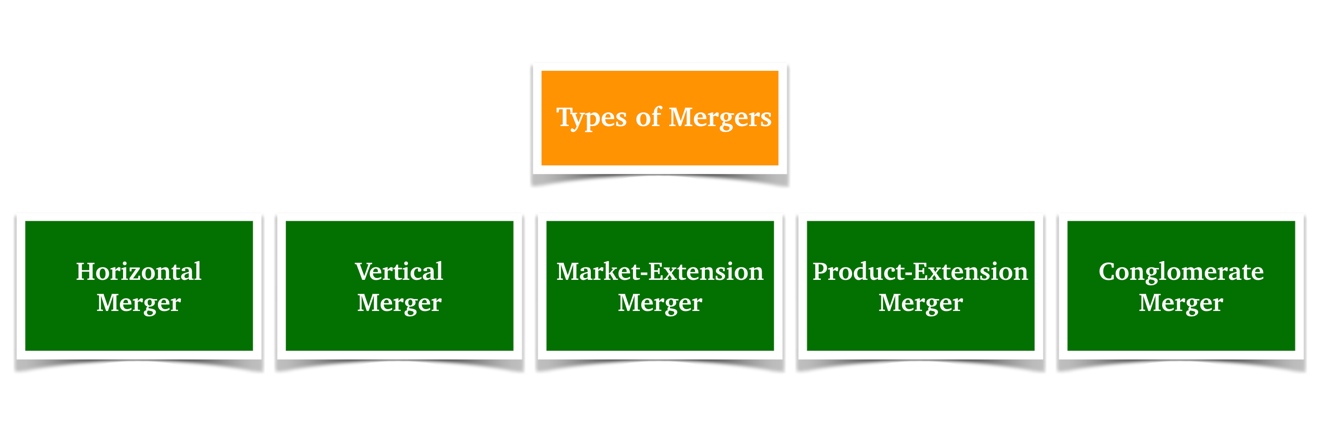
The Five Basic Types of Mergers
Horizontal Merger
This is a merger between companies that are in direct competition with each other in terms of product lines and markets. A famous example of a horizontal merger was the merger between HP (Hewlett-Packard) and Compaq in 2011. The successful merger created a global technology leader valued at over US$87 billion.
Horizontal mergers are often intended to increase market share, expand the customer base, add capabilities, or improve operating efficiency. Because the companies operate in the same or closely related markets, the buyer may already understand the target company’s products, customers, competitive environment, and growth opportunities.
In middle-market M&A, horizontal transactions frequently involve a strategic buyer acquiring a competitor or another company offering complementary capabilities. The buyer may identify opportunities to consolidate facilities, combine sales organizations, eliminate duplicative costs, strengthen purchasing power, or introduce the acquired company’s products to a broader customer base.
Vertical Merger
A merger between companies that are in the same supply chain.
Example: Walt Disney acquired Pixar Animation Studios for US$7.4 billion in 2006. Pixar was an innovative animation studio and had talented people. Walt Disney was a mass media and entertainment company. By combining forces, they created a very powerful company in their industry.
Vertical mergers generally involve companies operating at different stages of the production or distribution process. A manufacturer might acquire a supplier to gain greater control over critical inputs, for example, or acquire a distributor to gain more direct access to customers.
The strategic benefits of a vertical transaction may include greater supply-chain reliability, improved margins, more control over quality, shorter production timelines, better access to customers, and reduced dependence on outside suppliers or distributors.
Market-Extension Merger
A merger between companies in different markets that sell similar products or services. The motive behind this type of merger is to make sure that the merging companies will be able to operate in a bigger market and thereby gain large numbers of new clients.
A good example was RBC Centura’s merger with Eagle Bancshares Inc. in 2002. This market-extension merger helped RBC with its growing operations in the North American market.
A market-extension merger may enable a company to enter a new geographic territory, customer segment, or end market without building an entirely new operation from the ground up. The acquiring company may benefit from the target company’s existing customer relationships, employees, reputation, licenses, distribution channels, and knowledge of the local market.
These transactions can be particularly relevant to middle-market companies with strong regional positions or specialized customer relationships. A larger domestic or international buyer may see an established local business as an efficient platform for entering a new market.
Product-Extension Merger
A merger between companies in the same market that sell different but related products or services. For this kind of merger, the products and services of both companies are typically not the same but are related. The key is that they utilize similar distribution channels and common or related production processes or supply chains.
An example of a product-extension merger would be the merger between Mobilink Telecom Inc. and Broadcom. The two companies both operate in the electronics industry, and the resulting merger allowed the companies to combine technologies and extend their market reach.
A product-extension merger allows a company to broaden the range of products or services it can offer to existing or similar customers. The transaction may create cross-selling opportunities, expand the company’s addressable market, strengthen customer relationships, and reduce dependence on a limited number of products.
These transactions are common when a buyer believes it can introduce an acquired company’s products through its existing sales and distribution channels. The buyer may also be able to offer its own products to the acquired company’s customers, creating potential revenue synergies for the combined organization.
Conglomerate Merger
A merger between companies in unrelated business activities, e.g., a clothing company buying a software company. In other words, two totally different businesses. These types of mergers are also further defined as:
- Pure Conglomerate: In this case, the two companies have nothing in common. An excellent example of a Pure Conglomerate merger was the creation of W.R. Grace a specialty chemicals and industrial business that went on to buy over 150 different businesses, including retail outlets (Herman's Sporting Goods, Channel, Handy Dan, Angels, Diana, Sheplers), food chains (Del Taco, Coco's, Moonraker, Plankhouse, Houlihan's Old Place), coal, oil and natural gas (Booker Drilling, TRG, Homco & A-1 Bit & Tool, Davison cracking catalysts), construction (Zonolite insulation), graphic arts (Letterflex printing systems), chemicals (Dartak emulsion polymers, Evans sulfur compounds), agriculture (phosphate and nitrogen-based fertilizers), and hospital products (Vestal disinfectants).
- Mixed conglomerate: Mixed conglomerate mergers are ones where the two companies that are merging with each other have the goal of gaining access to a wider market and client base or expanding the range of products and services that are being provided by the respective companies. A possible example of this might be a merger of Bank of America and Starbucks, which would broaden both companies’ customer bases and product ranges. To some extent, Capital One is already pursuing this strategy via its cafes.
A possible example of this might be a merger of Bank of America and Starbucks, which would broaden both companies’ customer bases and product ranges. To some extent, Capital One is already pursuing this strategy via its cafes.
Conglomerate mergers may be pursued to diversify revenue, reduce dependence on a particular industry, enter an attractive new market, or deploy capital into businesses with different growth and economic characteristics.
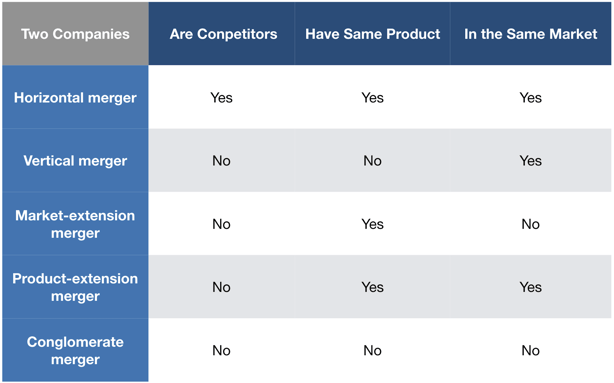
Listed below is a table that summarizes the different types of mergers.
Which Types of Mergers Are Most Relevant in the Middle Market?
Many middle-market transactions are legally structured as acquisitions rather than true mergers. Nevertheless, the five categories described above provide a useful framework for understanding why one company may decide to purchase another.
Written by He Wang
2 April 2020
Speak Confidentially with Versailles Group
Versailles Group provides clients with both buy-side and sell-side M&A services and has been completing cross-border transactions since its founding in 1987.
If you are considering selling or acquiring a company, we welcome the opportunity to discuss your objectives and offer a clear perspective on your options.