

Oct 24

The Challenge of Purchase Price Allocation

Donald Grava October 24, 2014


IRS Image

One of the most challenging aspects in structuring an M&A transaction is not necessarily the determination of a purchase price, but rather how that purchase price is allocated between the assets being sold. The major conflict at the core of this issue is the existence of tax polarity between the buyer and the seller. Generally speaking, the seller of the business is trying to maximize after tax proceeds while the buyer is trying to minimize the consideration relative to the after tax cash flow of future operations. Given these concerns, sellers typically look to sell stock while buyers usually want to buy assets. (Many times buyers prefer asset purchases because, in most jurisdictions, it limits liability. In Brazil, for example, it does not limit liability.)

Section 1060 of the IRS tax code attempts to mitigate conflicts regarding the allocation of the purchase price to various assets. Under Section 1060, both the buyer and the seller of a business are required to use the residual method for purchase price allocation. This means that the purchase price is first allocated to assets to the extent of their fair market value and any excess will be allocated to goodwill and going concern value.

A purchase price allocation is important to include in a purchase contract between a buyer and a seller because it gives guidance as to the tax consequences of the transaction. An allocation acknowledged by the two parties will allow the buyer to determine the basis of depreciable and amortizable assets while the seller is able to compute the sales price of the individual assets in order to determine any recapture amounts. With an allocation in place, the seller is also able to determine capital gains and ordinary income from an asset sale.

Although coming to an agreement about purchase price allocation can be challenging, having a tax expert and an experienced investment bank negotiating between buyer and seller will help both parties reach agreement on an allocation that is beneficial or at least fair to both parties and that conforms to IRS standards.


Oct 16

Valuation Approaches for M&A

Donald Grava October 16, 2014

graphics-money-symbols

When determining the value of a business, there are three basic approaches that can be used to determine the fair market value. These three approaches are the underlying asset approach, the market comparable approach, and the income approach.

The underlying asset approach is a technique in which the assets of the business determine how much it is worth. The assets being valued are both tangible and intangible which means they are considered in the valuation regardless of whether or not they show up on the balance sheet. The final value of the business is determined by a simple formula: Assets – Liabilities = Value of the Business.

Another common method of valuing a firm is the market comparable approach. This is where one compares a business to publicly held firms whose stock is trading. A value is derived by examining the public firm’s EV/EBITDA or EV/Revenue multiples and applying a similar multiple to the non-public, target firm. (EV = Enterprise Value and EBITDA = Earnings Before Interest Taxes, Depreciation and Amortization)

The third way of valuing a company is the income approach. The income approach is based on the company’s potential earnings in the future. The most common way of doing this is by using the discounted cash flow method. The discounted cash flow method (DCF) is where one projects the cash flows that the business will generate and then discount these returns to their present value.

No matter which approach is used, the accuracy of the valuation will depend on the level of detail and depth of analysis that is used in deriving that valuation. It is important to ensure the accuracy of all inputs used in these valuation approaches as these inputs will ultimately impact the value calculation of the target company.

One final note on valuations; “paper” valuations are interesting and useful, but they may or may not be an indication of what a willing buyer may pay a willing seller. Versailles Group has sold a number of businesses for more than any “paper” valuation would have indicated. The key to achieving such a valuation is to have the right buyers and a strong auction.

Sep 25

Who Are The Buyers?

Donald Grava September 25, 2014

When a business owner is considering the possible sale of their company, one of the first questions he or she is probably going to ask is who wants to buy it?


questions middle market investment bank


There are typically two types of possible buyers in an M&A transaction. The first type of buyer is financial sponsors usually called private equity firms. These firms look to make acquisitions as financial investments. The second type of buyer is strategic buyers who look to make an acquisition of a business that is a potential fit into their current operations or enables them to achieve strategic goals.

The financial buyers generally are more concerned with the valuation and risk of an acquisition compared to strategic buyers. The financial buyers care much more about the target company’s current and projected financials and are generally in constant contact with financial advisers and intermediaries looking for possible acquisition candidates to pursue. By definition, financial buyers are very value conscious.

Strategic buyers are generally looking for companies that can fit into their own operations and, other than the obvious candidates, can be more difficult to identify. Strategic buyers or just “strategics” usually are competitors, suppliers or other companies that operate in the seller’s industry or related industries. The advantage of these types of buyers is that they tend to operate a similar a business so it may be easier for them to understand the seller’s operations, motives for selling, and possible risks.

Depending on an owner’s motives for selling and his or her desire for involvement post-closing, either type of buyer may be appropriate. Having an experienced M&A adviser to identify, contact, negotiate, and structure a transaction with these buyers is essential in order to ensure the most value for the business and the best terms to make sure that the owner is properly compensated and, if wanted, a desirable role with the company after the acquisition is complete.

Sep 10

Are You Ready for the Next Bear Market?

Donald Grava September 10, 2014

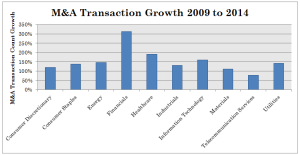
As the chart below shows, M&A activity has expanded rather dramatically over the last five years. We expect this trend to continue, but not forever!


September Blast Chart


Are you prepared for the next bear market?


We all know that the world’s economies are cyclical. The current bull market has been going for about 5.5 years versus an average of 4 years. Given this simple fact, it’s important to focus on your M&A goals and strategies. To be clear, we do not believe that the next bear market is imminent. We do; however, believe in being ahead of the curve.
Now is a good time to start a transaction that will either close by year-end or early next year. Too many entrepreneurs and companies procrastinate only to find it’s too late to maximize value or miss valuable opportunities. The question is, given the current strength of the M&A market, why wait to pursue a transaction?

Jun 27

M&A Activity By Sector

Donald Grava June 27, 2014

Worldwide M&A activity is continuing at a rapid pace this year for a number of reasons including the availability of credit, the robust liquidity of large companies and private equity firms, and the continued improvement in the economy.

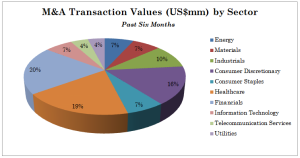
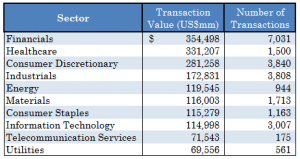
By sector, Financials, Healthcare, and Consumer Discretionary transactions accounted for over half of the M&A transaction value. If one examines M&A transactions by the number of transactions, 66 percent of the transactions were completed in the Financial, Consumer Discretionary, and Industrials sectors.

The following pie chart and table show M&A activity by sector.


June-July Pie


June-July Chart


May 30

M&A Multiples On The Rise

Versailles Group May 30, 2014

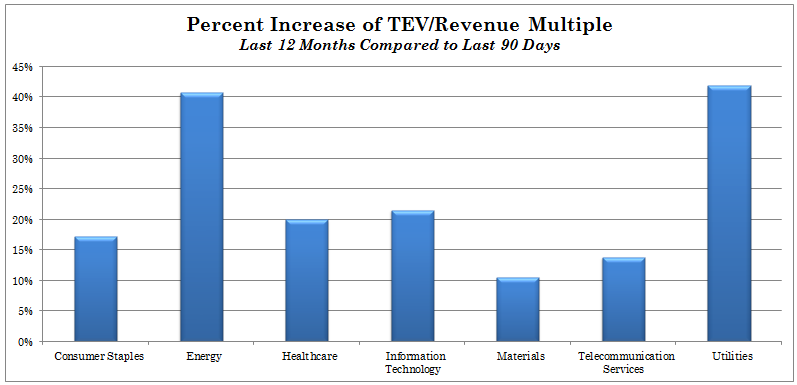
M&A activity was very strong in Q1; in fact, the M&A market this past quarter was more active than any quarter in the last several years. April and May continued this trend with a high level of activity in terms of both deal value and the number of transactions.

This heightened activity is driving multiples up as depicted in the chart below, which shows the percentage increase in TEV/Revenue multiples by industry from the last 12 months to the last 90 days.


May-june email blast chart


Why do deal multiples matter? If you’re a seller, you’ll receive more value for your company. If you’re a buyer, you’ll end up paying more. Therefore, it’s an opportune time for sellers to put their company on the market. Similarly, buyers should consider a transaction before the multiples increase further.


Mar 15

Building Shareholder Value Via Mergers and Acquisitions

Versailles Group March 15, 2014

With regard to building shareholder value, business owners and companies frequently ask themselves:

Is this the best time to sell my company or a part of my company?

Is this the best time to buy a company or part of a company?

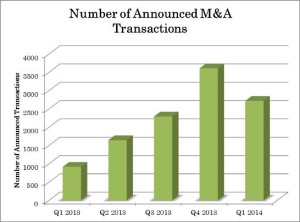
The charts below demonstrate from both a value perspective and the number of M&A transactions announced that now is the time to pursue these strategies.


March Blog3


March Blog1

The dramatic run-up of both deal value and number of transactions announced in Q1 2014 versus Q1 2013 is very evident, despite the fact there are still 15 working days left in March.

Jan 07

3 Things to Know About Boutique Investment Banks

Versailles Group January 7, 2014

When hiring a boutique investment bank, it’s important to focus on three main areas:

How long has the firm been in business?

Often times, many boutique investment banks are in existence because the founder or founders are between positions at larger firms. Therefore, if the firm you are considering has been in business for less than five years, it begs the important question: Is this a part-time occupation or a serious business? Most sellers only have one company to sell, so it’s important that the advisor be serious and not in between lucrative positions. If the firm that you are considering has been in business for more than 10 or 20 years, you’re probably safe.

Boutique Investment Banks Things to Know

Who will work on the proposed transaction?

The staffing for the engagement is important. How much M&A experience do they have? How long have they been with the firm? Are they likely to leave the firm in the middle of your transaction? Experience is important as M&A transactions are never mundane. There are always twists and turns from all of the parties involved. A successful M&A transaction occurs when a series of challenges are solved fast enough to keep both buyer and seller engaged.

What are the capabilities of the boutique investment bank?

What types of deals has the firm completed to date? Do they have international capabilities, not necessarily international offices? In other words, have they completed cross-border transactions? Many firms claim to have that capability, but it’s limited to completing transactions to or from their home country. True cross border capabilities include the ability to complete transactions completely outside the firm’s home country. International capabilities are more important now than ever before. The world has gotten smaller and it’s expensive to miss opportunities just because they’re outside of your geography.

Questions? Ask An Expert!

photo credit: kenteegardin

Dec 24

Do I Need a Boutique Investment Bank?

Versailles Group December 24, 2013

Many buyers or sellers wonder if they need a boutique investment bank versus a large full service firm. If what you need is a successful M&A transaction, you’re typically better off with a firm that derives all or most of its revenue from M&A. That means you’ll receive the best and most attention.

Do I need a Boutique Investment Bank

Typically, boutique firms are more nimble and able to react faster than larger full service firms. Therefore, they’re much better at completing middle market transactions where the number of buyers or targets is quite large. Boutiques are adept at operating in this environment. Boutiques are also good at giving the entrepreneur or corporate client that hasn’t completed a number of transactions the necessary advice to “walk” them through a complex maze of finding the right buyer or seller, presenting the transaction, helping guide due diligence, structuring a transaction that will be mutually agreeable, and negotiating a Definitive Agreement. All of these steps involve lots of intricacies that need to be managed efficiently and effectively. To conclude, for most middle market transactions a boutique investment bank will probably provide the highest level of service and the best possible outcome for either a buy or sell side assignment.

Questions? Ask An Expert!
Dec 10

How Middle Market Investment Banking is Different

Versailles Group December 10, 2013

Middle market investment banking provides some unique challenges for both buyer and seller.

Most importantly, the number of buyers or sellers available to do a transaction, relative to the very large deals that dominate the headlines, is huge. Many people underestimate how many possible targets or buyers there are to complete their transaction. It’s one of the reasons why an M&A advisor is even more important for a middle market transaction.

middle market investment banking different

Another major distinction of middle market investment banking is that most of the entrepreneurs have never purchased or sold a business before. For many of these individuals, pursuing a transaction may be difficult to understand. M&A can be a complex maze. For example, it’s important how and when certain information is released, when and what type of Non-Disclosure Agreement is used, and how to structure a transaction that is fair to both parties.

The value of a middle market investment banking transaction is always a hot topic among both buyer and seller. Many entrepreneurs have devoted themselves to building their business so they’re not familiar with terms like EBITDA or multiples. There are many stories about this misunderstanding, for example, one entrepreneur was telling everyone that the EBITDA multiple was dictated by the company’s zip code. Nothing could be further from the truth, but this poignant comment is a clue that M&A is a highly specialized field. Another entrepreneur noted that they wanted to sell their business for x million based on his retirement needs, the necessity of paying for their grandchildren’s college educations, etc. Those were all admirable goals, but had nothing to do with the value of the business.

Negotiating a transaction is an art, not a science. To be successful, both parties, on either side of a transaction, need to focus on win-win negotiating. That usually produces the best outcome for both parties. As most middle market business owners do not have significant M&A negotiating experience, there are frequently many transactions that fail. Most of them could have had a positive outcome, but the parties did not find a solution fast enough to keep the transaction moving forward.

To summarize, middle market investment banking is different than very large company investment banking. First of all, most of the time, it’s the individuals’ own money that is at stake. Large companies have millions of shareholders and a mistake on an M&A transaction won’t carry the consequences of a bad transaction for an individual. In most cases, the success of a middle market transaction could be insured by engaging professional investment bankers who know how to navigate the complex M&A maze, can guide the negotiations, and have the requisite experience to structure a mutually acceptable transaction.

Questions? Ask An Expert!