<img src="http://www.sas15k01.com/49531.png" style="display:none;">
Jan 27

2014 M&A Activity

Donald Grava January 27, 2015

M&A volume in 2014 was dramatically higher than 2013. In 2014, almost US$4 trillion of transactions were completed versus US$2.6 trillion in 2013. By volume, 43,613 transactions were completed in 2014 versus 40,783 transactions in 2013.

Graphically, here’s a look at the increase by quarter.


January email blast II chart I


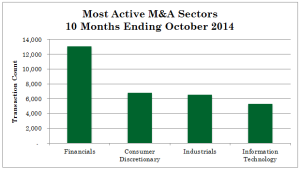
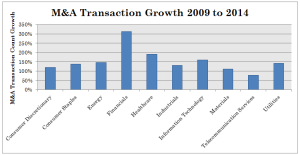
By sector, Financial Services, Healthcare, and Energy/Power were the most active.


Second January Blast Chart II v2


Jan 22

Advantages and Disadvantages of Broad and Targeted Auctions in M&A

Donald Grava January 22, 2015


I want to sell my company


M&A Auctions

An M&A auction is the process of presenting a company that is for sale to potential buyers. There are two different types of auctions, broad auctions and targeted auctions. There are several advantages and disadvantages to each approach.

Just as the name implies, a broad auction is designed to reach out to as many potential buyers as possible. Your M&A advisors, if he or she is well-experienced, should contact hundreds or even thousands of prospective buyers worldwide. This list should include both strategic and financial sponsors. The goal of this strategy is to maximize the competitive dynamics of the sales process to increase the odds of finding the best possible offer. It helps to ensure that all possible bidders have been reached and it limits potential buyers negotiating leverage. One of the concerns with this approach is maintaining the confidentiality of the transaction. Of course, an experienced M&A advisor will know how to conduct this type of auction without breaches of confidentiality and if done properly, this approach will insure the sale of the company for the best value and terms.

A targeted auction is when your M&A advisor focuses on a few clearly defined buyers that are identified as having a strong strategic fit. These buyers should also be vetted to make sure that they have the financial resources to acquire the company. With a targeted auction is it much easier to maintain confidentiality and minimize any possible business disruption from the process. However, there is a much higher chance that the best possible value and terms will not be achieved due to the limited auction. The only way to insure the best possible transaction is to make sure that all possible buyers, via a broad auction, are included in the process.

Your M&A advisor should be able to explain the pros and cons of each method and help the seller to make an informed decision.


Jan 20

M&A Factoid - Discounted Cash Flow Analysis

Donald Grava January 20, 2015


Facts on a sign jpg

Discounted Cash Flow Analysis or “DCF” is a valuation method used in M&A transactions in order to determine the value of a company for sale. This method projects the future free cash flows of the company for sale and then discounts these future cash flows to their present value. Cash flows received farther in the future have less value to the business today and so are discounted more than cash flows that will be received in the near term. DCF analysis is one of the most commonly used valuation methods in M&A. While this method can be very useful in determining the value of a company, it can lead to inaccurate valuations if the underlying inputs of the analysis are unrealistic. In other words, the outputs of a DCF analysis are only as good as the inputs used in it.


Jan 13

M&A Factoid - Confidential Information Memorandum

Donald Grava January 13, 2015

knowledge_is_power jpg


A Confidential Information Memorandum or “CIM” is used to market a business for sale to prospective buyers. The CIM or Offering Memorandum is usually created by the financial advisor of the business for sale and includes important information that a prospective buyer would need to submit an initial offer for the company. The CIM describes the business and its operations in detail, as well as includes the company’s financial statements. A strong CIM will highlight the company’s strengths and help prospective buyers understand the full potential of the investment. Normally, CIMs are not distributed to buyers until they have signed strict Non-Disclosure Agreement which prohibits the prospective acquirer from using any of the information for purposes other than the sale transaction.


Jan 08

Reasons for Establishing an Acquisition Program

Donald Grava January 8, 2015

There are several reasons why a company should make acquisitions. Listed below are some scenarios in which establishing an acquisition program can ensure your company’s continued success.

You may need to strengthen your position in the market if it is expected to have little or no growth or to mitigate competition. You may also want to “jump” into a related market or even venture into a new growing market.


Reasons for establishing an acquisition program


You may decide that it is necessary to increase the size of your business through an acquisition to gain economies of scale. Doing this may allow you to keep up with larger competitors that qualify for better interest rates, access to commercial paper markets, and generally are able to get better terms for financing. By realizing these advantages through an acquisition of another company, division, or product line, one will be able to grow the business faster.

Another issue that some businesses face is that they sell a specialized product line to a limited number of customers. Due to market conditions, these customers in turn “force” the company to accept smaller profit margins. In turn, when suppliers see the company becoming less profitable they are less inclined to offer favorable terms for payment. Meanwhile, larger competitors that sell to a more diverse customer base or sell a broader array of products are not affected by these problems. The acquisition of another company is a viable option to expand the customer list or product line and avoid these problems.

The challenge is ultimately to understand how your company is positioned in the market and visualizing how you would like to position it in the future. It is important to accurately identify your company’s strengths and weaknesses so that you can eliminate or mitigate the weaknesses and enhance your strengths through an effective acquisition program.

Jan 07

M&A Factoid – What is Due Diligence?

Donald Grava January 7, 2015


fact book jpg

With regard to M&A, due diligence is an audit of a potential investment, which takes place prior to the closing of a transaction. Due diligence is not only an opportunity for buyers to thoroughly examine the financial statements, physical assets, intellectual property, etc. of a potential acquisition, but is also an opportunity for the seller to assess the potential buyer and their ability to fund the transaction at closing. Due diligence is a critical step in the M&A process, as buyers use it to ensure they understand what is being purchased and sellers use it to become better acquainted with the potential acquirer.


Jan 02

Five Fears Entrepreneurs Have When Deciding to Sell

Donald Grava January 2, 2015

Fotosearch_k20403162


Deciding whether to sell a business is often a difficult decision for an entrepreneur to make, particularly the first time seller. Over the years, we have found that entrepreneurs have five fears: legacy, customers, employees, value, and confidentiality.

One common fear entrepreneurs have when deciding to sell a business is the wellbeing of their legacy. Entrepreneurs may be concerned that the sale of their business could mean the end of their product or service or possibly the discontinuation of their company’s legacy. In most cases, buyers are interested in a business for the value its products or services bring to customers or the reputation of the company’s brand. Buying a business simply to remove a competitor is not commonplace and is typically not a good use of funds by an acquiring company. A good financial advisor should be able to identify reputable buyers that will respect the entrepreneur’s legacy. Typically, these buyers will place a higher valuation on the company as they want to leverage the company’s brand.

Entrepreneurs also worry about their customers and how they will be affected by the sale of the company. For many entrepreneurs, the customer has been their main focus throughout the years and they want to ensure these customers will continue to have their needs met. The customer list is an important asset that a buyer is acquiring in a transaction and is often times seen as one of the key areas for potential synergies. Acquiring companies seek to continue great relationships with newly acquired customers in order to sell additional products or services to them and to maintain their own reputation in the marketplace. For these reasons, entrepreneurs should feel confident that their customers would receive the same level of attention and service that they had been provided in the past.

Entrepreneurs worry about the future of their employees, especially those employees who have worked with the company for years or maybe even decades. The thought of co-workers and friends being terminated after an acquisition is terrifying to most business owners. As worrisome as this may seem, the reality of the situation is usually just the opposite. In the middle-market, there are rarely acquisitions in which a company is acquired and the employees are fired. Most buyers are purchasing a business to grow it so they are usually anxious to keep the staff and to add additional employees. In the rare instances when employees of an acquired firm are fired, the buyer will ensure that they receive generous severance packages and may even help these employees find new positions. Buyers do this, as it is important for them to maintain a positive reputation as a responsible buyer. If they do not do that, they risk not being able to acquire other companies.

Another fear of entrepreneurs is that they will not achieve the maximum value for the business they have built. This focus can sometimes lead to sale paralysis during times when the business is growing. Entrepreneurs may think to themselves “my sales have been improving, if I hold off on selling my business for another year or two, perhaps I can get a lot more for my business.” This mentality exposes an entrepreneur to many unforeseen risks. Should sales decline before the start of the sale of the business or during the sale of the business, the valuation of the company will be significantly reduced as buyers like to see positive trends and are willing to pay in the present for future cash flow. To solve this dilemma, an entrepreneur’s financial advisor would structure and negotiate an “earn-out” to the deal structure that will reward the entrepreneur with future cash payments should the business meet performance thresholds. With this type of mechanism in place, entrepreneurs do not have to worry about not receiving “credit” for future performance. It also eliminates the risk of a reduction of value should the business have a sales decline before or during the sales process.

Lastly, entrepreneurs worry about sharing confidential information during the sales process. While this fear is certainly understandable, in many cases it is blown out of proportion. An experienced financial advisor can guide an entrepreneur through the sale process in such a way that anonymity of the business for sale is maintained until a potential acquirer has proven itself to be serious and have executed a strict Non-Disclosure Agreement or “NDA.” Such NDA would prohibit the buyer from utilizing any information obtained from the process for purposes other than the sale transaction. It is also important to note that acquiring companies and financial buyers go to great lengths to maintain their reputation as professional buyers, which means that they use confidential information very carefully. Companies that fail to respect confidential information, either before or after executing a Non-Disclosure Agreement, are rarely shown deals by sellers or their financial advisors. This penalty is real!

The best way for an entrepreneur to ease these five fears is by engaging a professional financial advisor in the sales transaction. An advisor with a proven record of accomplishment for obtaining exceptional value and maintaining confidentiality can help an entrepreneur achieve the best possible transaction while mitigating his or her fears, and eliminating the risks related to selling the company.


Dec 26

Sell-Side Advising: Buyer Selection

Donald Grava December 26, 2014

Bermuda


A critical function of a sell-side advisor during an M&A transaction is the creation of a comprehensive buyer list. During the screening process of potential buyers, your M&A advisor must be thorough in their analysis of both potential strategic and financial buyers. This detailed analysis can heavily contribute towards the success of a sell-side M&A engagement. Several factors are examined when developing a buyer list including but not limited to the financial capacity of an acquiring firm, potential synergies, and current market share.

If the list of potential buyers isn’t well-researched, there’s a risk that the “right” buyer may miss the opportunity to bid on the company. This could be an expensive mistake for the seller.


It is crucial that the sell-side advisor understand the potential buyers and what might motivate them. Having a thorough understanding of their strategies, operations, and financial stability is essential in marketing the business for sale. Your M&A advisor must help potential buyers understand how synergies can be realized through the acquisition of a client’s firm. This is an important step as it will help the potential buyer to truly understand the value of the business for sale.

Boutique investment banks with a global reach are capable of developing a comprehensive worldwide prospective buyer list. A list that is not limited by geographies, language, or customs will allow the best possible acquirer to be discovered so that the best value and terms can be derived for the seller. M&A experience is equally important as investment banks with decades of transaction experience will be more capable of helping potential buyers understand the synergies that can be realized through acquisition, are better equipped to deal with buyers from around the world, structure the transaction, and know how to manage the process to a successful conclusion.


Nov 28

Asset versus Stock Purchase

Donald Grava November 28, 2014


Do I need a Boutique Investment Bank


There are two possible ways to purchase a business; one way is through the acquisition of the company’s assets and the other is effected by buying the company’s shares or capital stock.

Asset acquisitions occur when the buyer purchases all of the company’s tangible and intangible assets from the seller. Tangible assets usually include everything from the company’s accounts receivable, inventory, furniture and fixtures, customer lists, logos, etc. Intangible assets would include things like proprietary technology and know-how, etc. In certain situations, buyers may also assume certain liabilities of the company to be acquired. In yet other circumstances, the acquirer may buy only selected assets.

A stock transaction occurs when the buyer simply purchases the capital stock or shares of the company for sale; in effect, eliminating the transfer of title of all the assets within the company. In this type of transaction, the buyer also “acquires” all of the debts and liabilities of the company.

Tax considerations are often times one of the major determinants in deciding which type of sale is used. When an asset acquisition takes place, the buyer steps-up the tax basis of the assets acquired, which results in increased depreciation and lower taxable income in future periods. In an asset acquisition there may be higher taxes for the seller because the company will have pay tax on the gain from the sale of the assets. The shareholders may also have to pay taxes on their individual gains when funds are distributed from the company. Usually, a good tax advisor can help the selling company and the shareholders to mitigate the taxes related to an asset transaction. Sometimes, these tax considerations complicate the negotiations, but a good M&A advisor should be able develop a fair way to resolve the issue(s).

From a liability standpoint, the acquisition of the company’s capital stock or shares increases the risk for the buyer because all actual or potential liabilities with regard to the selling company are acquired with the capital stock. Consequently, the due diligence process is often times more meticulous in a stock purchase due to these assumed liabilities and the enhanced risk of the transaction. This risk to the buyer can be mitigated by transferring liability back to the seller in the purchase agreement via representations and warranties. The buyer may also require a larger escrow and a longer time period if there are real or perceived risks related to undisclosed or even unknown liabilities.


Nov 21

Tips on Completing Successful Acquisitions

Donald Grava November 21, 2014


Acquisitions can be a very productive way to grow a company and to build shareholder value. More specifically, companies make acquisitions for either offensive or defensive reasons.

The key to leveraging acquisitions into a competitive advantage requires the buyer to focus on four specific capabilities, which include (i) carefully developing M&A objectives, (ii) managing your reputation as an acquirer, (iii) maintaining the strategic vision of the target, the buying company, and the transaction, and (iv) managing the integration, especially the expected synergies over time.

international mergers and acquisitions myths


M&A objectives need to be clearly outlined. In other words, what is the purpose of the acquisition? A company may make an acquisition to bolster its client list or cover a broader or new geography. Similarly, a company may buy another company for defensive reasons, for example, they may not want a competitor to have the benefit of acquiring the target company. In order to develop proper M&A objectives, a company must go far beyond any initial growth strategy and get to the core of how a potential target will add value. This involves considering the unique characteristics of their own business, their customers, their market, etc. Many times, companies don’t spend enough time developing their M&A objectives. If one is not careful in this analysis, the end result is wasted time, effort, and sometimes the loss of large amounts of money.

It is imperative that an acquirer manage its reputation as a buyer by having positive interactions with sellers. A buyer should always deal with targets fairly, and to the extent possible, in a transparent fashion. The acquiring company should communicate how the target will be assimilated so that the seller understands how it would fit into the bigger, long-term strategy of the buyer. In most cases, the buyer will not, and does not need to, divulge all of its strategies, but sellers like to understand how their companies will add value to the acquirer in the future. When buyers share their vision, sellers usually contribute to that discussion, which only adds more value. By dealing with targets in this way, the buyer builds a positive reputation in the marketplace and ends up by attracting more and better targets over the long term. Some of the world’s largest corporations have done this well and the end result is that even small targets perceive them as attractive buyers. “Attractive buyers” are able to complete more and better transactions whereas buyers that breach confidentiality agreements or do not operate in a professional and ethical way usually find themselves not being able to acquire any companies.

It’s vital that the buyer maintain and/or revise, over time, its strategic vision of itself, the target, and the projected synergies in order to create a truly successful transaction. For many buyers, this connection gets lost during the due diligence phase. Smart buyers will complete not only the standard due diligence, but also strategic due diligence, which will test the hypothesis that the target is in fact a synergistic acquisition. This additional diligence will help insure the long term success of the transaction.

Finally, it’s important for the buyer to keep reassessing the acquisition over the long term. The one constant of every business is that things keep changing. Therefore, the buyer needs to keep assessing the synergies between itself and the acquired company. Synergies that were apparent at the closing of the transaction may nor may not be available 12 or 24 months later. Like all parts of business, value will be created or destroyed as the buyer and seller continue to integrate their businesses over the longer term. If this integration process is managed properly and reassessed regularly, value will be maximized.

In the end, acquisitions can help companies grow and prosper, but only if the M&A process and the subsequent integration are conducted diligently and properly. If done correctly, acquisitions can bolster a company’s offensive position so that it can build shareholder value or enable it to build adequate defenses to protect shareholder value. In most cases, a professional M&A advisor can help guide this process to a successful transaction.