

Donald Grava

Versailles Group’s Founder, Donald Grava, brings a uniquely well-suited background to his position as President. His experience combines investment banking expertise with practical knowledge of the inner workings of corporations of all sizes.

Recent Posts

Apr 27

Q1 2017 Sees Strong Surge in Global M&A Activity

Donald Grava April 27, 2017

Global M&A activity for the first quarter of 2017 was robust.  There have been US$1.9 trillion in announced, completed, or pending M&A transactions.  In comparison with Q1 2016, M&A activity increased by an incredible 72%, which is partially due to a weak start of 2016.

In the US, M&A deal activity increased in Q1 2017.  Specifically, the value of M&A transactions was 13.2% above Q1 2016.
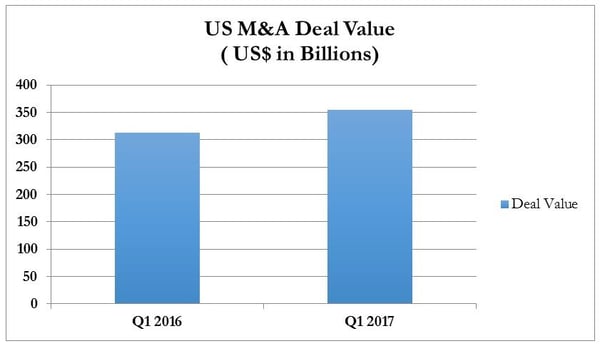
Bar chart of Q1 US M&A deal values from 2016 to 2017


In the middle market, there were 2,643 transactions for the quarter, the best first quarter since 2007.

Internationally, European M&A in the first quarter increased 16%, in comparison to the same period in 2016, to US$215.3 billion.  This transaction value was the best first quarter since 2008.  British M&A activity remained relatively strong in the first quarter of the year despite expectations of a slowdown ahead of the country's exit from the European Union.

M&A involving Asian companies fell 39% in the first quarter of 2017 to US$176 billion, the lowest level in nearly three years.  Tighter regulations in China have made it tougher for Chinese firms to launch takeovers overseas, which had a major impact on the region's overall deal-making in the first quarter.

There are a number of strong contributing factors to increasing M&A activity this year. First, sales and earnings growth is continuing, which portrays strong aggregate demand.  Rising demand encourages CEOs to make acquisitions to expand their businesses.  In addition, companies need to demonstrate growth to shareholders, which provides another reason to make acquisitions.  Second, the slowdown in emerging markets is forcing multinationals to find new avenues of growth.  M&A is actually the quickest route to growth.  Sometimes, it’s easier and less risky than innovation or cost-cutting.  Third, technology is also driving M&A activity.  Disruptive industries such as Artificial Intelligence, FinTech, and the Internet of Things are all continuing to contribute to M&A activity.

To summarize, overall, the M&A outlook for the rest of 2017 looks very favorable.


Written by Donald Grava

27 April 2017


Speak Confidentially with Versailles Group

Versailles Group provides clients with both buy-side and sell-side M&A services and has been completing cross-border transactions since its founding in 1987. If you are considering selling or acquiring a company, we welcome the opportunity to discuss your objectives and offer a clear perspective on your options.
Request a Session >>

Jan 13

Drivers Behind a Record Year in 2017 Middle-Market M&A

Donald Grava January 13, 2017

M&A in 2017, for a number of reasons, is projected to be robust and will probably be a record year for several reasons, including:

►  In 2016, private equity firms raised almost US$250 billion for acquisitions, which is now available.

►  Large corporates worldwide are still "sitting" on very large amounts of cash that they need to deploy.

►  The new US President is expected to make some fundamental changes that will be business-friendly.

►  Buyers and sellers are expected to take advantage of current market conditions.

►  The low-growth economy encourages the use of M&A as a tool to grow a company, acquire technology or R&D, etc.

►  Interest rates are still low, but are expected to increase over time - motivating buyers to move sooner rather than later.

►  Looming economic uncertainty is motivating buyers and sellers to complete transactions.

► Sellers' worries about valuations, which were an impediment in 2016, have been alleviated.  Now, sellers are becoming worried that if they don't complete a transaction in the near term, they may miss the "window."

Speak Confidentially with Versailles Group

Versailles Group provides clients with both buy-side and sell-side M&A services and has been completing cross-border transactions since its founding in 1987.

If you are considering selling or acquiring a company, we welcome the opportunity to discuss your objectives and offer a clear perspective on your options.

Request a Session >

Jan 11

2016 Financial Recap

Donald Grava January 11, 2017

2016 financial recap and outlook

As we leap into 2017 and begin to look at the future ahead, we must also look at some of the most impactful events that occurred in 2016.  While a full narrative of 2016 could fill a book, this is just a brief overview.  The exciting part is that 2016 has set the stage for robust M&A activity in 2017.

2016 began with Wall Street indices declining a record 10% in the first two weeks of trading, which marked the worst two-week start for the stock market in history.  This downward spiral could be attributed to China’s slowing economy and depreciating currency.  As the stock market continued to plunge, oil followed suit, dropping to below US$30/barrel early in 2016.  The amalgamation of falling stock prices and a huge oil oversupply was the driving force behind the massive drop from the 2014 fourth quarter price of approximately US$100 per barrel.  Throughout the year, we saw a rebound in not only stocks but oil as well, primarily due to the supply rebalancing and various OPEC agreements limiting production in 2017. 

The next major event came in June, when we saw the UK vote to leave the European Union, causing massive unrest regarding the future of markets and international trade.  US markets fell in the days following Brexit, but rebounded in a rally that erased the initial decline. 

As a whole, 2016 was the worst year the US has seen for IPOs since 2003, with capital raised from new issues down 40% from 2015.  According to Jonathan Gertler, CEO and managing partner of Back Bay Life Sciences Advisors, there is no debate on whether the IPO market is softer than in recent years, and he believes it to be mainly due to volatility in the US economy and “an exuberant market that drove valuations exceedingly high,” in the biotech industry specifically.  He went on to say that in the current market, there is an abundance of uncertainty, which does not bode well for high-risk stocks, specifically newly public companies.

A portion of this uncertainty that Gertler spoke about can be attributed to the surprise election of Donald Trump, as many firms and businesses prepared for an economy with Hillary Clinton in the Oval Office.  On November 8th, we saw the markets being agitated as the polling numbers continued to pour in favoring Trump, but this rally continued to build upon itself through the holidays.  Major indices saw gains of between six and twelve percent through the end of the year as many traders continued to bid up stocks as they “saw” deregulation, lower taxes, and increased infrastructure spending in the near future. 

As the markets have improved since the Nov. 8 election, the Federal Reserve decided to raise interest rates by 25 points in December.  Many believe the rate hike was a product of higher home prices, decreased unemployment, and improved confidence in the market that led to the Nov-Dec rally following the election.  Traders currently expect around two or three additional rate hikes for 2017, and according to the December Fed meeting minutes, rate hikes may be higher than previously expected in order to better control the growth of the economy. 

In the final days of 2016, markets hit record highs, with the Dow coming ever so close to the 20,000 mark, which many investors believe is simply a psychological barrier.  While 2016 had many quick turns and shocks (Brexit, Trump, etc.), the market and economy as a whole were able to come out on top in terms of growth and prosperity.  

The stock market exuded great resiliency in 2016, which began with a record-setting worst market performance in history to finish at record highs and prepare the US for a prosperous 2017.  

With regard to M&A activity, 2016 was the third-best year ever; however, M&A decreased between 16 and 20 percent from 2015 levels.  M&A activity is expected to be exceptionally strong over the next two or three years, but will peak in 2017.  Therefore, people interested in completing a transaction should execute now.

Speak Confidentially with Versailles Group

Versailles Group provides clients with both buy-side and sell-side M&A services and has been completing cross-border transactions since its founding in 1987. If you are considering selling or acquiring a company, we welcome the opportunity to discuss your objectives and offer a clear perspective on your options.
Request a Session >

Dec 15

M&A Outlook For 2017

Donald Grava December 15, 2016

M&A activity in 2017 is expected to pick up dramatically for four reasons.  First, the strong equity markets are generating optimism as they are usually a leading indicator.  Second, in a recent survey, an unprecedented number of business owners or executives claimed they are planning an M&A transaction in the next 12 months. Third, many domestic and European companies have accumulated large cash balances that are available for acquiring new businesses.  Fourth, private equity firms are sitting on a record US$1.1 trillion in uninvested capital and are expected to boost the number of completed transactions globally.

It’s expected that the North American M&A market will be strong for the next three years, particularly in the US.  However, M&A transactions in the US will peak at US$1.5 trillion in 2017. 

Logically, sellers should take advantage of 2017’s robust forecast.

On a global scale, US$2.7 trillion of M&A transactions were completed in 2015.  It’s been forecasted that US$3 trillion of M&A transactions will be closed in 2016.  In 2017, it is expected to increase again, to US$3.4 trillion.

With regard to the European market, inbound M&A transactions, by US companies taking advantage of a stronger US dollar, are expected to increase.  The UK, Germany, and Spain are the most attractive investment destinations, while France and Italy remain less interesting.

On the other side of the world, the re-emergence of Asia as one of the world’s most dynamic growth stories is steady and striking.  China Yuan’s depreciation and the bursting asset bubble have spurred increasing outbound activities by Chinese buyers into neighboring Asian countries as well as developed countries.  At the same time, the Chinese Government is starting to control this outbound activity, which may alter some of this activity.

Lastly, the African and Middle Eastern markets are worth paying attention to as oil prices rebounded after OPEC announced production cuts. A recovery in oil prices will enable more available funding, which subsequently may boost deal-making activities in the region.

Founded in 1987, Versailles Group is a boutique investment bank that specializes in international mergers, acquisitions, and divestitures. Versailles Group’s skill, flexibility, and experience have enabled it to successfully close M&A transactions for companies in the middle and lower-middle market. Versailles Group has closed transactions in all economic environments, literally around the world.

Versailles Group provides clients with both buy-side and sell-side M&A services and has been completing cross-border transactions since its founding in 1987.

Dec 04

Market Price - When to Accept an Offer

Donald Grava December 4, 2016

Versailles Group - I want to sell my business

Market Price - When To Accept An Offer Versus When To Walk Away

Sellers always want to know whether they are being offered a fair value for their company or if they should just walk away from a potential sale.  Typically, one considers general valuation ranges for a business based on multiples of the company’s EBITDA (earnings before interest, taxes, depreciation, and amortization).  The multiple will be specific to the type of business being sold and its growth projections.  While these multiples may be helpful at first, the true market price of the company is discovered once the bids from prospective buyers are compiled.  Clients are often surprised by how close in value the offers are, but it’s because that value range is the market price.  Selling a business is a simple example of supply and demand; the buyer’s bids find the equilibrium.

When should I accept a bid? 

Accept a bid that comes in at market price as defined by the offers that are received.  One trap that sellers fall into is that after the bids are compiled, they decide their business is worth more.  While it is always preferable to receive a higher value, sellers must be realistic and honest with themselves about price.  When selling anything, there’s always a maximum value that can be obtained.  There is no such thing as a dumb buyer who will pay an outlandish amount.

The next key mistake is when the seller decides to hold onto their business, believing that all the potential buyers are wrong about the company’s value.  These individuals convince themselves they can keep growing the business and sell it for more in one to three years.  Anything can happen in a year or two, and in this scenario M&A is very much like gambling—it’s better to just quit while you’re ahead.  Most companies are not going to have high growth rates forever, and eventually, the financial projections will not look as promising.  Selling a business now while it’s stable is more realistic than expecting a higher value in a few years when the circumstances, including the economy, may be very different.  And, if there are any “hiccups” with the business, e.g., the loss of a large customer, the business may not even be saleable.  The risk of holding is enormous, especially when one considers that most company owners have a majority of their net worth in the business.

All in all, if most of the bids are around the same number, it is advisable to accept an offer and move on.  Business owners must understand that there is a good chance these bids are the highest value they may ever see for their company.  Blockbuster Video and the music CD business are excellent examples of why business owners should act sooner rather than later.

When should I walk away?  

Sellers who are not using an M&A advisor should generally be more cautious when accepting a bid.  True market value can only be determined by receiving a number of offers or at least testing the market on a worldwide basis.  Individuals attempting to do a deal on their own may not be entirely happy with the offers they have received, which may be the result of only having reached out to a limited number of buyers.  It’s unlikely that a small pool of prospective buyers would reflect the true market price for a business.  If you feel uneasy about the bids and have not had a professional explore all possible options on your behalf, you should strongly consider whether the offer is worth taking.  When selling a company, the seller should be confident that he or she has been in touch with every possible buyer and that to the extent possible, an auction has been established.  Anything short of that might portray an offer that is below market value.

Founded in 1987, Versailles Group is a boutique investment bank that specializes in international mergers, acquisitions, and divestitures. Versailles Group’s skill, flexibility, and experience have enabled it to successfully close M&A transactions for companies in the middle and lower-middle market. Versailles Group has closed transactions in all economic environments, literally around the world.

Versailles Group provides clients with both buy-side and sell-side M&A services and has been completing cross-border transactions since its founding in 1987.

Nov 29

The Sale of Your Business and Value

Donald Grava November 29, 2016

Versailles Group - i want to sell my business

Value and the sale of your business

When considering the sale of a business, it is very easy for a business owner to be uncertain or even pessimistic about its value.  This is definitely a mistake, particularly because it can cause a potential seller to miss out on possible opportunities.

It may be ironic that I founded an M&A boutique firm to help people sell businesses; however, my own father, when I was young, who owned a small chain of variety stores, decided to close the business rather than sell it.  He sincerely believed that no buyers would be interested.  Mind you, he didn’t test that theory; however, he thought he was right.

A business owner should never assume that his or her business is too small to be of interest to a large company.  It is important to remember that there is a difference between the financial value as portrayed by the financial statements and the market value.  The market value includes more than just how much the company is worth monetarily.  It includes the value of intangible assets for example, the customer base, distribution network, location, having a unique service or product, long term and loyal customers, name recognition, etc. These factors go way beyond the balance sheet and income statement.  These and other factors always contribute to a company’s value but are not always easily quantifiable.

Additionally, just because a company has modest financial results does not mean it will not sell.  Buyers will look at the future of the company and make an assessment of its potential.  This is especially true when the economy is in a down cycle.  It is also important for the seller to accurately analyze the business’s true financial position, marketability, and potential.  A good M&A advisor will know how to do this quickly and accurately.

For a company with modest financial results, it is important not to oversell the company, as buyers may pull out if they feel the current financial results are unsustainable or the revenue and profit projections are unrealistic.  When pursuing the sale of a company, one must strike a balance between underselling the company and overselling it and scaring off or losing potential buyers during the sales process.  Once again, a good M&A advisor can help strike the necessary balance.  The advisor can also provide value-added by finding the “right” buyer who will understand the value and potential of the company for sale.

Founded in 1987, Versailles Group is a boutique investment bank that specializes in international mergers, acquisitions, and divestitures. Versailles Group’s skill, flexibility, and experience have enabled it to successfully close M&A transactions for companies in the middle and lower-middle market. Versailles Group has closed transactions in all economic environments, literally around the world.

Versailles Group provides clients with both buy-side and sell-side M&A services and has been completing cross-border transactions since its founding in 1987.

Nov 25

M&A - An Effective Tool To Enhance Growth

Donald Grava November 25, 2016

Mergers and acquisitions are an effective and efficient substitute for R&D for companies that need help combating shrinking market share or stagnant growth. In some cases, companies are confronted with fierce competition from startups and utilize M&A as a way to “outsource” R&D and leave the risk of innovation to startups that tend to excel at R&D. Many of these companies are skipping R&D almost entirely by acquiring other companies. This trend is true in almost all industries, and many of the transactions are cross-border.

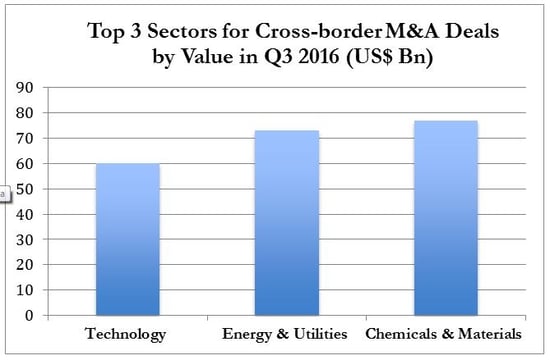
The chart below depicts the top three sectors for cross-border M&A.

Bar chart: Top 3 sectors for cross-border M&A deals by value in Q3 2016

In recent months, Samsung has been actively involved in M&A deal making as a way to instantly build up its capabilities in emerging technologies such as mobile payments, cloud-based services, and artificial intelligence.

Samsung’s planned purchase of U.S. autoparts supplier Harman International Industries Inc. for US$8 billion in an all-cash deal instantly makes Samsung a major player in the world of automotive technology. It’s an excellent example of a company that is using M&A to expand. This deal will be the South Korean smartphone maker’s biggest acquisition in history.

M&A in general and cross-border M&A in particular is a well-proven way to enhance shareholder value, either by acquisitions or divestitures. While most of the press is focused on the large transactions, middle-market companies can also utilize this “tool” to make defensive or offensive acquisitions or divest businesses that no longer fit the company’s strategy.

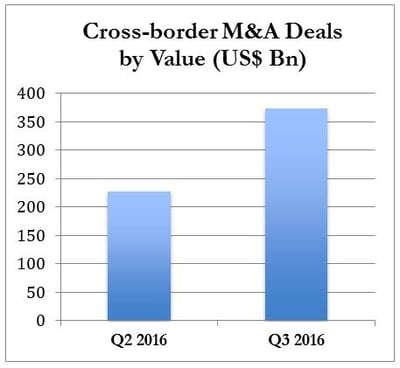
The chart below demonstrates the growth of cross-border M&A deals from Q2 2016 to Q3 2016.

Bar Chart: Cross-border M&A deals by value (Q2 vs Q3 2016)


Versailles Group is a Boston-based investment bank that specializes in international mergers, acquisitions, and divestitures.  Versailles Group’s skill, flexibility, and experience have enabled it to successfully close M&A transactions for companies with revenues greater than US$2 million.  Versailles Group has closed transactions in all economic environments, literally around the world.

Versailles Group provides clients with both buy-side and sell-side M&A services and has been completing cross-border transactions since its founding in 1987.  

More information on Versailles Group, Ltd. can be found at www.versaillesgroup.com.


For additional information, please contact

Donald Grava

Founder and President

+1 617-449-3325


November 25, 2016

Nov 15

Record M&A deals in October 2016

Donald Grava November 15, 2016

Record October for M&A Deals - Reflects Current Market Conditions

The US M&A market is on a roll, which is good news for both sellers and buyers in the middle market.  

A series of high-profile deals announced in October makes it the biggest month ever for M&A transactions and even surpassed the epic deal-making surge in January 2000. Mega deals are driving activity and are almost too numerous to count, e.g., the oil-and-gas business combination of General Electric and Baker Hughes, the telecom tie-up of CenturyLink and Level 3, and AT&T’s acquisition of Time Warner, etc.

Another good example in the global semiconductor sector is Qualcomm’s US$47 billion acquisition of NXP Semiconductors, which notched the biggest semiconductor-targeted M&A deal on record globally.

Top 5 Global Tech Targeted M&A Deals on Record

Top 5 Global Tech M&A Deals Chart 

So far this year, US$1.6 trillion of M&A transactions have been announced in the domestic market.  It reflects easy financing conditions, more confidence in the economic and business outlook, and keen foresight on the part of management teams.

The current economic environment of low interest rates and high stock prices has encouraged deal-making.  Cheap borrowing costs make it easy to finance deals, while high stock prices provide companies with higher valuations.  

With unprecedented economic conditions, owners of middle-market businesses, in particular, have a continued incentive to start or keep doing deals.


Versailles Group, Ltd.

Founded in 1987, Versailles Group is a boutique investment bank that specializes in international mergers, acquisitions, and divestitures. Versailles Group’s skill, flexibility, and experience have enabled it to successfully close M&A transactions for companies in the middle and lower-middle market. Versailles Group has closed transactions in all economic environments, literally around the world.

Versailles Group provides clients with both buy-side and sell-side M&A services and has been completing cross-border transactions since its founding in 1987.


November 15, 2016

Nov 01

Global M&A Rebounds in Q3 2016

Donald Grava November 1, 2016

Global M&A Rebounds With Newfound - Attractiveness in Europe

With mega deals leading the market, the global M&A market showed signs of rebounding in Q3.  Compared to US$1.0 trillion in Q1 and US$1.1 trillion in Q2, the value of global M&A increased to US$1.2 trillion in Q3, marking the second consecutive quarterly improvement.  In all, there were 19,416 transactions announced during Q3 and 11 transactions valued at more than US$10 billion each.

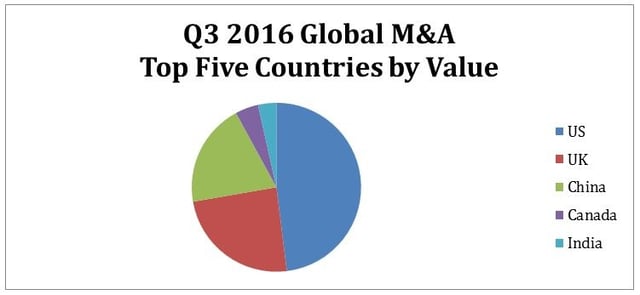
Regarding deal value, the US led the market, followed by the UK, China, Canada, and India.  US companies remain top attractions for global investors as US$416 billion of deals were completed with US targets in Q3.  These US transactions accounted for 40% of the global market and were more than double the deal value of either the UK or China.  

The chart below shows the top five global target countries by deal value.

Pie chart showing the top five global target countries by deal value

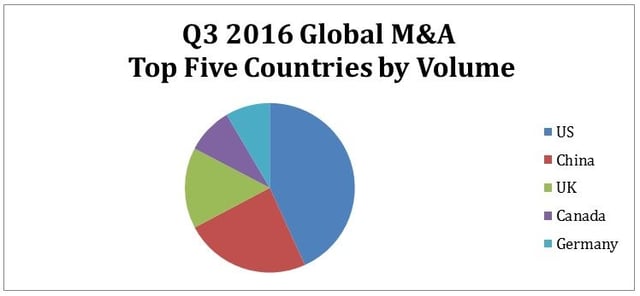
In terms of volume, most of the M&A deals were concentrated in the US, followed by China, the UK, Canada, and Germany, continuing the trend for the first half of 2016. 

Pie chart showing the top five global target countries by deal volume

It is worth noting that M&A activities in Germany have remained resilient in the face of slower growth and tremendous volatility in the global market, with both the volume and value of transactions remaining close to the 2015 peak level.  What made Germany stand out in the global M&A market rankings is the giant US$132 billion deal between SABMiller and AB InBev, which is the largest deal by value in Q3 worldwide.

Interestingly, the ever-increasing deal value in the UK is bucking the trend in the global M&A market.  Since the Brexit vote, there have been rumors that the level of mergers and acquisitions activities across Europe would be threatened; however, the positive M&A data in Q3 2016 signaled the newfound attractiveness of European M&A.


Versailles Group, Ltd.

Founded in 1987, Versailles Group is a boutique investment bank that specializes in international mergers, acquisitions, and divestitures. Versailles Group’s skill, flexibility, and experience have enabled it to successfully close M&A transactions for companies in the middle and lower-middle market. Versailles Group has closed transactions in all economic environments, literally around the world.

Versailles Group provides clients with both buy-side and sell-side M&A services and has been completing cross-border transactions since its founding in 1987.

Oct 04

Utilizing M&A to Adapt to a Rapidly Changing Business Environments

Donald Grava October 4, 2016

The importance of M&A as a Tool to Adapt to Changing Business Environments

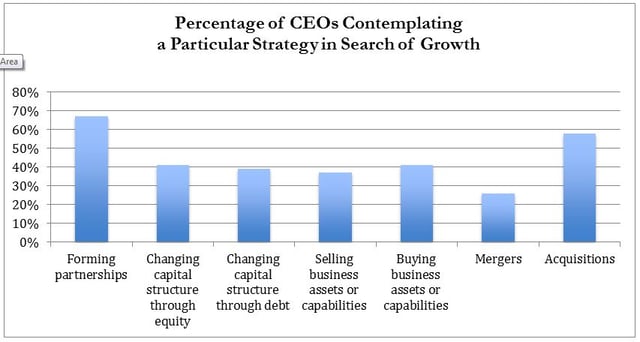
To succeed in the current business environment, companies will need to develop a keen sense of agility to grapple with the slow and uncertain economy, political risks, the threat from new entrants with more creative and efficient business models, etc.  It is widely recognized by CEOs that to respond to today’s marketplace organic growth is far from enough because most transformational technologies are outside the core competency of the average organization.  According to KPMG, CEOs are pursuing a range of activities in search of growth, which are listed below.  For each activity, the percentage indicates what percentage of CEOs will think about that particular action.

Bar chart: % of CEOs contemplating a particular strategy in search of growth


M&A, including minority investments, is expected to play a major role as companies search for new and valuable business solutions. Companies that are able to be proactive in terms of technological and business model disruptions will greatly enhance their chances of success, profitability, and longevity.  With regard to the US presidential election, and as Warren Buffett said, the market will move forward with either candidate who happens to get elected as President.  The country will survive and business will survive.  Succinctly, M&A will go on regardless of political uncertainty.

Founded in 1987, Versailles Group is a boutique investment bank that specializes in international mergers, acquisitions, and divestitures. Versailles Group’s skill, flexibility, and experience have enabled it to successfully close M&A transactions for companies in the middle and lower-middle market. Versailles Group has closed transactions in all economic environments, literally around the world.

Versailles Group provides clients with both buy-side and sell-side M&A services and has been completing cross-border transactions since its founding in 1987.