

<img src="http://www.sas15k01.com/49531.png" style="display:none;">

Donald Grava

Donald Grava
Versailles Group’s Founder, Donald W. Grava, brings a uniquely well-suited background to his position as President. His experience combines investment banking expertise with practical knowledge of the inner-workings of corporations of all sizes. Prior to Versailles Group, Mr. Grava was the former First Vice President of ELM Securities Inc., a New York-based investment banking firm, where he originated and successfully closed many domestic and international transactions. Prior to ELM, Mr. Grava gained invaluable corporate finance experience while at Warburg Paribas Becker in New York City. Prior to working on Wall Street, Mr. Grava honed his practical knowledge of corporate operations through strategic and financial planning roles at two different Fortune 200 companies. Mr. Grava started his career at Coopers & Lybrand where he gained hands-on accounting experience. Mr. Grava holds the following Securities Licenses: 7, 24, 27, 66, and 79. These licenses are sanctioned by FINRA (Financial Industry Regulatory Authority, Inc.). Mr. Grava is on the Board of Directors of The Jebb Center for Autistic Adult Living, a 501(c)(3) organization devoted to providing safe and challenging living environments for adults with Autism. Mr. Grava earned a B.A. in economics from Yale University and an M.B.A. from New York University’s Leonard N. Stern School of Business. While at Yale, he was captain of the heavyweight crew.

Recent Posts

Aug 04

M&A - Top Five Countries - First Half 2016

Donald Grava August 4, 2016

M&A Activity - First Half 2016

Top Five Countries

With regard to M&A in the global arena, it’s fascinating to observe which countries attract the most activity and how that evolves over time.  The charts below reflect the top five countries with the highest deal value and volume for the first six months of 2016.

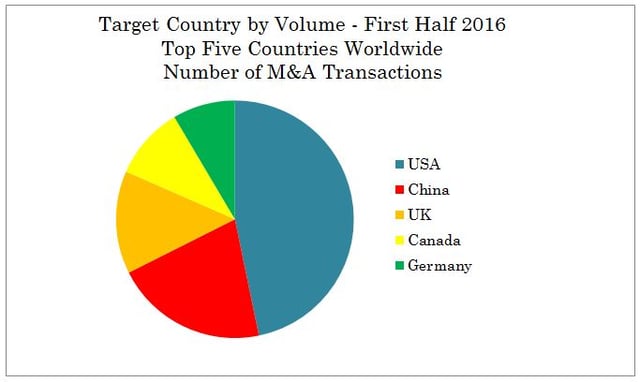
The United States and China have been able to maintain their M&A leadership in the first half of 2016.  In terms of deal volume—the number of transactions completed worldwide—the US accounted for 23% of the deals completed while China captured 10% of the deals worldwide.

The chart below represents the number of M&A transactions completed by country in the first six months of 2016.  The US and China dominate this category, with 10,151 and 4,519 deals completed respectively.  When compared to the first quarter, the breakdown by volume for these five countries has remained remarkably similar.  Each country has been able to continue closing deals at roughly the same pace. 

Versailles Group - M&A activity

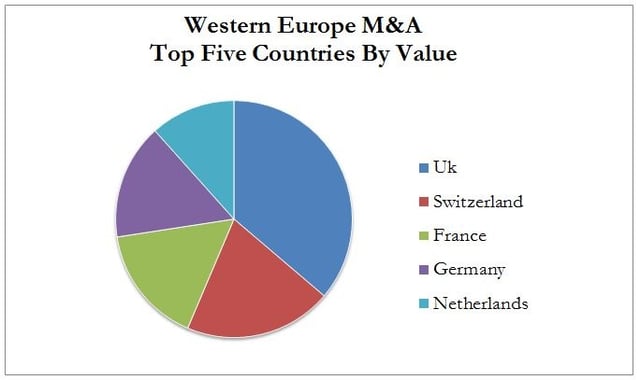
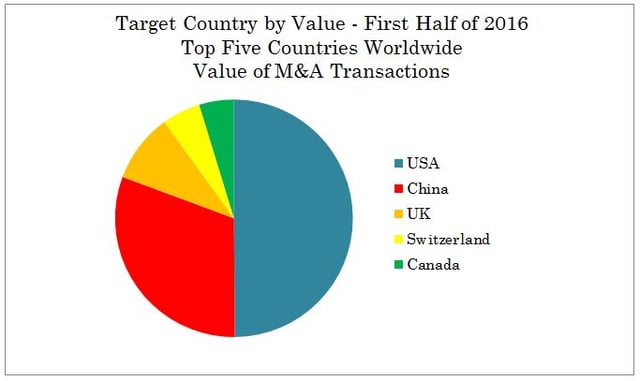
Represented in the chart below is the value of M&A transactions completed by country, for the top five countries, in the first six months of 2016.  The US and China are again leaders in this category.  Collective deal value in the United States reached US$633,441MM, and China’s total transactions were valued at US$390,570MM.  Switzerland remains in the top five countries for deal value, which is uncommon; however, during Q1 Syngenta was acquired by ChemChina, and this one large deal is in part responsible for Switzerland’s high rank.  

Versailles Group - M&A


Two countries to keep an eye on for the remainder of the year are Australia and France.  Lately, Australia has been receiving media attention for potential growth in M&A deals.  For the first half of 2016, Australia came in only 282 deals behind Germany.  It will be interesting to see if Australia is able to push up into the top five countries for volume next quarter.  Likewise, France is trailing Canada in the rankings for deal value so far in 2016.  As M&A activity is likely to experience shifts throughout Europe after the Brexit vote, M&A activity by county may look slightly different next quarter.

Versailles Group is a 29-year-old Boston-based investment bank that specializes in international mergers, acquisitions, and divestitures.  Versailles Group’s skill, flexibility, and experience have enabled it to successfully close M&A transactions for companies with revenues between US$2 million and US$250 million.  Versailles Group has closed transactions in all economic environments, literally around the world.

Versailles Group provides clients with both buy-side and sell-side M&A services, and has been completing cross-border transactions since its founding in 1987.  
More information on Versailles Group, Ltd. can be found at www.versaillesgroup.com.

For additional information, please contact

Donald Grava

Founder and President

+617-449-3325

August 4, 2016

 
Jul 20

M&A - Brazilian Bargain Hunt

Donald Grava July 20, 2016


M&A in Brazil - Bargain Hunt

M&A in Brazil Versailles Group

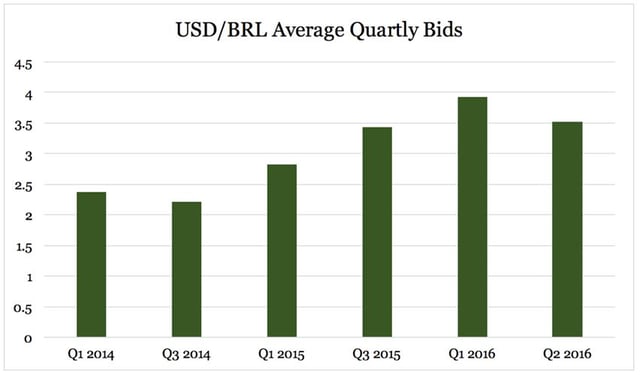
At this point in time, Brazil is providing M&A buyers with incredible opportunities for a number of reasons.  Despite a history of healthy economic growth, Brazil’s economy has recently lost momentum.  The country has officially been in a recession since the end of 2014, with no immediate recovery in sight.  Inflation is now over 10%, and unemployment reached 9% in 2015.  Additionally, the Brazilian stock market has plummeted along with its currency.  The chart below depicts the decrease in the value of the Brazilian real in comparison to the US dollar.

Brazil M&A - Versailles Group

Compounding the economic problems, Brazil is experiencing temporary political unrest due to a large corruption scandal.  There isn’t much hope for economic improvement in 2016; however, once the political turmoil settles, economists are optimistic about what 2017 will bring for the Brazilian economy.  Brazil boasts a large domestic market, with a variety of innovative industries and an abundance of natural resources.  The previous decade’s economic growth averaged around 4 to 5 percent per annum.  It is likely that the economy will start to grow at the tail end of this crisis, as the Brazilian government has plans to address the economic problems in the form of cutting public spending and implementing policies through the Central Bank.

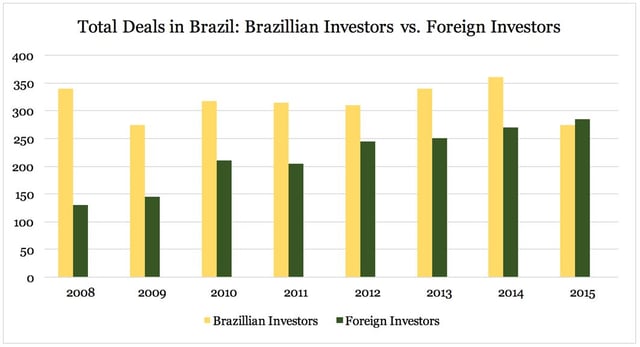
What does this mean for foreign investors?  Brazilian companies are the cheapest they have been in years, and with a vast array of investment options.  In short, Brazil presents a unique opportunity.  This is echoed by the fact that foreign investors are flocking to the region, and are beginning to outpace local investors.  The chart below compares foreign investors to Brazilian investors.

M&A in Brazil - Versailles Group

M&A buyers that can look beyond two or three years will be able to achieve excellent returns.  The Brazilian economy has the capability for strong and consistent growth.  Over the years, the middle class in Brazil has grown, literacy rates have increased, and Brazil is the 8th or 9th largest economy in the world.

In conclusion, an M&A buyer can capitalize on the current domestic situation, which has resulted in slashed valuations and many opportunities where sellers have to sell.  Furthermore, foreign investors will also be able to capitalize on the strong US dollar as compared to the Brazilian Real, which make Brazilian acquisitions incredibly affordable and will enable investors or acquirers to earn a healthy return on their investment in the future.

Versailles Group is a 29-year-old Boston-based investment bank that specializes in international mergers, acquisitions, and divestitures.  Versailles Group’s skill, flexibility, and experience have enabled it to successfully close M&A transactions for companies with revenues between US$2 million and US$250 million.  Versailles Group has closed transactions in all economic environments, literally around the world.

Versailles Group provides clients with both buy-side and sell-side M&A services, and has been completing cross-border transactions since its founding in 1987.  
More information on Versailles Group, Ltd. can be found at www.versaillesgroup.com.

For additional information, please contact

Donald Grava

Founder and President

+617-449-3325

July 20, 2016

 
Jul 12

M&A Activity in Asia Grows, Led by China

Donald Grava July 12, 2016

M&A Activity in Asia Grows, Led by China

Versailles Group - China update


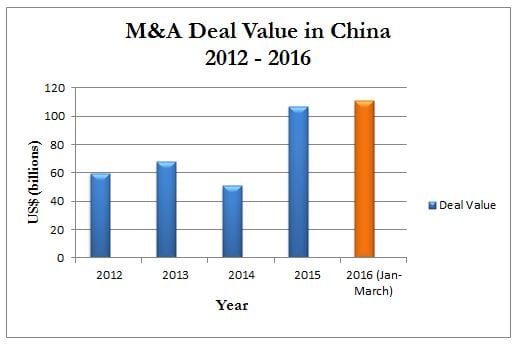
While global M&A activity in Q1 2016 was lower than the record-breaking deal volume witnessed in Q1 2015, one bright spot has emerged amid volatile markets and political uncertainty: China.  In Q1 2016, China claimed its largest quarterly share of global mergers and acquisitions on record.  According to Thomson Reuters, roughly US$110 billion in M&A deals, or 15 percent of global deal value, involved Chinese buyers. 

The chart below depicts deal value in China across the past five years, 2012 - 2016. The value of outbound Chinese deals in Q1 2016 ($110 billion) surpassed China’s previous annual record of $109 billion over the whole of 2015.

Versailles Group - China M&A Update

Overall, M&A activity in Q1 2016 throughout Asia increased by 9 percent compared to Q1 2015.  Last year, the region reached a deal value of US$275 billion, accounting for almost 40% of global deal value (US$699 billion).  When analyzing the activity by country, China played a significant role in M&A activity across the continent.  Mega deal activity, characterized by deals which have a value greater than $5 billion, contributed to China’s M&A prowess, as the top ten deals in Asia all had either a Chinese company as an acquirer or a seller.  The largest deal in Q1 2016 was China National Chemical Corp’s acquisition of the Swiss company Syngenta, which amounted to a $46 billion transaction and marked China’s biggest takeover of a foreign company. 

Recently, China has exhibited a strong appetite for foreign acquisitions, particularly in the U.S.  O’Melveny law firm’s 2016 investment study suggests that Chinese business owners’ investment in the U.S. will be higher in 2016 than in previous years.  The study mentioned the U.S. as a key target nation for Chinese acquirers, as Chinese buyers are looking for growth at a time where their home markets are facing a relative slowdown.  Overall, China’s cross border deal value has increased over the past year; including both inbound and outbound acquisitions.  Specifically, China’s cross border deal value totaled $95.1 billion in Q1 2016, representing an increase of 136 percent compared to Q1 2015.  

Chinese companies have emerged as a dynamic force in deal making in a number of sectors.  China’s increased M&A activity highlights its attempt to serve its growing consumer class, as the nation copes with sharp declines in its stock market and less domestic economic growth prospects.  According to Barclay’s Head of Americas M&A, Larry Hamdan, we should “expect China outbound M&A to continue as they seek to bring leading international brands and technologies to their home market and to drive growth by expanding into new geographies.”  Gilberto Pozzi, co-head of global M&A at Goldman Sachs, agrees that China is attempting to drive growth through cross border acquisitions, asserting that “robust Chinese M&A activity was primarily driven by a combination of decelerating growth in China, leading companies to diversify across geographies, and government support on foreign strategic acquisitions.” 

In the future, we can expect China’s remarkable amount of outbound M&A activity to continue. According to Pozzi, decelerating growth and the government’s encouragement of foreign acquisitions are both “strong tailwinds which direct towards continued outbound Chinese M&A activity for the rest of 2016 and beyond.”  As more Chinese buyers have recently begun to hire advisers very early in the deal making process, we have seen more and more successful transactions.

Versailles Group is a 29-year-old Boston-based investment bank that specializes in international mergers, acquisitions, and divestitures.  Versailles Group’s skill, flexibility, and experience have enabled it to successfully close M&A transactions for companies with revenues between US$2 million and US$250 million.  Versailles Group has closed transactions in all economic environments, literally around the world.

Versailles Group provides clients with both buy-side and sell-side M&A services, and has been completing cross-border transactions since its founding in 1987.  
More information on Versailles Group, Ltd. can be found at www.versaillesgroup.com.

For additional information, please contact

Donald Grava

Founder and President

+617-449-3325

July 12, 2016


Jul 06

Brexit - Middle Market M&A

Donald Grava July 6, 2016

Brexit Middle Market M&A

Versailles Group - Brexit


U.S. middle-market M&A is, for the most part, shielded from the Brexit volatility, according to Franklin Square’s senior economist, Lara Rhame.  In 2015, U.S. middle-market companies generated 87 percent of their revenues from domestic sales.  Of the 13 percent of the middle-market revenues generated outside the U.S., only 3 percent came from Europe.  Thus, M&A in the U.S. should not be drastically impacted by Britain’s exit from the EU, as U.S. companies have placed a greater emphasis on buying and selling both domestically and outside of Europe. 

Nevertheless, the post-referendum weakening of the British Pound relative to the U.S. dollar could potentially have significant implications for M&A activity between Britain and the U.S.  As the exchange rate between the Pound and the Dollar fluctuates, so do sales between the two countries – this phenomenon is known as the substitution effect.  As the Pound strengthens against the Dollar, Pound denominated goods and services become more expensive, meaning that Dollar denominated goods and services become more attractive.  Hence, U.S. sales to Britain increase, and British sales to the U.S. decrease.  In contrast, when the Pound weakens, Pound denominated goods and services become less expensive, resulting in Dollar denominated goods and services becoming less attractive.  Thus, U.S. sales to Britain decrease, and British sales to the U.S. increase. 

Ultimately, this substitution is rooted in the notion that as prices rise, consumers will replace more expensive items with less costly alternatives.  In recent years, the exchange rate of the British Pound to the U.S. Dollar has averaged about US$1.60.  This rate declined a bit throughout the start of 2016, and dropped to roughly US$1.36 immediately after the Brexit vote.  Overall, this low exchange rate puts the Pound near a multi-decade low relative to the U.S. Dollar.  One possible effect of this record-low exchange rate is substitution; in terms of M&A, this substitution could potentially lead to U.S. companies buying more companies in the U.K. 

Studies have repeatedly suggested that U.S. middle market companies should consider expanding outside the U.S.; these companies should either buy or sell overseas, or potentially establish overseas operations.  Hence, the decision to expand generally comes down to the choice of either building or buying.  In the most basic terms, a target company in the U.K. that is selling will cost about 15 percent lower in U.S. Dollar terms compared to two or three years ago.  This reduction is very beneficial for U.S. companies looking to buy British companies.  Consequently, some private equity firms have argued that the Brexit economic uncertainty will bring prices on potential U.K. acquisitions down to more reasonable levels, which could spur cross-border M&A activity.

A good M&A advisor with cross-border transaction experience should be able to assist in acquiring a company in the UK.  As always, it’s important to have several targets in mind so that the very best acquisition is completed.

Versailles Group is a 29-year-old Boston-based investment bank that specializes in international mergers, acquisitions, and divestitures.  Versailles Group’s skill, flexibility, and experience have enabled it to successfully close M&A transactions for companies with revenues between US$2 million and US$250 million.  Versailles Group has closed transactions in all economic environments, literally around the world.

Versailles Group provides clients with both buy-side and sell-side M&A services, and has been completing cross-border transactions since its founding in 1987.  
More information on Versailles Group, Ltd. can be found at www.versaillesgroup.com.

For additional information, please contact

Donald Grava

Founder and President

+617-449-3325

July 6, 2016

 
Jun 26

Tech M&A Update - Q1 2016

Donald Grava June 26, 2016

Q1 2016 Tech M&A Update

speed-power-1920-1080-.jpg

Q1 2016 Tech M&A Update

While the tech industry may not repeat the same record-breaking deal volume it experienced in 2015, the consensus is that 2016 will be a very active year for technology M&A.  

According to prominent venture capitalist, Marc Andreessen, Microsoft’s planned acquisition of LinkedIn is indicative of an imminent increase in M&A across the tech sector.  Andreessen predicts there will be many deals through the remainder of 2016 and the entirety of 2017, asserting that there are numerous deals that should have already happened, but have not occurred yet.  “Most of the big tech companies have done very well over the past five years, they’ve piled up lots of cash, and they have to go shopping,” affirmed Andreessen on Tuesday, June 14, 2016.

Tech M&A is also on the rise globally, accounting for roughly 14% of M&A deals worldwide in Q1 2015, which was the most of any industry.  The chart below depicts tech deal volume and value in Q1 for the past five years.  Overall, global Tech M&A deal volume peaked this past quarter (Q1). 


Versailles Group - Tech M&A Update


Just recently, Microsoft Corp announced its planned acquisition of LinkedIn Corp in an all-cash transaction deal valued at US$26.2 billion.  According to Mergermarket’s records, the deal is the third highest valued deal within the US technology sector since 2001 and has consequently given a much needed boost to the sector’s current M&A activity.

Thus, despite a slow start to the year and a lack of momentum, M&A activity in the US tech sector is back on track to match last year’s record.  833 deals worth US$254.7 billion were struck in 2015, which overshadowed 2014’s record value by 94.7%.  According to Thomson Reuters, US$209 billion in tech transactions have been announced so far this year and these deals are expected to close by year end.

Versailles Group is a 29-year-old Boston-based investment bank that specializes in international mergers, acquisitions, and divestitures.  Versailles Group’s skill, flexibility, and experience have enabled it to successfully close M&A transactions for companies with revenues between US$2 million and US$250 million.  Versailles Group has closed transactions in all economic environments, literally around the world.

Versailles Group provides clients with both buy-side and sell-side M&A services, and has been completing cross-border transactions since its founding in 1987.  
More information on Versailles Group, Ltd. can be found at www.versaillesgroup.com.

For additional information, please contact

Donald Grava

Founder and President

+617-449-3325

June 26, 2016

Jun 16

M&A - The Letter of Intent

Donald Grava June 16, 2016


Versailles Group - M&A The Letter of Intent


M&A - The Letter of Intent

When a business is being sold, a buyer typically makes an offer for the business.  Next, the seller responds with a counteroffer, which is followed by the negotiation of terms and then the execution of a Letter of Intent (“LOI”) by both parties.  Sometimes, the LOI is called a Memorandum of Understanding (“MOU”).  To summarize, the LOI or MOU documents the buyer’s proposed price and terms.  Once the LOI is signed, due diligence begins, during which the buyer confirms the condition of the business and the seller confirms the buyer’s ability to complete the deal.

Even though an LOI, or MOU, contains terms that are still negotiable, buyers often get nervous once the document has been executed.  During the diligence process, they start double and triple-checking all of the details.  Part of the M&A advisor’s job is to facilitate the buyer’s diligence, reassure the buyer, and keep the process moving towards a closing.  

Generally, LOIs and MOUs are not binding, but many buyers and sellers view them as binding contracts.  Therefore, these documents often include contingencies; more specifically conditions to be met before the offer becomes legally binding.  However, certain other clauses of the LOI or MOU will be binding, e.g., exclusivity, confidentiality, timing of the transaction, etc.

Signing the LOI or MOU usually takes the company off of the market during the exclusivity period; thus, the seller should be sure to do some diligence on the buyer’s financial ability before signing.  The deal will not close if the buyer cannot pay the purchase price.  Thus, it can sometimes be advantageous to accept a lower price from a financially capable buyer as opposed to a higher price from a potentially financially unstable buyer.

Finally, it is critical to thoroughly review the LOI or MOU with an attorney.  The seller should also seek advice from their M&A advisor and CPA, if necessary.  Sellers should be careful not to focus only on the proposed sales price as there are many factors that affect how good or bad the deal is for the seller.

Versailles Group is a 29-year-old Boston-based investment bank that specializes in international mergers, acquisitions, and divestitures.  Versailles Group’s skill, flexibility, and experience have enabled it to successfully close M&A transactions for companies with revenues between US$2 million and US$250 million.  Versailles Group has closed transactions in all economic environments, literally around the world.

Versailles Group provides clients with both buy-side and sell-side M&A services, and has been completing cross-border transactions since its founding in 1987.  
More information on Versailles Group, Ltd. can be found at www.versaillesgroup.com.

For additional information, please contact

Donald Grava

Founder and President

+617-449-3325

June 16, 2016


Jun 05

M&A Activity - Q1 2016 Top Five Countries for M&A

Donald Grava June 5, 2016


Q1 2016 Top Five Countries for M&A 


With regard to M&A activity, people always want to know where the most transactions are being completed.  The charts below reflect the activity in the top five countries for the first quarter of 2016.

    If one looks at volume, i.e., the number of transactions completed worldwide, the US and China are the clear leaders.  There were 5,018 transactions completed in the US, which accounted for almost 50 percent of the worldwide volume.  By contrast, in China 1,938 M&A transactions were completed, which accounted for 19 percent of the volume.  

    The chart below shows the number of M&A transactions completed by country in Q1 2016 for the top five countries.

M&A transactions by volume

By value of M&A transactions completed around the world, the US was again the leader in the first quarter of 2016.  Some US$279,171 MM of transactions were completed in the US, which accounted for 47 percent of the total value of transactions completed worldwide.  On the other hand, China represented 31 percent of the worldwide value, approximately US$182,832 MM of transactions were completed.  Switzerland is usually not in the top five list; however, due to a very large transaction, the acquisition of Syngenta by ChemChina, it was propelled into third place.

The chart below shows the value of M&A transactions completed by country in Q1 2016 for the top five countries.

M&A transactions by value


Many think that an M&A transaction is simply a matter of developing and posting a listing and/or notifying a few M&A firms; however, that strategy usually results in failure or a poor transaction.  The best transactions are completed when a seller or buyer develops a strategy for success.

Versailles Group is a 29-year-old Boston-based investment bank that specializes in international mergers, acquisitions, and divestitures.  Versailles Group’s skill, flexibility, and experience have enabled it to successfully close M&A transactions for companies with revenues between US$2 million and US$250 million.  Versailles Group has closed transactions in all economic environments, literally around the world.

Versailles Group provides clients with both buy-side and sell-side M&A services, and has been completing cross-border transactions since its founding in 1987. 

More information on Versailles Group, Ltd. can be found at www.versaillesgroup.com.

For additional information, please contact

Donald Grava

Founder and President

+617-449-3325

June 5, 2016


May 23

M&A Activity - Private Equity

Donald Grava May 23, 2016

Quarterly M&A Comparison

Globally, both the volume and value of M&A transactions slowed in the first quarter of 2016.  Private Equity transactions were not exempt from this slowdown, which is being caused by tightening credit to finance transactions, election uncertainty, and lower confidence in the economy.

With regard to the volume of Private Equity transactions, the following chart depicts the Q1 2016 slowdown.  More specifically, Q1 2016 was almost 17 percent lower than Q1 2015.

Versailles Group - M&A Quarterly Comparison 

With regard to the value of Private Equity transactions in the first quarter, the slump in the number of completed transactions was even more apparent.  The value of transactions in Q1 2016 versus Q1 2015 decreased by 34 percent.  The major factor contributing to this was the simple fact that there was a dramatic slowing of very large transactions.

 Versailles Group - Quarterly M&A Comparison


Private Equity buyers still have plenty of “dry powder” and continue to look for transactions across all sectors.  Their investors are always looking for good returns, which can only happen if the Private Equity firm is invested.  In addition, while Private Equity buyers frequently don’t outbid strategic buyers, they do offer competitive valuations.  Furthermore, they provide business owners that are selling a very viable alternative with lots of other benefits.

The key to closing a successful transaction, particularly if the goal is to do that in 2016 is to explore the topic and develop definitive objectives.  Many sellers wait too long or have this fuzzy notion that a qualified buyer will seek them out.  Neither scenario achieves the best value.  

Versailles Group is a 29-year-old Boston-based investment bank that specializes in international mergers, acquisitions, and divestitures.  Versailles Group’s skill, flexibility, and experience have enabled it to successfully close M&A transactions for companies with revenues between US$2 million and US$250 million.  Versailles Group has closed transactions in all economic environments, literally around the world.

Versailles Group provides clients with both buy-side and sell-side M&A services, and has been completing cross-border transactions since its founding in 1987.  More information on Versailles Group, Ltd. can be found at www.versaillesgroup.com.
For more information, please contact

Donald Grava

Founder and President

+617-449-3325

 May 23, 2016 

May 18

M&A - Financial Vs. Strategic Buyers

Donald Grava May 18, 2016

M&A - Financial Versus Strategic Buyers

Versailles Group M&A - Financial versus Strategic Buyers

M&A - Financial Versus Strategic Buyers

M&A buyers are usually classified as either strategic or financial buyers.  Strategic buyers are companies actively pursuing opportunities to grow or diversify their revenue sources in the seller’s market.  Strategic buyers represent about 70 percent of the total M&A market.  Usually, a strategic buyer will have something in common with the selling company; they can be competitors, suppliers, customers, or even an unrelated company with a complimentary product looking to gain access to the seller’s industry, market, or business. Ultimately, they are looking for a company with attributes that can be integrated into their established business strategy to create synergy - the concept that the value of two companies combined is greater than the sum of the separate individual parts.  (Sometimes, strategics make acquisitions to diversify.)

Financial buyers look for good businesses they can build up over a few years and then sell to make a profit.  Private equity, venture capital, family offices, and some hedge funds are good examples of financial buyers.  Their acquisitions comprise the remaining 30 percent of the M&A market.  They look for growth prospects, good management, and future exit opportunities.  Rather than integrate the company into their own, they work with the seller’s management team to understand what resources they need and help obtain them, in an effort to foster growth.

During the Transaction 

Understanding the end goals of both financial and strategic buyers is essential to understanding how and why their approaches differ.  After the transaction, a strategic buyer will consolidate the target business with their business systems, controls, and management to recognize synergies from the integration of the two organizations.  If it’s a total integration, this may present a challenge for a seller that is looking to remain active in the company.  In this case, the best alternative is a financial buyer, who typically allows the company to run as a stand-alone entity.  In contrast, the financial buyer’s goal is to improve the business operations in order to make the company a more attractive investment to a future acquirer. 

Efficiency of the Transaction

Typically, a financial buyer has completed many deals before and has developed a kind of “playbook” to follow making the process flow along more efficiently than an inexperienced strategic buyer.  However, financial buyers tend to be more thorough in their diligence, for a couple reasons.  First, they have to take the time to learn about the industry they will be entering, whereas a strategic buyer generally has strong industry knowledge and has already developed an outlook for the future.  Additionally, things that may make sense to a strategic buyer may become an issue for a financial buyer who doesn’t understand industry norms.  

Secondly, a financial buyer is more likely to keep the current personnel in place than a strategic buyer.  Thus, the diligence process will have a stronger focus on the infrastructure of the target company.  Effectively, strategic buyers will focus on validation and the ability to integrate the target into their business model and financial buyers, in addition, will have to study the business model, the personnel, and much more.  

Consideration

One of the most important issues for sellers is the amount of consideration paid by each type of buyer.  Generally, a strategic buyer will offer greater consideration than a financial buyer.  In essence, financial buyers are purchasing explicitly what the company has to offer.  They buy the expected future earnings, in hopes to expand the cash flow beyond what the company has done previously, but they do not pay for that potential.  Usually, a strategic buyer will pay a premium to recognize the synergies that make the transaction attractive.  Almost immediately after closing, a strategic buyer will recognize synergistic benefits.  These benefits can be attributed to various factors that will depend on the organizations involved but can include greater market share, combined talent, and cost reduction.  Most importantly, the more realizable the synergies are, the more the purchaser will be willing to pay.  

There are also defensive reasons for a strategic buyer to pay a premium.  Suppose there are three companies who sell the same product; two with large distribution networks and significant market share.  The third company lacks the sales capability but they know how to produce the product for much less.  If the third company were to sell itself, it would make sense that the other two would pay a significant premium to prevent the other from acquiring the low cost producing seller.  In this scenario, a financial buyer would be outbid as they would be unwilling to pay a defensive premium. 

While the differences between strategic and financial buyers are evident, there is no clear answer as to what type of buyer is best for a seller.  The best way to discover what is right for the seller is to reach out to both strategic and financial buyers.  Understanding the characteristics and intentions of the target and acquiring entities is essential in making the right decision.  Aside from the obvious benefits of fostering competition, reaching out to both types of buyers present the opportunity for the seller to see more options and ultimately better understand what is in their best interest.  It’s also the best way to drive the highest possible valuation.

Versailles Group is a 29-year-old Boston-based investment bank that specializes in international mergers, acquisitions, and divestitures.  Versailles Group’s skill, flexibility, and experience have enabled it to successfully close M&A transactions for companies with revenues between US$2 million and US$250 million.  Versailles Group has closed transactions in all economic environments, literally around the world.

Versailles Group provides clients with both buy-side and sell-side M&A services, and has been completing cross-border transactions since its founding in 1987.  More information on Versailles Group, Ltd. can be found at www.versaillesgroup.com.
For more information, please contact

Donald Grava

Founder and President

+617-449-3325

May 18, 2016

May 11

Quarterly M&A Comparison

Donald Grava May 11, 2016

Quarterly M&A Comparison

Global M&A activity in the first quarter of 2016 decreased in comparison to the last eight quarters.

As depicted in the graph below, in terms of volume, Q1 2016 was the lowest in the past two years.  Despite the decrease, there were still approximately 20,000 transactions completed in just three months.

Q1 2016 M&A Volume


In terms of the aggregate value of M&A transactions, Q1 2016 was not the lowest in the past eight quarters.  Q1 2014 was actually lower.  The reduction of value reflects a slowing of mega-mergers, which sometimes skew the statistics particularly when one is focused on the lower middle market.

Q1 2016 M&A comparison


In the lower middle market, M&A activity remains robust, but it's important for both buyers and sellers to make sure that they are addressing the entire market.  For example, sellers should make sure that they are contacting buyers internationally.  Buyers should make sure that they are contacting targets in their entire marketplace to insure that they have the ability to comparison shop and complete the best possible transaction.

One of the biggest challenges to completing an M&A transaction is to make sure that the buyer or seller have engaged a well-experienced advisor that has experience in the international arena.  The world has gotten “smaller,” largely due to the improvements in communications.  In the “old” days, say prior to 1982, international telephone calls were extremely expensive, faxes didn’t exist, and telex was a worldwide standard, but slow and expensive.  To summarize, email, cheap telephone calls, etc. have made it easy for people to communicate worldwide.  But, many M&A advisors don’t have the experience to deal with people with different customs and cultures.  Versailles Group has nearly 30 years of dealing with buyers and sellers around the world.  We use a culturally sensitive approach that allows us to successfully complete transactions that increase shareholder value on both sides of the negotiating table.  Win win negotiating always works best!

May 11, 2016