


<img src="http://www.sas15k01.com/49531.png" style="display:none;">

Donald Grava

Donald Grava
Versailles Group’s Founder, Donald W. Grava, brings a uniquely well-suited background to his position as President. His experience combines investment banking expertise with practical knowledge of the inner-workings of corporations of all sizes. Prior to Versailles Group, Mr. Grava was the former First Vice President of ELM Securities Inc., a New York-based investment banking firm, where he originated and successfully closed many domestic and international transactions. Prior to ELM, Mr. Grava gained invaluable corporate finance experience while at Warburg Paribas Becker in New York City. Prior to working on Wall Street, Mr. Grava honed his practical knowledge of corporate operations through strategic and financial planning roles at two different Fortune 200 companies. Mr. Grava started his career at Coopers & Lybrand where he gained hands-on accounting experience. Mr. Grava holds the following Securities Licenses: 7, 24, 27, 66, and 79. These licenses are sanctioned by FINRA (Financial Industry Regulatory Authority, Inc.). Mr. Grava is on the Board of Directors of The Jebb Center for Autistic Adult Living, a 501(c)(3) organization devoted to providing safe and challenging living environments for adults with Autism. Mr. Grava earned a B.A. in economics from Yale University and an M.B.A. from New York University’s Leonard N. Stern School of Business. While at Yale, he was captain of the heavyweight crew.

Recent Posts

Jun 06

Consumer Products M&A Update

Donald Grava June 6, 2015

Consumer Products M&A Update

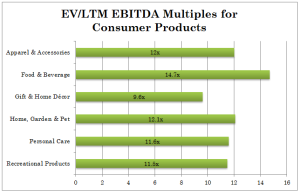
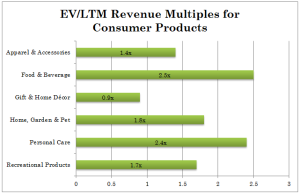
With regard to consumer products multiples, it’s interesting to observe the differences in valuations between the various segments. Whether the metric is enterprise value divided by last twelve month’s revenue (“LTM”) or enterprise value divided by last twelve months EBITDA, Food and Beverage commands the highest multiples. (We explain why below.)
Gift & Home Décor seems to garner the lowest valuations in this sector. But, “low” doesn’t mean bad in this case. A multiple of 9.6 times EBITDA is very respectable for this niche.


Consumer Products M&A Update Consumer Products M&A Update


Consumer Products M&A Update Consumer Products M&A Update


In the consumer space, strategic acquisitions are a relatively quick way for buyers to keep pace with emerging consumer trends. For example, there are a number of soft drink companies that have acquired water companies, sports and energy drink companies, etc. The purpose of these acquisitions was to respond, very quickly, to customer demand. This heightened demand and competition for companies in this niche translates into higher multiples and values as depicted in the charts above.

Since 1987, Versailles Group's skill, flexibility, and experience have enabled it to successfully close M&A transactions for companies with revenues between US$2 million and US$250 million. Versailles Group has closed transactions in all economic environments, literally around the world. Versailles Group provides clients with both buy-side and sell-side M&A services, and has been completing cross-border transactions since its founding in 1987.
If you would like to discuss strategic options, please contact me.

Donald Grava


Jun 04

How to obtain maximum value when selling

Donald Grava June 4, 2015

How to obtain maximum value when selling

How to maximize value when selling

How to obtain maximum value when selling


The Seller’s Perspective: Is Cash Really King?
If you’re selling your company, one of the most important things to consider is the method of payment. Will you receive cash, debt, stock, or other consideration? That is, literally, the multimillion dollar question.

Most business owners prefer to receive cash, at least initially. As they say, “cash is king.” It’s simple, easy, and it gives owners a sense of closure that no other alternative can offer. Yet in many transactions, cash isn’t always a feasible option, or even necessarily the best option. Instead, business owners should always consider legitimate alternatives to cash, such as debt, stock, and contingent payments. The seller, with his M&A advisor should weigh the respective pros and cons of each appropriately. Below is a brief overview of these options:

Cash
Sometimes, an all-cash payment will make the most sense for the seller. If you don’t trust in your buyer’s long-term stability, solubility or ability to run the merged company then “taking the cash and running” may really be your best bet, regardless of whether or not the buyer offers you a better deal. Nobody wants to be paid in debt, stock or other contingent payments when all it gives you is a stake in a “sinking ship.”

Getting paid in cash is also a good idea if you’re in a hurry to completely divest from your current company or industry. Cash can offer you a fresh start and an ability to diversify your wealth. This would not be true of a stock, debt, or contingent payment deal.

Sometimes, the decision to choose cash as payment isn’t necessarily so simple. If the economy is weak, it may be difficult for the buyer to generate cash. And even in a good economy, a buyer still might give you a better deal if you accept some part of the consideration in debt, stock, or other contingent payments.

Alternative #1: Debt
If your buyer has good credit and you can get a higher valuation, you should strongly consider accepting some debt (usually in the form of promissory notes) as payment. This may also enable a buyer that you’d like to work with in the future to complete a transaction even though they didn’t have enough cash to close the transaction. If the credit is good, then even with debt, you’ll eventually be paid the same amount in the end—or possibly even more, depending on the interest rate. In some cases, you may actually find that buyers are willing to pay more for your company if you’ll accept debt. When it’s easier for buyers to finance, after all, it’s also easier for buyers to pay a higher price.

Of course, debt carries its fair share of disadvantages. For starters, it’s riskier than cash, since you’ll likely be counted as a subordinated lender. That means that if your buyer goes bankrupt, you’ll only be able to reclaim your money after other, more “senior” lenders have already taken their share. And unlike cash, you won’t be receiving all of your money up front, since the debt will be only paid off over time, usually two to five years.

Alternative #2: Stock
In other instances, the buyer may offer you their stock as payment. Frequently, this is offered in addition to cash or debt. Buyers often do this when they want to keep you involved with your company, even after you sell it. If you trust the long-term prospects of your buyer, accepting a stock payment can very easily become the most lucrative option of all. You can often receive a better deal from buyers if you accept stock instead of cash, and unlike debt, the theoretical rate of return on a stock is limitless. Many times, a seller makes a very hefty return on future increases in the stock price.

Obviously, this option isn’t ideal for those who want to make a clean break from their businesses and retire from the industry altogether. Stock is also riskier than cash or even debt. If the buyer goes bankrupt, stockholders are the very last in line to get their money back.

Alternative #3: Convertible (Debt) Securities
Convertible debt securities aim to combine many of the upsides of debt and stock payments, with none of the downsides. Essentially, a convertible debt security is a piece of debt (often a bond) that can be optionally be converted into a stock at a given “conversion price.” If you don’t want to choose between debt payments or stock payments when selling your company, payment via convertible debt securities may be a good solution. You receive the aforementioned benefits of debt, including regular interest payments and more bankruptcy protection, while also gaining the benefits of stock, such as the ability to share in the buyer’s future profits (if you convert your security).

Nevertheless, convertible securities are not without disadvantages. They tend to offer lower interest rates than regular debt, and their conversion price is usually set well above the current market price of the buyer’s stock at the time of transaction. To summarize, if you’re lucky, compared to stock, convertible securities will give you equivalent returns with lower risk. If you’re unlucky, then compared to debt, convertible securities will give you lower returns with equivalent risk.

Alternative #4: Contingent Payments
The most common contingent payment is the traditional earnout. Essentially, the seller will pay these amounts based on the future performance of the company. Most of the time, these arrangements are for relatively short periods of time, i.e., 12 to 36 months. This form of payment works best when the seller stays with the business and has an ability to influence the outcome.

There are as many forms of other types of contingent payments as people have the imagination to think them up. Versailles Group was involved in a transaction where part of the seller’s consideration was an annual payment of $1 million for the rest of his life. Provided that the seller, his investment banker, and lawyer analyze these alternatives thoroughly, they can be very rewarding for the seller.

Conclusion
At Versailles Group, we strive to keep our clients fully informed of all possible options during an M&A transaction, especially on the all-important matter of payment methods. That’s how to maximize value when selling.

As a boutique investment bank, our best interest is served when our client’s best interest is protected. Since 1987, this fundamental value has constantly reaffirmed Versailles Group’s position as a leading M&A advisor to middle market companies around the world. If you’re interested in selling or buying a business, please contact us for a free consultation.

Jun 02

Why Hire an Investment Banker for Acquisitions

Donald Grava June 2, 2015

Why Hire an Investment Banker for Acquisitions


why hire an investment banker for acquisitions


Why Hire an Investment Banker for Acquisitions

When acquiring other companies, corporations usually have many resources at their disposal, for example they can utilize their corporate development team, finance department, in-house counsel, etc. Consequently, management may feel that hiring an investment banker is an unnecessary expense. This is particularly true if management is not able to see the true value that a banker brings to the acquisition process.

The following are some of the value added features that an investment banker would bring to the process of completing a successful acquisition or answer the simple question: why hire an investment banker for acquisitions.

Appearance of Neutrality

When attempting to purchase another company, especially a competitor in the same industry, corporations face the challenge of appearing as genuinely interested. Many times, when an acquirer contacts a target in the same industry, they are seen as a competitor attempting to obtain sensitive information. An investment banker plays an important role in breaking down this barrier. Even though the banker is working for the acquirer, there is an appearance of neutrality. Consequently, target companies feel more comfortable dealing with an investment banker, particularly because they know he or she knows how to handle confidential information.

Target companies also feel that an acquirer that has hired an investment banker is truly serious as the buyer has made a commitment of time and money with regard to the investment banker’s participation in the transaction. Conversely, buyers without representation appear as less serious or only interested in obtaining confidential information.

Better Relationships Post Closing

The buy-side investment banker plays a critical role when representing the buyer. He or she can negotiate aggressively on the buyer’s behalf. After the transaction is closed, the buyer and seller can work together as they were not the ones fighting over value and terms. If these two parties had negotiated fiercely with one another during the merger, relations post-closing will be strained.

Thus, by utilizing an investment banker, the acquirer’s relationship with the target will be better post-closing. This is another critical role that an investment banker plays as the future success of an acquisition is dependent on the smooth integration of management teams post-closing, particularly if there are any contingent payments.

Objectivity

During the M&A process, it is invaluable to have a resource that can provide an objective opinion on the best acquisition strategy, valuation, and other matters. Corporations, even those with large staffs, may not be able to examine the full ramifications of an acquisition target post-closing. An experienced investment banker can help the buyer gain the perspective that is needed to complete a successful acquisition. This assessment covers the gambit of strategic, tactical, valuation, terms, negotiating tactics, structure, etc. Only an independent investment banker will be able to provide an objective third party view to a buyer.

Conclusion

There are many reasons why an investment banker can add real value to the acquisition process. They add an aura of neutrality, better relationships for buyer and seller post-closing, objectivity, and expertise with all of the moving parts that make up an acquisition transaction. This should answer the important question of why hire an investment banker for acquisitions.


May 28

How do I sell my company – NDAs

Donald Grava May 28, 2015

How Do I Sell My Company – NDAs

How do I sell my company - NDAs


How Do I Sell My Company – NDAs

Many people ask us, how do I sell my company? There are many critical steps in that process; however, perhaps the most important one is a good Non-Disclosure Agreement. Most companies have Non-Disclosure Agreements or NDAs in order to share information with potential suppliers or other “partners.” However, most do not have a good M&A NDA. M&A NDAs are more specialized and cover some important items.

Before we explore what should be included in a good M&A NDA, it’s important to understand why this document is needed. The simple answer is obvious; the Company doesn’t want their data used for anything other than the exploration of a possible transaction. The less obvious reason is that the NDA is also for the benefit of the ultimate buyer. At the end of the day, the acquirer will have to face competitors and other buyers that just had a very detailed and in-depth look into the company being sold.

A good M&A NDA should cover the simple fact that none of the information revealed in the M&A process can be used for any purpose other than evaluating a potential transaction. It should also restrict the buyer from talking with customers, suppliers, employees, etc. Another important function of the NDA is to prevent potential buyers from hiring any of the employees, particularly the executives. This document should also prohibit the buyer from discussing the transaction with anyone other than the company’s advisors. It should be clear that any data shared with these other individuals is the responsibility of the buyer.

Some M&A NDAs also cover things like reps and warranties surrounding the preliminary information that is conveyed. It may also specify that the seller will cover the cost of its M&A advisor and that the buyer’s costs of exploring the transaction will remain as its responsibility.

From a seller’s perspective, the NDA should provide a reasonable layer of comfort. From a buyer’s perspective, the NDA shouldn’t be so restrictive that they don’t want to even look at the company for sale. Many buyers that are afraid of liability problems will only look at non-confidential data before proceeding. This can be detrimental to the seller’s goal of generating the highest possible bid and the best terms.

As they say, “good fences make good neighbors.” Yet, it’s important for the document to have balance between buyer and seller. Experienced M&A advisors know what to look for in an NDA. It is important that all parties consult an attorney before executing an NDA.

With a proper M&A NDA, a seller will have taken an important step in answering the complex question of how do I sell my company - NDAs.

May 26

How To Sell A Company

Donald Grava May 26, 2015

How To Sell A Company

how to sell a company

How To Sell A Company

Many company owners wonder how to sell their company. It’s a good question and certainly every business owner thinks about this topic periodically. In our mind, it’s not only a question of how to sell their company; it’s how to sell it for the maximum value and best terms.

The actual process is not that complicated, but there are many pitfalls. Many owners think that they know who the most logical buyer will be when the time comes. But, they’re always disappointed later when that buyer isn’t interested or makes an impossibly low offer. The other major mistake that’s made is to share information without a Non-Disclosure Agreement.

Versailles Group has handled a number of engagements where the owners had started the process themselves and then realized the problematic nature of that. Most business owners don’t have the time to devote to developing the buyer list, creating the materials that need to be shown, or to deal with the demands of the buyers. However, what has been even more astounding is to learn that these normally careful business owners have shared sensitive company information without any protection.

When selling, the most important thing is to have a Non-Disclosure Agreement (“NDA”) with the buyer. It’s always best to have an M&A NDA, which is different than a standard agreement. While a standard agreement may protect the information, there are many other items that should be included.

Beyond the NDA, the seller should have a strong list of potential buyers. An experienced M&A advisor or investment bank will know how to assemble a list of this kind. A good list will go well beyond competitors and known companies in the seller’s market. Versailles Group has sold a number of businesses to buyers that would be well beyond the normal lists created by others. We view the world as our territory, and we look for buyers that may be slightly outside of our clients business. This creates additional demand and these “other” buyers frequently pay more because they need to access to the market, the products, the technology, etc.

A strong buyer is one of the key ingredients. The other is clear documentation that shows all of the USPs or Unique Selling Points of the company. An M&A advisor will know what buyers are looking for in this type of presentation and know when and how to convey it. This is an art that is developed over the course of many transactions and many years of experience.
Once the buyers have the appropriate information, and if there are multiple buyers, an auction can be created. This is a silent auction and totally confidential. It enables the seller to derive extra value or enhanced terms from the transaction. Offers are usually stated by the buyer in terms of a Letter of Intent.

Once the Letter of Intent is executed, the buyer will conduct thorough due diligence. A good M&A advisor will be able to help their client manage this process. At some point, the buyer will produce a Definitive Agreement. Sellers should pay close attention to the terms and conditions, particularly the representations and warranties. This is a critical document in the process. Versailles Group, as a result of its years of experience knows what should and should not be in a document of this type. It’s also important to know how to negotiate these documents. That’s critical!

Most transactions are a simultaneous sign and close and that will be the day that the consideration is conveyed to the seller. If done properly, it’s a happy day for both parties.
More information on how to sell a company can be obtained by contacting Versailles Group directly.


May 21

Why Hire An Investment Banker?

Donald Grava May 21, 2015

Why Hire An Investment Banker?

why hire an investment banker

Why Hire An Investment Banker?

Entrepreneurs and CEOs are driven individuals with a passion for their businesses. They are go-getters that take the initiative in almost every aspect of their company. For these reasons it is no surprise that when it comes to M&A, many entrepreneurs and CEOs feel they can do it themselves. These individuals have successfully run their business for years or possibly even decades and may ask themselves “why hire an investment banker?”

While some entrepreneurs and CEOs are capable of completing M&A transactions, the majority of these business leaders are not. The result is that they tend to complete deals for less than maximum value or end up with a transaction with less than optimal terms. An investment banker plays a crucial role in achieving the most value in a transaction and best terms in ways that are not always apparent to entrepreneurs and CEOs.

Appearance of Neutrality

When attempting to sell to another company, especially a competitor in the same industry, entrepreneurs and CEOs face the challenge of presenting themselves as genuinely interested. Many buyers shy away from dealing directly with entrepreneurs, particularly in the lower middle market because they know that they simply don’t have the proper experience to complete a transaction. An experienced investment banker can provide the seller with the appropriate guidance on how to conduct an auction, respond to offers, cope with due diligence, negotiate the terms and conditions, etc.

Better Relationships Post Closing

When a company sale takes place and the entrepreneur or other owner-managers stay with the business, both the buyer and seller management teams must learn to work together as fellow employees. If these two parties have been negotiating fiercely with one another during the merger, relations post-closing will be strained. An investment banker negotiating on behalf of the seller can act as a shield between their client and the other party. By utilizing an investment banker, a party has greater leeway in terms of the negotiating tactics that can be used because post-closing the “blame” for the use of those tactics can be placed on the investment banker, not on the seller. This is one of the critical roles that an investment banker plays as the true measure of a successful transaction is frequently the smooth integration of management teams post-closing.
Objectivity

During the sales process, there are bound to be unexpected challenges that arise, particularly for the seller. In these instances, it is invaluable to have a resource that can provide an objective opinion on what is the best strategy to proceed. Entrepreneurs and CEOs that are closely tied to a business may, understandably, take “bumps” in the process personally. Having an experienced advisor in these situations can help to ease tensions, formulate a measured response even in difficult situations, and keep the transaction moving forward.

Thus, we have the answer to why hire an investment banker. The M&A advisor can assist in many ways that most entrepreneurs or CEOs can’t envision. Careful management of the M&A process by the investment banker will result in higher valuations, better terms, and support better relationships between the buyer and seller post-closing. Therefore, sellers should hire an experienced investment bank with many years of experience. Versailles Group, founded in 1987, has completed a large number of successful transactions for entrepreneurs and corporate managers worldwide.


May 19

Regulation A – Regulation A+

Donald Grava May 19, 2015

Regulation A – Regulation A+

Regulation A - Regulation A+

Regulation A – Regulation A+

This blog offers a brief summary of Regulation A and Regulation A+ offerings. Obviously, this is a very complex matter with a number of issues that would have to be addressed by the issuer with a FINRA-registered broker dealer coupled with a well-experienced securities attorney.

Historically, Regulation A or Reg A offerings have been utilized. In fact, from 2012 to 2014, only 26 Regulation A offerings were qualified by the SEC. Reg A offerings have not been popular because of (i) the offering costs, (ii) the burden of an SEC review, and (iii) the necessity of complying with the state blue sky laws in each state where an offering is conducted. The other issue with Regulation A offerings is that they were restricted to offerings of less than US$5 million.

Regulation A+ or Reg A+ was adopted to implement the rule-making mandate of Title IV of the Jumpstart Our Business Startups Act (commonly referred to as the JOBS Act), which was signed into law in April 2012. One of the major changes of Regulation A+ is that it now allows an issuer to offer and sell up to US$50 million of securities over a 12 month period in a public offering, without complying with the registration requirements of the Securities Act.

Regulation A+ provides for two tiers of offerings; Tier 1 offerings of up to US$20 million in any 12 month period and Tier 2 offerings for up to US$50 million in any 12 month period. Each Tier has its own unique offering requirements which should be discussed with a registered broker dealer, for example, Tier 2 offerings of Reg A+ introduces an investment limitation for non-accredited investors. This limitation does not allow these investors to purchase more than ten percent of the greater of the investor’s annual income or net worth.

Reg A+ limits the securities offered to equity securities, including warrants, debt securities convertible into or exchangeable into equity interests, including guarantees of such securities. There are also other limitations, for example, an issuer cannot be an existing SEC reporting company, a “blank check company,” etc.

Another unique feature of Regulation A+ offerings is that issuers have liability with regard to offers or sales made by means of an offering statement or oral communications that may include a material misleading statement or omission. This liability is not present in offerings made under Rule 506 of Regulation D. Disappointed investors in a Rule 506 offering cannot sue, under the federal securities laws, for negligent misrepresentation. In these cases, the investor must prove actual intent to defraud, or reckless indifference to the truth of the representations made in the offering.
Regulation A+ securities are subject to FINRA Rule 5110, which prohibits FINRA members and their associated persons from participating in any public offering of securities unless they comply with the filing and review requirements of the Rule.

Raising capital is an important tool for entrepreneurs to maintain the necessary funds to grow and expand their businesses. That being said, as a result of a number of frauds, the US Government, the SEC, and FINRA have all developed a number of laws and regulations for the raising of capital. No entrepreneur should ever attempt to raise capital without using a FINRA-registered broker dealer. Versailles Group, Ltd.’s affiliate, VGL Global LLC is a registered broker dealer and has the expertise to assist companies in raising capital.


May 17

M&A Deals - 20 Years of M&A

Donald Grava May 17, 2015

M&A Deals - 20 Years of M&A

M&A Deals - 20 Years of M&A


M&A Deals - 20 Years of M&A

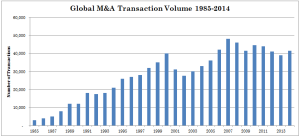
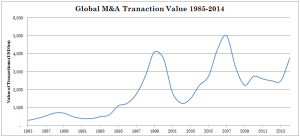
Listed below are two charts that show global M&A volume and value for the last 20 years. We thought that these charts would give our readers some insight into M&A over the last two decades.
M&A Deals - 20 Years of M&A


M&A Deals - 20 Years of M&A


Overall, it’s interesting to note the increase in M&A activity from 1985. Twenty years ago, M&A was not as popular of a tool as it is today. In the 1980s companies would take the time to identify a new location, design and build a factory, and start selling product. Over the years, management teams have realized that with less risk an existing business could be purchased and produce faster results.

One can also observe the cyclicality of M&A. There were peaks in deal volume in 1991, 2000, and 2007. The increasing activity from 1995 to 2000 was the result of Y2K and the dot com era, which became the dot bomb era!

The takeaway of these charts is that M&A follows financial cycles like all of the economies around the world. In down cycles, one can see that the value of transactions decreased more dramatically than the volume. This means that sellers received less value for their businesses.

We’re all hoping that the current strong M&A markets continue forever, but the reality is that like all cycles it will end. That’s certain. What’s uncertain is the timing.


May 14

Operational Due Diligence

Donald Grava May 14, 2015

Operational Due Diligence

Operational Due Diligence

Operational Due Diligence

Due diligence is an important aspect of all M&A transactions as it is a process that allows the acquirer to truly understand what they are purchasing. Mistakes during this process can prove to be costly and can make the difference between a successful acquisition and a failed one. The most common mistakes acquirers make during this process are failing to conduct operational due diligence and utilizing inexperienced people to conduct the process in effort to save on costs.

When conducting due diligence, most buyers tend to focus their efforts on financial, legal, and Human Resource due diligence. What is all too commonly missed during this process is the operational due diligence, i.e., studying, in detail, the customers, products, services, and business pipeline of the company to be acquired.

Most of the time, acquirers in the same industry don’t focus on operational due diligence as they feel they already understand the target’s business or customers. In reality, it is extremely difficult to truly “know” a company as every business is unique and competitors within the same industry will usually attempt to conceal their operations from one another. Operational due diligence should not only consist of asking customers about their satisfaction levels with the target company, but also thoroughly examining customer contracts to fully understand the risks involved with acquiring those customers.

Another common mistake acquirers make is using inexperienced people to conduct the due diligence process in an effort to save costs in the short term. This strategy can lead to substantial losses in the future as inadequate due diligence increases the likelihood of missing important red flags. Acquirers should always utilize employees that are qualified to conduct thorough due diligence. If such employees do not have the bandwidth to conduct the process or will slow down the transaction to a great degree, then the acquirer should always consider hiring a consultant that knows the industry and has experience performing M&A due diligence. While using more senior employees and hiring outside consultants will increase the cost of the transaction, this is certainly money well spent to insure that the acquisition will be valuable to the acquirer.

It is all too easy for acquirers to feel comfortable with targets in their industry. However, acquirers cannot afford to overlook operational due diligence and must treat every acquisition as a prudent investor. It is also imperative that acquirers are not “penny wise and pound foolish” in the performance of due diligence. Utilizing experienced employees and hiring outside consultants to conduct the due diligence process may increase the cost of the acquisition, but it will insure the acquisition adds to shareholder value.

Acquirers should always ask their M&A advisor how to organize their diligence. M&A advisors cannot perform the actual diligence as they have a conflict of interest. However, most well-experienced M&A firms have seen the diligence efforts from both sides of a transaction. Consequently, they have the unique ability to help organize the efforts and to avoid common pitfalls, particularly with neglecting operational due diligence. Versailles Group, a boutique M&A firm that has over 25 years of experience helping buyers and sellers knows how to guide a client through this very important process. They have seen, first hand, how to and how not to conduct proper due diligence.


May 13

M&A Deals – Sell Side Considerations

Donald Grava May 13, 2015

M&A Deals – Sell Side Considerations

M&A Deals – Sell Side Considerations

M&A Deals – Sell Side Considerations

With regard to transactions in the middle market, when an entrepreneur begins the sales process of their company, he or she can easily become consumed by the process. This should be one of the most important sell side considerations for an entrepreneur, i.e., how not to get over involved in the process.

In order to complete a successful sale, the entrepreneur must maintain his or her focus on what’s most important, that being the business. This is why it is so critical to have a well-experienced M&A firm handle your transaction. Typically, boutique M&A firms offer middle market companies the best level of service for their transactions. They know how to mitigate the time and effort that an entrepreneur will have to make to the completion of a successful transaction.

The continued strong performance of the company plays an important role in a successful sale, which is why it’s one of the more important sell side considerations. When entrepreneurs neglect their companies during the sales process, they are putting the value of the company at risk. During the sales process for the company, potential acquirers will watch the financial performance of the company closely and will react negatively to any “slip up” in revenues. While a buyer may fully understand that this hiccup in performance was because of management’s focus on the sales process, they won’t hesitate to use this as an opportunity to negotiate a reduction in the value. The best way to avoid this scenario is to make sure that the M&A firm is managing the sales process so that the entrepreneur can stay focused on his or her business.

A knowledgeable financial advisor or boutique M&A firm will be able to tell entrepreneurs what materials potential buyers will want to see and may even populate a data room with such data. Getting this information ready in advance will reduce the stress of numerous data requests from a buyer once due diligence is in full swing.

Throughout the sales process entrepreneurs should always expect the unexpected. An experienced M&A advisor will be able to guide entrepreneurs through the M&A process, which is not always a straight line. As a buyer conducts its due diligence, unforeseen flaws are likely to be discovered. When this occurs, the most effective way to ease a potential buyer’s fears is to present a company that is continuing to perform well. This will not only keep the sales process moving, but will also preserve the value for the business by preventing a price negotiation.

Entrepreneurs selling their business can often times feel like they are performing a juggling act and it may seem as if there are too many things to keep an eye on. This is actually another one of those very important sell side considerations. An experienced boutique M&A firm can be the extra set of hands the entrepreneur needs to maintain the company’s financial performance while also executing a successful sale. With this type of teamwork, the highest value for the business will be obtained and the sales process can be completed in the most efficient manner.

At the risk of being redundant, it’s important for the entrepreneur to make sure that they are hiring a well-qualified M&A advisor with years of experience. They will know how to guide the entrepreneur through a variety of circumstances that always creep into M&A transactions, but are not fatal to completing a successful transaction. There are many sell side considerations and Versailles Group, a boutique M&A firm or investment bank would be happy to explain how to accomplish the best possible results in the sale of your company.