

Apr 09

M&A Deals - Q1 2015 Activity

Donald Grava April 9, 2015

M&A Deals - Q1 2015 Activity


Global M&A Activity - Q1 2015

Globally, M&A transaction value for Q1 2015 was approximately US$831.5 billion, which showed growth of approximately ten percent over Q1 2014. The following chart shows Q1 global M&A activity from 2012 through 2015.

M&A Deals - Q1 2015 Activity

Both the US/Canada and Asia/Pacific showed an approximate 22 percent growth in M&A transaction value from Q1 2014 to Q1 of 2015. As shown in the following charts, both markets (except for 2013 in Asia/Pacific) have had steady M&A growth over the last few years.


US/ Canada M&A Activity - Q1 2015


M&A Deals - Q1 2015 Activity


Asia/Pacific M&A Activity - Q1 2015


M&A Deals - Q1 2015 Activity


European M&A Activity - Q1 2015

European M&A deals have slowed from last year, but have not slipped below 2013’s slowdown.

M&A Deals - Q1 2015 Activity


Latin America M&A Activity - Q1 2015

M&A deals in Latin America/Caribbean have slowed from last year, but are still ahead of 2012 and 2013.


M&A Deals - Q1 2015 Activity


Africa/MEast M&A Activity - Q1 2015

M&A deals in Africa/Middle East have shown a steady decline from 2013’s high and, are, in fact, lower than even 2012.

M&A Deals - Q1 2015 Activity

While M&A activity is robust, sellers should move quickly. Over the years, Versailles Group has seen many sellers miss the "window." This was very apparent in the Great Recession as many buyers waited too long and found that not only did their businesses suffer during the recession, but that the value of their business declined tremendously.


Mar 31

M&A Deals - Integration of Employees in Acquisitions

Donald Grava March 31, 2015

M&A Deals - Integration of Employees

in Acquisitions

M&A Deals - Integration of Employees in Acquisitions

M&A Deals - Integration of Employees in Acquisitions

In M&A deals - integration of employees in acquisitions is critical. In many cases, retaining personal is an overlooked aspect by the new owners of an acquired business. For some reason, this neglect starts during the due diligence phase. Buyers keep saying that the people are important, but do little to prove it. Frequently, employment agreements are the very last documents that a buyer submits to the seller and/or the employees. It’s a pity because the people are very important “assets” and have feelings. By contrast, the accounting details or legal matters don’t care if they’re verified first or last. It’s important for the buyer to send strong signals to employees that they will keep. As they say, action speaks louder than words.

Emphasis needs to be placed on making the employees to be acquired comfortable in knowing that they will be kept. This usually means talking with them directly and presenting fair and reasonable employment agreements. For most acquisitions, keeping key employees from leaving is essential to ensure a successful transaction. In most middle market M&A deals, the employees have been with the business for years and have special expertise in the company’s day to day operations. The experience and information that these employees have can be invaluable to a new management team. In many cases, existing employees have good ideas on how to improve customer service or create other efficiencies so new management should be open to their suggestions.

Interviewing and listening to employees is also a good way for management to evaluate newly acquired personal and see which ones take initiative and are really dedicated to their jobs. Employees are important “assets.” The most successful M&A transactions use this as a cardinal rule and deploy these people in an appropriate and mutually beneficial way. Furthermore, smart acquirers show these employees respect from an early stage in the transaction.
Newly merged companies need to work towards building a winning team-oriented attitude within the company culture. This encourages teamwork and builds mutual respect between employees and management. Post-acquisition, it is important that management is transparent with employees about possible changes within the company. If management is honest with the employees about these changes, then the employees will be more receptive to new ideas and strategies within the company. Furthermore, in many cases, the employees will actually embrace the changes and help the company to achieve its objectives.

M&A deals can be complex; however, if well thought out and executed properly, they can be very productive for the acquiring company. An experienced M&A advisor can help the acquiring company with these details because they’ve seen different buyers implement different strategies and generally know what works and what doesn’t work. The most successful managers are those that seek advice from their advisors and listen carefully to the input.


Mar 31

M&A Deals - Q1 IT Update

Donald Grava March 31, 2015

M&A Deals - Q1 IT Update

M&A Deals - Q1 IT Update

M&A Deals - Q1 IT Update

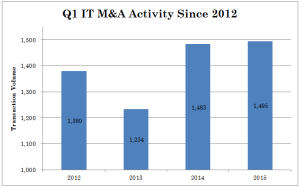
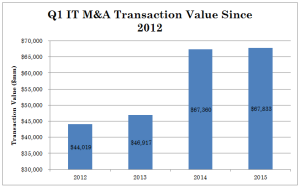
With regard to M&A deals - Q1 IT update, IT deals for the first quarter of this year are slightly ahead of the same period last year in terms of both volume and value. Approximately 1,500 transactions were closed with a value of approximately US$67.8 billion.
 

M&A Deals - Q1 IT Update


M&A Deals - Q1 IT Update

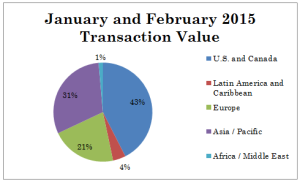
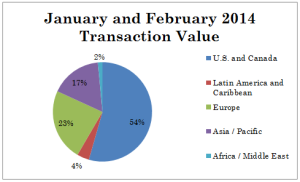
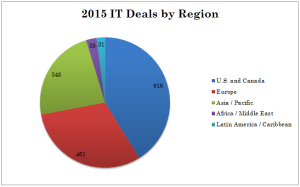
By region, 616 of the approximately 1,500 transactions (or about 41 percent) were announced in the US and Canada. Europe accounted for 461 transactions or about 31 percent. Approximately 348 transactions were announced in the Asia Pacific region for about 23 percent. Here are the details:
 

M&A Deals - Q1 IT Update

Versailles Group, founded in 1987, is an expert at closing successful M&A deals. Software transactions have included the sale of Bedford Software, a Toronto Stock Exchange listed company, the sale of Layered Inc., a company owned by Mr. Paul Allen, co-founder of Microsoft, the sale of BEZ Systems, the sale of a software business for Logica plc, etc. Versailles Group's forte is to listen to its clients objectives and works diligently to find the appropriate buyer. In these cases, high valuations are achieved and both buyer and seller are happy with the results.

Versailles Group was founded by Mr. Donald Grava, who has an extensive background in accounting, finance, M&A, and other matters. Mr. Grava started his M&A career on Wall Street in New York, where at an early stage in his career, he was exposed to international companies and cross-border transactions. As a result, many of Versailles Group's transactions have been cross-border.


 

Mar 25

M&A Deals - Locked Box

Donald Grava March 25, 2015

M&A Deals - Locked Box

M&A Deals - Locked Box

Locked Box

In M&A deals, buyers and sellers are always looking for ways to reduce what is often a lengthy process of preparing, reviewing, and agreeing on final price adjustments derived from the closing accounts. In order to simplify this process, more M&A transactions are beginning to implement a “locked box” pricing mechanism. The locked box mechanism negates the need for preparing and reviewing final price adjustments post-closing and allows the buyer and seller to allocate their resources into other aspects of the M&A deal.

The Locked Box M&A deal is an essentially a fixed price transaction. This means that the equity price is fixed in the sale and purchase agreement at signing based on the historical balance sheet at the pre-signing date or “locked box date.” Protection against any “leakage” of value between the locked box date and the closing is provided by the seller through representations and warranties written into the sale and purchase agreement and are usually supported by indemnification. This “leakage” of value can be in the form of dividends, management fees, or the transfer of assets. By using this mechanism, no closing accounts are required. Therefore, there are no adjustments made between the locked box date and closing; the price the buyer is paying is the price agreed upon at the locked box date.

There are several benefits from both the buyer and seller’s point of view with regard to the locked box. It offers price certainty as the price is fixed from the locked box date which makes the deal simpler as there is no closing mechanism. There are fewer costs associated with this deal structure as the creation of a definitive agreement takes a shorter amount of time. Another benefit is that management’s time is not tied up post-closing. Provided the seller can offer appropriate comfort in terms of the integrity of the locked box balance sheet as well as relevant warranties over locked box accounts, the locked box will be beneficial for both parties.

As in all M&A deals an experienced M&A firm can help take care of these details. Many think that their lawyer can handle these points, and they’re right. But, the most successful transactions are completed by a team and the most successful entrepreneurs and corporate managers know this. When the team addresses these types of complex issues, the client always wins!


Mar 24

M&A Deals Telecom

Donald Grava March 24, 2015

M&A Deals Telecom

Versailles Group M&A Deals Telecom


M&A Deals - Telecom Industry - Q1 Update

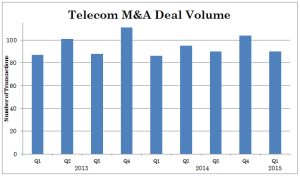
M&A deals in the telecom space are off to a good start this year. Through March 23, 2015, there have been 90 M&A deals - telecom closed or announced worldwide. With approximately one more week left in the quarter, this is more transactions than either Q1 2013 or Q1 2014.

Here’s a chart showing the activity by quarter from 2013 to date.

Versailles Group - M&A Deals


With regard to value, through March 23, 2015, US$663.2 billion of M&A deals were closed.

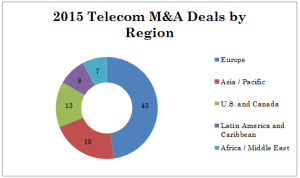
Europe saw the most M&A deals with 43 of the 90 transactions. Asia was next with 19 transactions. Here is a chart with the number of transactions by region.


Versailles Group - M&A Deals

Mar 23

M&A Deals - Healthcare

Donald Grava March 23, 2015

M&A Deals

Versailles Group - M&A Deals

Healthcare M&A Deals

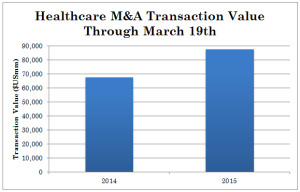
Healthcare M&A deals are off to an excellent start this year as evidenced by the chart below, which shows the increase in value of M&A deals from January 1 to March 19 of this year as compared to the same period last year.


Versailles Group M&A Deals
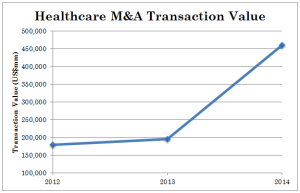
This strong M&A activity continues a trend of increasing transaction values in the Healthcare sector. Since 2012, the aggregate value of healthcare M&A deals has grown 157 percent.

Versailles Group M&A Deals


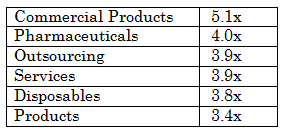
In terms of revenue multiples, and M&A deals, the following segments had the highest multiples:

Versailles Group M&A Deals


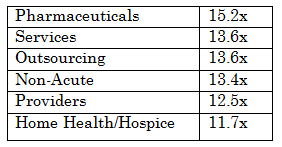
In terms of EBITDA multiples and M&A deals, the following segments had the highest multiples:

Versailles Group M&A Deals


Most people watching healthcare M&A deals in 2015 believe that it will be a very strong year in terms of numbers of transactions and the value of such transactions. The Affordable Care Act is pushing companies to get larger and larger to achieve economies of scale in order to compete effectively. From our vantage point, it appears that healthcare companies need to get larger or they won’t be able to compete in today’s more demanding marketplace.

For companies on the acquisition “trail,” it’s imperative to have an experienced M&A advisor on the team to help refine the acquisition criteria so that important transactions are not missed. With clear criteria, targets can be identified and contacted quickly to make the process as efficient as possible. Furthermore, if a number of targets are contacted at once, the buyer gains valuable strategic market information, can complete comparison “shopping,” and conclude the best possible M&A deal.

For healthcare companies interested in selling, it’s important to have an M&A advisor that can properly identify, worldwide, every possible buyer in order to create the best possible auction. An experienced Investment Bank should be able to create a worldwide, silent auction in order to make sure that a proper market is made for the seller. The second and third bidders will also keep the “winner” honest during the due diligence phase. Furthermore, should the “winner” not be able to complete the transaction, for any reason, the second and third place bidders should be considered as excellent back up buyers.

Mar 17

M&A Deals - Activist Investors and M&A

Donald Grava March 17, 2015

M&A Deals

m&a deals, sell my company


Activist Investors and M&A

M&A deal making, over the years, has been affected by activist investors. This is particularly true for financial sponsor buyers such as private equity firms. In most cases, financial sponsors are more sensitive to changes in the valuation for a target company as compared to strategic buyers. There are two primary reasons for this. First, the shorter investment horizon for financial buyers makes it difficult for a financial buyer to add enough value and to sell out with a gain within three to five years. Strategic buyers, on the other hand, are usually making acquisitions for the long haul, which means they don’t have to face that issue. Second, strategic buyers are able to achieve economies of scale on many fronts, which means they can afford to pay more, up-front, for the target.


Activist investors have deterred some financial sponsors or private equity firms from completing M&A deals by bidding up share prices of target companies that the activist investors view as too low. Run ups in the share price of potential target companies makes acquisitions too costly for some financial sponsors, thus discouraging M&A transactions. While strategic buyers have proven to be more flexible in purchase price, they too are finding it harder to complete deals where activist investor presence is strong. The activist investors’ demand for a higher purchase price has made obtaining shareholder approval to complete an M&A transaction more challenging.
The key to getting M&A deals done amidst strong shareholder activism is through detailed target selection and management’s need to pitch the deal to their shareholders from inception. These are not easy tasks and having an experienced financial advisor to guide the management team through the M&A deal is invaluable. An investment bank with decades of experience will be better suited to help management successfully complete an M&A transaction even in the presence of strong shareholder activism or other challenges.


Mar 10

Why Make an Acquisition?

Donald Grava March 10, 2015

M&A Deals

Acquisitions


Versailles Group - Acquisitions


There are several reasons why companies make, or should consider making, acquisitions. Among the more important reasons are the following:

Accelerate market access for existing products. For example, for a non-US company, the US and Canada combined would provide exposure to one of the largest and most vibrant markets in the world.

Obtain skills or technology faster or at lower cost than they can be developed.

Acquire products in other geographies that can be manufactured and sold in the company's home territory.

Increase market share and/or reduce competition.

Diversify product portfolios or add entirely new products.

Achieve economies of scale for production, sales, etc.

Develop cross-selling opportunities.

Enable vertical integration.

M&A deals require focus and attention to detail. A well-experienced investment banker can help a company refine its objectives with regard to an acquisition and help them complete a successful transaction.

Over the years, many prospective clients have come to us with an idea that they'd like to acquire another company. In many cases, the idea hasn't been a bad one, but not worth pursuing. Some CEOs believe that an acquisition will fix an unprofitable or troubled business. Yes, that's possible, but not likely. In other words, one should consider acquisitions carefully, define the goals of acquiring a company, and then devise a strategy and tactics to achieve it. Buying something for the sake of it, will not increase shareholder value. And, certainly buying a company without carefully defined objectives will only exacerbate profitability or other problems at the acquiring company.


Mar 05

M&A Deals - CIM

Donald Grava March 5, 2015

M&A Deals

Confidential Information Memorandum

Versailles Group - Offering Memoranda


A Confidential Information Memorandum (“CIM”) (also known as an Offering Memorandum) is used as the primary marketing tool for the selling company in an M&A transaction. It is a written and detailed description of the company that is for sale. Frequently, the CIM is greater than fifty pages long and contains information about the company’s products or services, markets, technology, manufacturing, sales and marketing efforts, staffing, financial information, etc.

The selling company’s management team along with an experienced team of M&A advisors will work together to develop an accurate and comprehensive CIM that details the most important features about the company for sale. Typically, a significant amount of time is spent preparing the CIM before it is deemed to be complete and ready for distribution to interested buyers, who will have executed non-disclosure agreements in order to receive the information.

The objective of the CIM is to give potential buyers a strong understanding of the company for sale. Sometimes modified versions of a CIM are created which will be presented to strategic buyers in instances where the seller may be concerned about sharing specific confidential information with a competitor.

The financial information provided in the CIM is one of the most important sections. It always includes both historical and projected financials, which help prospective buyers determine an initial valuation for the company. The projections that are created need to be defensible and there should be a clear explanation as to how the selling company plans on reaching those goals. Potential buyers will look closely at these numbers as they are a major factor in their determination of an initial valuation of the company.


Mar 04

M&A Deals - Entrepreneurs

Donald Grava March 4, 2015

Versailles Group - Ebook

M&A Deals - Entrepreneurs

Versailles Group is pleased to announce the publication of its newest Ebook - Five Common Fears That Entrepreneurs Have When Selling Their Business." This Ebook is designed to help entrepreneurs complete M&A deals, in particular, the sale of their company.

Entrepreneurs, after spending a lot of time and effort to build a company, always have many uncertainties regarding the possible sale of their "baby." This eBook addresses several points including:

How value concerns can be mitigated with deal structure

Buyer motivation

What happens to employees and customers after a sale

What happens to employees and customers after a sale

How confidential information is kept safe throughout the sales process