<img src="http://www.sas15k01.com/49531.png" style="display:none;">

Donald Grava

Donald Grava
Versailles Group’s Founder, Donald W. Grava, brings a uniquely well-suited background to his position as President. His experience combines investment banking expertise with practical knowledge of the inner-workings of corporations of all sizes. Prior to Versailles Group, Mr. Grava was the former First Vice President of ELM Securities Inc., a New York-based investment banking firm, where he originated and successfully closed many domestic and international transactions. Prior to ELM, Mr. Grava gained invaluable corporate finance experience while at Warburg Paribas Becker in New York City. Prior to working on Wall Street, Mr. Grava honed his practical knowledge of corporate operations through strategic and financial planning roles at two different Fortune 200 companies. Mr. Grava started his career at Coopers & Lybrand where he gained hands-on accounting experience. Mr. Grava holds the following Securities Licenses: 7, 24, 27, 66, and 79. These licenses are sanctioned by FINRA (Financial Industry Regulatory Authority, Inc.). Mr. Grava is on the Board of Directors of The Jebb Center for Autistic Adult Living, a 501(c)(3) organization devoted to providing safe and challenging living environments for adults with Autism. Mr. Grava earned a B.A. in economics from Yale University and an M.B.A. from New York University’s Leonard N. Stern School of Business. While at Yale, he was captain of the heavyweight crew.

Recent Posts

Apr 09

M&A Deals - Q1 2015 Activity

Donald Grava April 9, 2015

M&A Deals - Q1 2015 Activity


Global M&A Activity - Q1 2015

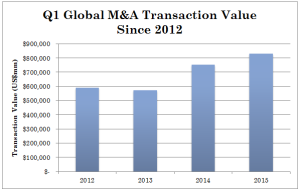
Globally, M&A transaction value for Q1 2015 was approximately US$831.5 billion, which showed growth of approximately ten percent over Q1 2014. The following chart shows Q1 global M&A activity from 2012 through 2015.

M&A Deals - Q1 2015 Activity

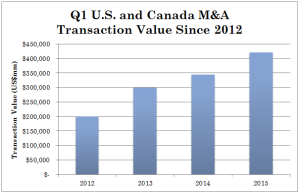
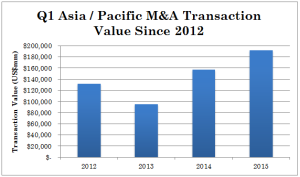
Both the US/Canada and Asia/Pacific showed an approximate 22 percent growth in M&A transaction value from Q1 2014 to Q1 of 2015. As shown in the following charts, both markets (except for 2013 in Asia/Pacific) have had steady M&A growth over the last few years.


US/ Canada M&A Activity - Q1 2015


M&A Deals - Q1 2015 Activity


Asia/Pacific M&A Activity - Q1 2015


M&A Deals - Q1 2015 Activity


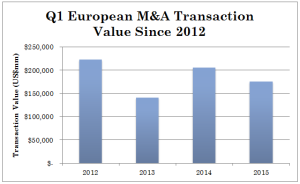
European M&A Activity - Q1 2015

European M&A deals have slowed from last year, but have not slipped below 2013’s slowdown.

M&A Deals - Q1 2015 Activity


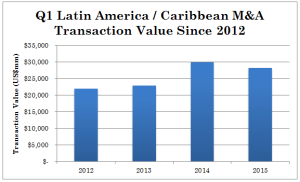
Latin America M&A Activity - Q1 2015

M&A deals in Latin America/Caribbean have slowed from last year, but are still ahead of 2012 and 2013.


M&A Deals - Q1 2015 Activity


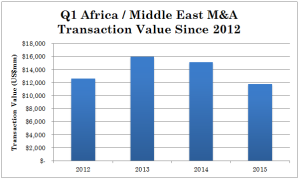
Africa/MEast M&A Activity - Q1 2015

M&A deals in Africa/Middle East have shown a steady decline from 2013’s high and, are, in fact, lower than even 2012.

M&A Deals - Q1 2015 Activity

While M&A activity is robust, sellers should move quickly. Over the years, Versailles Group has seen many sellers miss the "window." This was very apparent in the Great Recession as many buyers waited too long and found that not only did their businesses suffer during the recession, but that the value of their business declined tremendously.


Apr 07

M&A Deals - The Benefits of a Global Auction

Donald Grava April 7, 2015

M&A Deals - The Benefits of a Global Auction

M&A Deals - The Benefits of a Global Auction

M&A Deals - The Benefits of a Global Auction

With regard to M&A Deals – the benefits of a global auction should always be considered when selling your business. It is important to offer a sell side transaction as broadly as possible to achieve the best possible results.
A broad based approach will result in a global auction for the company, thus ensuring the highest possible value as bids are received from across the globe. A multitude of bids to examine will reveal the true value of the selling company. It will also provide the seller with unique insights as some of the bids will have different structures. This will give the seller a chance to “mix and match” structures to obtain not only the highest value, but also the best terms.

Versailles Group has conducted a number of these global auctions over the last 28 years. It should be stressed that all of these auctions are 100 percent confidential. It should also be noted that the results have been phenomenal, in terms of both value and terms. Versailles Group sold a company in Massachusetts to a company in South Africa. Another company headquartered in Houston was sold to a company in New Zealand. The firm has multiple success stories, all based on the international, highly confidential auction. In the case of the South African company, they paid two times the next closest bid, which demonstrates that this process works.

Entrepreneurs and corporate sellers should always be cognizant of the eventual sale of their business and should be preparing for a sale long before they think it’s time. Private equity investors and venture capital investors achieve success when selling businesses because they start preparing for a sale even before they invest.

Most business owners don’t think about selling their business, particularly when they’re starting out; however, it is something that should be considered annually. This should be done with a professional M&A advisor that can advise you about your company’s possible value, the market, possible timing, etc.

When it is time to sell, a broad based approach to the sale should be your first consideration. Frequently, the best buyer is a company on the other side of the world. That being said, as with all M&A deals, confidentiality is paramount. Only responsible M&A advisors know how to conduct themselves and the sale of your company in a secure and confidential manner.

M&A Deals - The Benefits of a Global Auction - Conclusion

An M&A advisor with decades of experience and a global reach will know how to create and facilitate a worldwide, confidential auction. That is the best way to achieve the maximum value and terms when selling a company. To summarize, for M&A deals – the benefits of a global auction should not be underestimated.


Apr 02

M&A Deals: Sell-Side Considerations for Middle Market Business Owners

Donald Grava April 2, 2015

For an owner of a middle-market private company, hiring an experienced boutique investment bank is crucial when considering the sale of your business.  Professional M&A advisors with decades of transaction experience not only help determine your company's true market value but also implement strategies to maximize that value throughout the sales process.  Just as importantly, the right advisor helps secure favorable terms, which is often overlooked when sellers focus solely on price.  In reality, a successful M&A transaction involves far more than valuation alone. 

View of Paris, France

Considerations Before A Sale

Optimal Timing for Your Exit

One of the most critical decisions entrepreneurs face is determining when to sell their business.  Many make the mistake of delaying a sale to implement "one more improvement," such as launching a new product line or developing an additional sales channel.  While these initiatives may seem beneficial, they often cause owners to miss peak market conditions, overlook emerging competitive threats that could reduce value, or delay unnecessarily as industry dynamics shift.

Another common mindset we have seen is anticipating another year of strong growth, prompting owners to miss the optimal window to sell.  Markets fluctuate, regulations change, and personal circumstances can unexpectedly force a sale under significantly less favorable terms.

The best exits occur when your business is performing well and you can sell from a position of strength, not under external pressure.  It’s important to hire an M&A advisor who will analyze market trends, industry consolidation patterns, and your company's growth trajectory to identify the optimal selling window before value deterioration occurs.  In other words, taking a proactive approach enables you to control both the timing and the narrative presented to buyers.  

Preparation For Sale

Another important point to consider is preparing the company for sale.  Some of the items that should be included are: organize financial records and clear up any issues with customers, employees, suppliers, etc., streamline operations and reduce owner dependence.  Most importantly, the potential seller should resolve any legal and compliance issues that are outstanding.

Confidentiality Protection

Business owners should carefully consider how confidentiality will be maintained during the sales process, as it is critical to preserving business value.  An experienced M&A advisor can help by putting robust non-disclosure agreements in place, preparing anonymized marketing materials to protect your identity in the early stages, and using a strategic approach to buyer outreach that minimizes competitive risks while maximizing value and favorable terms.

Market Approach Strategy

You'll need to determine whether a broad marketing approach (contacting numerous potential buyers) or a targeted approach (approaching select strategic acquirers) best serves your objectives.  This decision should weigh the likelihood of achieving maximum valuation through competitive tension, industry-specific confidentiality concerns, the strategic fit with specific buyers who might pay premium valuations, and timeline considerations.  Included in this analysis will be management bandwidth constraints.  A good M&A advisor can help weigh the pros and cons of the various approaches.


Considerations During A Sale

Preparation for Buyer Meetings

Before buyer engagement begins, your M&A advisor should help you anticipate likely buyer concerns and prepare detailed responses, address potential red flags with appropriate context and remediation plans, and maintain operational focus.  Being thoroughly prepared to address questions about operations, technology, human resources, and financials is essential for maintaining deal momentum and credibility.  Building credibility with the buyers is essential to achieving a successful outcome.

Negotiation Strategy

Expert negotiation is critical to maximizing value beyond just the headline purchase price.  Key considerations include purchase agreement structure and terms, working capital adjustments, earnout provisions and their achievability, representation and warranty terms, non-compete provisions and their scope, and post-closing operational requirements.  Each of these elements can significantly impact the final value you receive from the transaction and should be carefully negotiated with professional guidance.  In this regard, your M&A advisor will team up with your attorney to not only protect your interests but also to maximize the valuation and contractual terms.

Exclusivity Period

Once a buyer submits a strong offer and you move into due diligence, they will typically request an exclusivity period (also known as a “no-shop” provision).  During this period, which usually lasts between 30 and 90 days, you agree not to negotiate with other potential buyers while the buyer conducts a thorough review of your business.

Exclusivity is a standard part of M&A transactions, but it does shift negotiating leverage toward the buyer.  For that reason, it should only be granted once a buyer has demonstrated real commitment via their actions and through a strong purchase price and favorable terms.  It is also important to negotiate a reasonable time frame and to keep the process moving efficiently with a well-prepared data room and responsive communication.

When managed properly, the exclusivity period can create focus and efficiency, helping both parties progress toward closing.  When handled poorly, it can result in wasted time, reduced negotiating power, and missed opportunities with other interested buyers.


Considerations After A Sale

Integration Planning

After completing the M&A transaction, focus shifts to integration and operational continuity.  Even when departing, sellers play a vital role in facilitating smooth leadership transitions, helping retain key employees through the change, ensuring customer relationships remain stable, and preserving the company culture that's been built over time.  A thoughtful transition preserves the entrepreneurial legacy while positioning the company for continued success under new ownership.

Legacy Protection

Your M&A advisor should help you develop appropriate transition strategies that protect the interests of loyal employees, maintain quality standards for longtime customers, honor commitments to business partners and community stakeholders, and safeguard the reputation you've worked decades to build.


Conclusion

In summary, selling your business represents the culmination of years of entrepreneurial effort. Working with experienced M&A advisors who understand the nature of transactions provides the expertise needed to navigate this complex process successfully.

For expert guidance on middle-market M&A transactions, please contact our experienced team of investment bankers who would be happy to discuss your objectives on a confidential basis. Such consultation will be performed at no cost to you.


Written by Donald Grava

Originally published:  29 Jul 2015

Last updated:  21 August 2025


Versailles Group, Ltd.

Versailles Group is a 38-year-old boutique investment bank that specializes in international mergers, acquisitions, and divestitures. Versailles Group’s skill, flexibility, and experience have enabled it to successfully close M&A transactions for companies with revenues greater than US$2 million. Versailles Group has closed transactions in all economic environments, literally around the world.

Versailles Group provides clients with both buy-side and sell-side M&A services and has been completing cross-border transactions since its founding in 1987. 

More information on Versailles Group, Ltd. can be found at

www.versaillesgroup.com

For additional information, please contact

Donald Grava

Founder and President

+617-449-3325



Mar 31

M&A Deals - Integration of Employees in Acquisitions

Donald Grava March 31, 2015

M&A Deals - Integration of Employees

in Acquisitions

M&A Deals - Integration of Employees in Acquisitions

M&A Deals - Integration of Employees in Acquisitions

In M&A deals - integration of employees in acquisitions is critical. In many cases, retaining personal is an overlooked aspect by the new owners of an acquired business. For some reason, this neglect starts during the due diligence phase. Buyers keep saying that the people are important, but do little to prove it. Frequently, employment agreements are the very last documents that a buyer submits to the seller and/or the employees. It’s a pity because the people are very important “assets” and have feelings. By contrast, the accounting details or legal matters don’t care if they’re verified first or last. It’s important for the buyer to send strong signals to employees that they will keep. As they say, action speaks louder than words.

Emphasis needs to be placed on making the employees to be acquired comfortable in knowing that they will be kept. This usually means talking with them directly and presenting fair and reasonable employment agreements. For most acquisitions, keeping key employees from leaving is essential to ensure a successful transaction. In most middle market M&A deals, the employees have been with the business for years and have special expertise in the company’s day to day operations. The experience and information that these employees have can be invaluable to a new management team. In many cases, existing employees have good ideas on how to improve customer service or create other efficiencies so new management should be open to their suggestions.

Interviewing and listening to employees is also a good way for management to evaluate newly acquired personal and see which ones take initiative and are really dedicated to their jobs. Employees are important “assets.” The most successful M&A transactions use this as a cardinal rule and deploy these people in an appropriate and mutually beneficial way. Furthermore, smart acquirers show these employees respect from an early stage in the transaction.
Newly merged companies need to work towards building a winning team-oriented attitude within the company culture. This encourages teamwork and builds mutual respect between employees and management. Post-acquisition, it is important that management is transparent with employees about possible changes within the company. If management is honest with the employees about these changes, then the employees will be more receptive to new ideas and strategies within the company. Furthermore, in many cases, the employees will actually embrace the changes and help the company to achieve its objectives.

M&A deals can be complex; however, if well thought out and executed properly, they can be very productive for the acquiring company. An experienced M&A advisor can help the acquiring company with these details because they’ve seen different buyers implement different strategies and generally know what works and what doesn’t work. The most successful managers are those that seek advice from their advisors and listen carefully to the input.


Mar 31

M&A Deals - Q1 IT Update

Donald Grava March 31, 2015

M&A Deals - Q1 IT Update

M&A Deals - Q1 IT Update

M&A Deals - Q1 IT Update

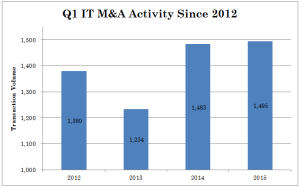
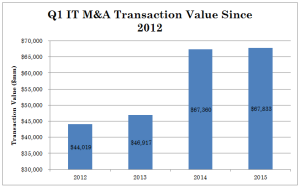
With regard to M&A deals - Q1 IT update, IT deals for the first quarter of this year are slightly ahead of the same period last year in terms of both volume and value. Approximately 1,500 transactions were closed with a value of approximately US$67.8 billion.


M&A Deals - Q1 IT Update


M&A Deals - Q1 IT Update

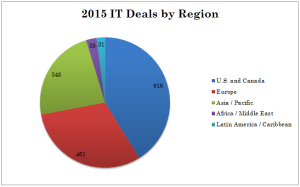
By region, 616 of the approximately 1,500 transactions (or about 41 percent) were announced in the US and Canada. Europe accounted for 461 transactions or about 31 percent. Approximately 348 transactions were announced in the Asia Pacific region for about 23 percent. Here are the details:


M&A Deals - Q1 IT Update

Versailles Group, founded in 1987, is an expert at closing successful M&A deals. Software transactions have included the sale of Bedford Software, a Toronto Stock Exchange listed company, the sale of Layered Inc., a company owned by Mr. Paul Allen, co-founder of Microsoft, the sale of BEZ Systems, the sale of a software business for Logica plc, etc. Versailles Group's forte is to listen to its clients objectives and works diligently to find the appropriate buyer. In these cases, high valuations are achieved and both buyer and seller are happy with the results.

Versailles Group was founded by Mr. Donald Grava, who has an extensive background in accounting, finance, M&A, and other matters. Mr. Grava started his M&A career on Wall Street in New York, where at an early stage in his career, he was exposed to international companies and cross-border transactions. As a result, many of Versailles Group's transactions have been cross-border.


Mar 26

M&A Deals - Failed Acquisitions

Donald Grava March 26, 2015

M&A Deals - Failed Acquisitions

M&A Deals - Failed Acquisitions

Why Do Some M&A Deals Result in Failure?


After the closing of an M&A deal, it is up to the buyer to ensure the success of the transaction. However, it’s only fair to say that not all of the work comes post-closing! In fact, the most successful buyers expend a lot of time and effort before the closing.

There are several reasons why acquisitions fail, but this generally occurs for two primary reasons. The first is that the buyer was overly optimistic about the potential synergies of a transaction. Thorough due diligence and analysis, before closing, is imperative to avoid these types of failures. Second, and this happens more than we’d like to see, the buyer is not able to competently manage the newly acquired business or underestimates the amount of time the transition will take.

When the buyer is overly optimistic about possible synergies with the target company and possible economies of scale, it can lead to a failure. Similarly, if the newly acquired company’s products or services do not grow as anticipated, there’s a chance for failure. Furthermore, if the buyer has underestimated the strength of the market competition, the amount of capital needed to grow the business, or other associated costs related to the transition of ownership or overestimated potential cost savings, it will be very difficult to ensure the success of the newly acquired company.

If the buyer is unable to properly manage the business it will almost certainly lead to a failed acquisition. The management team needs to have a strong understanding of the business being acquired. Furthermore, the acquiring company needs to make sure that it retains key management and other employees to ensure the operations run as planned. If the corporate cultures of the acquiring and acquired companies are vastly different, it can lead to poor chemistry between the employees of the two companies, which can cause tension in the workplace. This tension deteriorates the team effort and can cause financial losses.

In order to complete a successful acquisition, thorough due diligence is an absolute must. Such diligence must include a complete assessment of the buyer’s own strengths and weaknesses and a detailed analysis of the expected financial results. While there are too many conflicts of interest to have your investment banker complete the due diligence, the bankers are certainly well equipped, or should be equipped to help guide the process. A well experienced investment banker certainly knows about the potential pitfalls related to doing an acquisition and can help the buyer avoid them. When the proper diligence and analysis is done, the result is a successful acquisition.
M&A deals can be exhilarating for both the buyer and the seller, if done properly.


Mar 25

M&A Deals - Locked Box

Donald Grava March 25, 2015

M&A Deals - Locked Box

M&A Deals - Locked Box

Locked Box

In M&A deals, buyers and sellers are always looking for ways to reduce what is often a lengthy process of preparing, reviewing, and agreeing on final price adjustments derived from the closing accounts. In order to simplify this process, more M&A transactions are beginning to implement a “locked box” pricing mechanism. The locked box mechanism negates the need for preparing and reviewing final price adjustments post-closing and allows the buyer and seller to allocate their resources into other aspects of the M&A deal.

The Locked Box M&A deal is an essentially a fixed price transaction. This means that the equity price is fixed in the sale and purchase agreement at signing based on the historical balance sheet at the pre-signing date or “locked box date.” Protection against any “leakage” of value between the locked box date and the closing is provided by the seller through representations and warranties written into the sale and purchase agreement and are usually supported by indemnification. This “leakage” of value can be in the form of dividends, management fees, or the transfer of assets. By using this mechanism, no closing accounts are required. Therefore, there are no adjustments made between the locked box date and closing; the price the buyer is paying is the price agreed upon at the locked box date.

There are several benefits from both the buyer and seller’s point of view with regard to the locked box. It offers price certainty as the price is fixed from the locked box date which makes the deal simpler as there is no closing mechanism. There are fewer costs associated with this deal structure as the creation of a definitive agreement takes a shorter amount of time. Another benefit is that management’s time is not tied up post-closing. Provided the seller can offer appropriate comfort in terms of the integrity of the locked box balance sheet as well as relevant warranties over locked box accounts, the locked box will be beneficial for both parties.

As in all M&A deals an experienced M&A firm can help take care of these details. Many think that their lawyer can handle these points, and they’re right. But, the most successful transactions are completed by a team and the most successful entrepreneurs and corporate managers know this. When the team addresses these types of complex issues, the client always wins!


Mar 24

M&A Deals Telecom

Donald Grava March 24, 2015

M&A Deals Telecom

Versailles Group M&A Deals Telecom


M&A Deals - Telecom Industry - Q1 Update

M&A deals in the telecom space are off to a good start this year. Through March 23, 2015, there have been 90 M&A deals - telecom closed or announced worldwide. With approximately one more week left in the quarter, this is more transactions than either Q1 2013 or Q1 2014.

Here’s a chart showing the activity by quarter from 2013 to date.

Versailles Group - M&A Deals


With regard to value, through March 23, 2015, US$663.2 billion of M&A deals were closed.

Europe saw the most M&A deals with 43 of the 90 transactions. Asia was next with 19 transactions. Here is a chart with the number of transactions by region.


Versailles Group - M&A Deals

Mar 23

M&A Deals - Healthcare

Donald Grava March 23, 2015

M&A Deals

Versailles Group - M&A Deals

Healthcare M&A Deals

Healthcare M&A deals are off to an excellent start this year as evidenced by the chart below, which shows the increase in value of M&A deals from January 1 to March 19 of this year as compared to the same period last year.


Versailles Group M&A Deals
This strong M&A activity continues a trend of increasing transaction values in the Healthcare sector. Since 2012, the aggregate value of healthcare M&A deals has grown 157 percent.

Versailles Group M&A Deals


In terms of revenue multiples, and M&A deals, the following segments had the highest multiples:

Versailles Group M&A Deals


In terms of EBITDA multiples and M&A deals, the following segments had the highest multiples:

Versailles Group M&A Deals


Most people watching healthcare M&A deals in 2015 believe that it will be a very strong year in terms of numbers of transactions and the value of such transactions. The Affordable Care Act is pushing companies to get larger and larger to achieve economies of scale in order to compete effectively. From our vantage point, it appears that healthcare companies need to get larger or they won’t be able to compete in today’s more demanding marketplace.

For companies on the acquisition “trail,” it’s imperative to have an experienced M&A advisor on the team to help refine the acquisition criteria so that important transactions are not missed. With clear criteria, targets can be identified and contacted quickly to make the process as efficient as possible. Furthermore, if a number of targets are contacted at once, the buyer gains valuable strategic market information, can complete comparison “shopping,” and conclude the best possible M&A deal.

For healthcare companies interested in selling, it’s important to have an M&A advisor that can properly identify, worldwide, every possible buyer in order to create the best possible auction. An experienced Investment Bank should be able to create a worldwide, silent auction in order to make sure that a proper market is made for the seller. The second and third bidders will also keep the “winner” honest during the due diligence phase. Furthermore, should the “winner” not be able to complete the transaction, for any reason, the second and third place bidders should be considered as excellent back up buyers.

Mar 20

M&A Deals - Cross Border M&A

Donald Grava March 20, 2015

M&A Deals

Versailles Group - M&A Deals - Cross Border M&A

Cross Border M&A


The world is getting smaller, at least from an M&A perspective! Increased competition and globalization in almost all industries has fostered in an era of friendly M&A deals without borders. Strategic buyers have been the primary source of M&A transactions in recent years as many firms look to remain competitive in an increasingly global landscape. Most of the time, M&A deals are completed for either offensive or defensive reasons. And, post-recession, the companies with cash have wanted to deploy it quickly and efficiently. Most of the time, the best way for a company to invest is by buying another company. In the “old” days, a company would create a strategy and business plan to expand their business. This would include acquiring or building new plant and equipment. In today’s environment, that takes too long and is too risky for most companies. Therefore, buying another business is a faster, more direct, and less risky approach to expanding a business.


As technology continues to make communication throughout the world easier, companies have not hesitated to do transactions in other countries and continents. These cross-border deals have further fueled M&A in recent years. Acquisitions provide the buying company with an opportunity to expand their global reach in order to generate new sources of revenue, acquire new technology or products, etc.
It is important to note that unlike the M&A deals of the 1980’s, the transactions taking place today are much more friendly in nature as strategic buyers look for target firms that can complement their core competencies.
The role of investment banks in M&A transactions has also evolved with the motivation of buyers and sellers. Today, more than ever, investment banks are required to be global in their reach. Investment banks that fail to offer cross border services are proving to be less valuable to strategic buyers who are looking to expand their businesses across the globe. It’s imperative to work with a firm with many years of cross border M&A experience as there are many nuances and cultural factors that play into closing a successful transaction. This is true whether it’s hiring an investment bank on the buy-side or the sell side.