

Jul 09

M&A Advisory Services for Founder-Led Businesses: 10 Things to Know in 2026

Versailles Group July 9, 2026

For many founder-led business owners, the first serious M&A conversation begins before a formal decision to sell. It may start with an inbound buyer inquiry, a succession planning question, a desire to take chips off the table, or the realization that the company may need a strategic or financial partner for its next stage of growth.

Why M&A Advisory Services Matter in 2026

The 2026 M&A market remains active.  PwC’s 2026 mid-year outlook indicates that global M&A value is on track to reach approximately $4 trillion.  According to Deloitte, 90% of private equity respondents and 80% of corporate respondents expected an increased number of deals in 2026. Similarly, 87% of private equity respondents and 81% of corporate respondents expected aggregate deal value to increase.

For founder-led businesses, this means the market is favorable, but preparation is still critical. A well-structured M&A process helps owners get ready before going to market, respond strategically to inbound interest, and avoid entering exclusivity before fully understanding the key terms.

Below are 10 things founder-led business owners should know about M&A advisory services in 2026.

1. Founder-Led Businesses Require Specialized M&A Advisory Services

Founder-led businesses often have qualities buyers value: entrepreneurial culture, customer loyalty, specialized expertise, long-standing relationships, and a clear company identity. However, those same qualities can also raise buyer questions.

Potential buyers may ask:

  • How dependent is the business on the founder?
  • Can customer relationships transfer smoothly after closing?
  • Is there a management team capable of operating the business independently?
  • Are systems, reporting, and processes institutionalized?
  • Will the founder remain involved after the transaction?
  • How much growth depends on the founder’s personal relationships?

These questions do not necessarily reduce value, but they must be addressed thoughtfully. Experienced M&A firms help position founder-led companies by explaining not only what the business has achieved, but also how it can continue to grow under new ownership.

In many founder-led transactions, the key issue is whether the process gives the founder enough leverage, buyer options, and deal certainty to make an informed decision.

2. M&A Advisory Services Help Founders Understand What the Business May Be Worth

One of the first questions most founders ask is: “What is my business worth?”

A qualified M&A advisor helps answer that question with market-based analysis rather than guesswork. Valuation support may include reviewing historical financial performance, adjusted EBITDA, revenue trends, gross margins, customer concentration, management depth, industry outlook, comparable transactions, and potential buyer synergies.

For founder-led businesses, valuation is not only about last year’s earnings. Buyers also evaluate whether the business is transferable, scalable, defensible, and capable of performing after the founder steps back.

Important valuation factors may include:

  • Revenue growth and quality of revenue
  • Adjusted EBITDA and margin trends
  • Recurring or repeat customer revenue
  • Customer concentration
  • Supplier concentration
  • Management team strength
  • Sales pipeline visibility
  • Industry growth prospects
  • Intellectual property or proprietary processes
  • Founder dependency
  • Financial reporting quality
  • Potential strategic buyer synergies

For example, two companies with similar EBITDA may receive different valuations if one has recurring revenue, lower customer concentration, stronger second-level management, and cleaner financial reporting.

A founder may think about value based on years of effort and personal commitment. Buyers typically think about value based on risk, future cash flow, growth potential, and strategic fit. Strong M&A advisory services help bridge that gap.

3. Preparation Before Buyer Outreach Can Improve the Sale Process

Many founders wait until they are ready to sell before preparing the business for buyer review. In practice, preparation before buyer outreach can materially improve the quality of the M&A process.

Before approaching buyers, an advisor may help the founder organize financial statements, normalize earnings, prepare add-back schedules, identify diligence issues, review customer data, develop growth narratives, and prepare confidential marketing materials.

This preparation often includes a confidential information memorandum, or CIM, that explains the company’s history, operations, financial performance, market position, customer base, management team, and growth opportunities.

For founder-led businesses, preparation should also address transition planning. Buyers will want to understand what happens after closing. For example:

  • Will the founder remain with the company for a transition period?
  • Is the second-level management team ready for more responsibility?
  • Are key customer relationships held by the founder or by the broader organization?
  • Are operating procedures documented?
  • Are financial reports and KPIs buyer-ready?

Preparation gives buyers confidence. It also helps the founder avoid answering difficult questions for the first time during diligence, when leverage may already be shifting toward the buyer.

4. A Strong M&A Advisor Helps Position the Company’s Story

A founder knows the company better than anyone. However, the founder’s story still needs to be translated into a format that buyers, lenders, investors, and acquisition committees can evaluate.

This is where M&A advisory services become especially important. A strong advisor helps convert the founder’s knowledge into a clear investment thesis.

That may include explaining:

  • Why the company has grown
  • What makes the business defensible
  • Why customers choose the company
  • How the business compares to competitors
  • Where future growth may come from
  • Why the company is attractive to strategic or financial buyers
  • How the business can succeed beyond the founder

For example, a founder may say, “Our customers trust us because we have been in the industry for 30 years.” An advisor may help translate that into a buyer-focused message: “The company benefits from long-standing customer relationships, high repeat business, and a reputation for technical expertise in a specialized market.”

That distinction matters. Buyers assess not only past performance, but also the future.

5. Buyer Outreach Should Be Targeted, Confidential, and Competitive

The best buyer is not always the buyer with the highest initial indication of value. Founder-led business owners may also care about certainty of closing, employee treatment, cultural fit, strategic rationale, financing capability, and the founder’s post-closing role.

This is especially important when a founder has already received inbound interest. A single buyer may be serious, but a single conversation does not establish market value. Without a broader process, the founder may not know whether other buyers would value the business more highly, offer better terms, or provide greater certainty.

An experienced advisor may identify several categories of potential buyers, including:

  • Strategic acquirers
  • Competitors
  • Suppliers or customers
  • Private equity firms
  • Private equity portfolio companies
  • Family offices
  • Independent sponsors
  • Search funds
  • International buyers

Experienced M&A firms help founder-led businesses reach a broader universe of qualified buyers while maintaining control over confidentiality, messaging, and timing.

6. Confidentiality Is Central to Protecting the Business

Confidentiality is one of the most important concerns in founder-led M&A.

If employees, customers, competitors, suppliers, or lenders learn about a potential transaction too early, it can create confusion and risk. Even a well-intentioned buyer inquiry can become disruptive if it is not managed carefully.

M&A advisory services often include confidentiality protections such as:

  • Anonymous teaser materials
  • Non-disclosure agreements
  • Controlled buyer lists
  • Staged information sharing
  • Secure data rooms
  • Process letters
  • Limited access to sensitive customer or employee information
  • Careful timing around management meetings and site visits

For founders, confidentiality protects employees, customer relationships, competitive position, and negotiating leverage. A founder should understand exactly how an advisor will protect sensitive information before any buyer outreach begins.

7. Deal Structure Can Matter as Much as Purchase Price

Founders often focus on valuation. However, deal structure can materially affect actual economics, risk, tax impact, and post-closing obligations.

Two offers with similar purchase prices can produce very different outcomes. Important deal structure considerations may include:

  • Cash paid at closing
  • Seller financing
  • Earnouts
  • Equity rollover
  • Working capital adjustments
  • Escrows and holdbacks
  • Asset sale versus stock sale
  • Employment or consulting agreements
  • Non-compete provisions
  • Transition support
  • Tax considerations

For example, a founder may receive one offer at a higher valuation with a significant earnout and another offer at a slightly lower valuation with more cash paid at closing. The higher headline price may not be the better offer if the earnout depends on aggressive future performance targets outside the founder’s control.

Working capital can also materially affect proceeds. A buyer may agree to a purchase price but later negotiate a working capital target that reduces cash received at closing. Similarly, escrow, indemnity, rollover equity, and financing conditions can change the real risk profile of a transaction.

An M&A advisor helps compare offers based on total value, certainty, timing, structure, contingencies, and post-closing obligations. Legal and tax advisors should also be involved before a founder agrees to final transaction terms.

8. Founders Should Be Careful Before Signing an LOI

The letter of intent, or LOI, is one of the most important stages in a sale process.

An LOI may appear preliminary, but it often sets the economic and procedural framework for the rest of the transaction. Once a founder signs an LOI and grants exclusivity, leverage often shifts toward the buyer. At that point, the seller may be limited in the ability to speak with other buyers while the selected buyer completes diligence, arranges financing, and negotiates definitive agreements.

Before signing an LOI, founders should understand:

  • Purchase price and form of consideration
  • Cash at closing
  • Earnout terms
  • Rollover equity requirements
  • Working capital expectations
  • Escrow or holdback requirements
  • Exclusivity period
  • Financing conditions
  • Key diligence conditions
  • Expected closing timeline
  • Post-closing employment or consulting obligations
  • Non-compete and restrictive covenant expectations

A strong M&A advisor helps founders evaluate not only whether the headline offer is attractive, but also whether the LOI terms preserve leverage and reduce the risk of retrading later in the process.

9. Founders Should Understand the Difference Between M&A Firms, Business Brokers, and Acquisition Consultants

Business brokers can be appropriate for smaller, owner-operated businesses where the buyer universe is more local and the transaction process is less complex.

Acquisition consultants may help buyers identify acquisition targets or develop buy-side growth strategies.

M&A firms and investment banks typically advise on more complex middle-market transactions that may involve valuation analysis, confidential buyer outreach, competitive process management, negotiation, due diligence coordination, and deal structuring.

For founder-led middle-market businesses, the right advisor often depends on transaction size, business complexity, buyer universe, confidentiality needs, and owner objectives.

When evaluating M&A advisory services, founders should ask:

  • Does the advisor have experience with middle-market business sales?
  • Has the advisor worked with founder-led or entrepreneur-owned businesses?
  • How will the advisor estimate valuation?
  • How will the advisor identify potential buyers?
  • How will confidentiality be protected?
  • Who will actually manage the transaction day to day?
  • How will buyer communications be handled?
  • How will competing offers be compared?
  • What transaction experience does the advisor bring to negotiations?

The goal is to hire an advisor who understands the founder’s business, timeline, concerns, and desired outcome.

10. The Right Advisor Helps Founders Avoid M&A Mistakes

Many founders only sell a business once. Buyers, especially private equity firms and experienced strategic acquirers, may evaluate acquisitions regularly. That experience gap can create risk.

Common mistakes founders should avoid include:

  • Speaking with only one buyer without testing broader market interest
  • Sharing confidential information too early
  • Going to market before financial information is prepared
  • Accepting a valuation indication without understanding structure
  • Focusing only on the multiple instead of net proceeds
  • Underestimating due diligence
  • Overlooking customer concentration or management succession issues
  • Failing to prepare for working capital negotiations
  • Signing an LOI before understanding exclusivity and contingencies
  • Waiting too long to plan for ownership transition
  • Choosing an advisor based only on fees

A strong M&A advisor helps founders anticipate issues before they become costly. The advisor’s role is not only to market the company, but also to manage the process, protect leverage, evaluate buyers, and help the founder make informed decisions.

In many cases, the quality of the process can affect the quality of the outcome.

Considering a Sale?

A business owner does not need to be ready to sell tomorrow before speaking with an M&A advisor. In fact, early guidance can be valuable. If you are evaluating inbound buyer interest, considering a sale, or planning for a future ownership transition, we would welcome the opportunity to discuss valuation, buyer appetite, timing, and potential transaction alternatives.

Request a Session >>


Frequently Asked Questions

What are M&A advisory services?

M&A advisory services help business owners evaluate, prepare for, and execute mergers and acquisitions transactions. For sellers, this often includes valuation analysis, preparation of marketing materials, buyer identification, confidential outreach, negotiation, due diligence coordination, and closing process support.

When should a founder hire an M&A advisor?

A founder should consider speaking with an M&A advisor when evaluating a sale, receiving inbound buyer interest, planning for retirement or succession, considering a recapitalization, or seeking to understand valuation and market interest. Early guidance can help the founder prepare before launching a formal process.

Do I need an M&A advisor if I already have an offer?

An advisor can help determine whether the offer reflects market value, whether the structure is favorable, and whether other buyers may have stronger interest. A single offer may be attractive, but it does not necessarily show what the broader market would pay.

What is the difference between an M&A advisor and a business broker?

Business brokers typically focus on smaller business sales, while M&A advisors and investment banks often work on more complex middle-market transactions. 

How do M&A firms find buyers?

M&A firms typically identify buyers through industry research, transaction databases, private equity relationships, strategic acquirer mapping, portfolio company analysis, prior transaction experience, and targeted outreach. The goal is to create a qualified buyer universe that includes both strategic and financial buyers.

How long does it take to sell a middle-market business?

The timeline varies based on preparation, buyer interest, diligence, financing, negotiation, and transaction complexity. Many middle-market sale processes take several months from preparation through closing, and complex transactions may take longer.

How important is confidentiality in the M&A process?

Confidentiality is extremely important, especially for founder-led businesses. A well-managed process protects sensitive information through anonymous teasers, non-disclosure agreements, staged information sharing, secure data rooms, and careful communication protocols.


Mar 06

M&A Trend - Projected Rebound in 2024 Deal Activity

Brigitte Grava March 6, 2024

Projections indicate a rebound in M&A transactions, with a 13% rise in deal volume projected for US private equity and a 12% increase for corporate M&A. This positive outlook for 2024 M&A activity may stimulate greater buyer interest and lead to higher valuations.

3D illustration depicting rising arrows on a blue background


In the fast-paced world of dealmaking, various economic indicators, geopolitical tensions, and market sentiments are interconnected, which can lead to significant shifts in the market landscape in a short period. Over the past several years, we have witnessed a fascinating journey in M&A activity, from record highs due to favorable economic conditions to sudden downturns triggered by policy changes. This rollercoaster ride offers valuable insights into the complexities of dealmaking and the strategies that emerge amidst uncertainty.

In 2021 and early 2022, historic highs in M&A activity were driven by favorable economic conditions, such as moderate inflation, robust economic activity, and low interest rates. However, the Federal Reserve's historic tightening cycle in March 2022 triggered a sudden pullback, and dealmaking activity slowed significantly as the cost of capital surged, and uncertainties loomed large. Private equity deal volumes in the US were substantially lower in 2023 compared to the peak observed in 2021, with a similar trend observed in corporate M&A transactions. These numbers underscore the ripple effects of macroeconomic shifts on the dealmaking landscape, serving as a barometer of broader economic trends.

Despite the downturn, there are glimmers of optimism for the future, as a CEO outlook survey hints at a renewed enthusiasm for deal activity. A significant proportion of US CEOs expressed interest in completing M&A transactions in the coming months, with joint ventures and strategic alliances emerging as key alternative strategies for navigating uncertainties. This reflects a shift towards collaborative approaches to innovation and growth. The survey highlights the emphasis on investments in generative AI (GenAI), indicating a growing recognition of the transformative potential of emerging technologies. While uncertainties linger regarding the trajectory of AI development, the willingness to invest underscores a proactive stance toward embracing innovation and driving future growth.

There is an optimistic future for M&A, with a gradual recovery in PE M&A activity expected through 2024, following a 19% contraction in 2023. It is predicted that there will be a 13% increase in PE deal volume in 2024, which would still leave deal activity about 8% below the 2022 level and 18% below the 2021 peak. While the shortfall relative to recent peaks will be notable, the more important development is that PE deal volume growth is likely to surpass its pre-pandemic pace next year. Between 2010 and 2019, PE deal volume grew at a 9% compounded annual growth rate (CAGR).

The journey of M&A activity in recent years has been remarkable, with periods of prosperity and uncertainty. Economic indicators, policy decisions, and market sentiments all play a significant role in shaping the landscape of dealmaking. Although challenges may arise, businesses have shown resilience and adaptability, using proactive strategies and collaborative approaches to pave the way for future growth. With optimism for a gradual recovery on the horizon, we should embrace the lessons learned and the opportunities that lie ahead. Agility, foresight, and a willingness to embrace change will be the keys to success in the fast-paced world of dealmaking.


Written by Brigitte Grava

5 March 2024


Versailles Group, Ltd.

Founded in 1987, Versailles Group is a boutique investment bank that specializes in international mergers, acquisitions, and divestitures. Versailles Group’s skill, flexibility, and experience have enabled it to successfully close M&A transactions for companies in the middle and lower-middle market. Versailles Group has closed transactions in all economic environments, literally around the world.

Versailles Group provides clients with both buy-side and sell-side M&A services and has been completing cross-border transactions since its founding in 1987.

Apr 27

Q1 2017 Sees Strong Surge in Global M&A Activity

Donald Grava April 27, 2017

Global M&A activity for the first quarter of 2017 was robust.  There have been US$1.9 trillion in announced, completed, or pending M&A transactions.  In comparison with Q1 2016, M&A activity increased by an incredible 72%, which is partially due to a weak start of 2016.

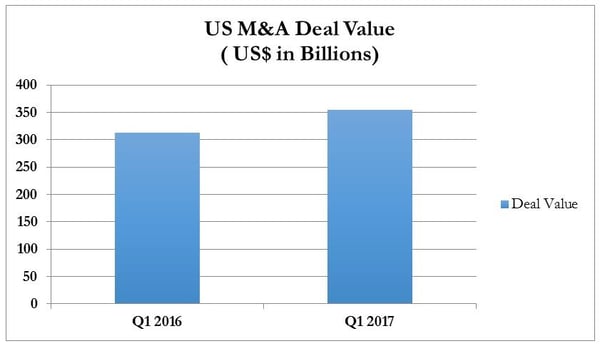
In the US, M&A deal activity increased in Q1 2017.  Specifically, the value of M&A transactions was 13.2% above Q1 2016.

Bar chart of Q1 US M&A deal values from 2016 to 2017


In the middle market, there were 2,643 transactions for the quarter, the best first quarter since 2007.

Internationally, European M&A in the first quarter increased 16%, in comparison to the same period in 2016, to US$215.3 billion.  This transaction value was the best first quarter since 2008.  British M&A activity remained relatively strong in the first quarter of the year despite expectations of a slowdown ahead of the country's exit from the European Union.

M&A involving Asian companies fell 39% in the first quarter of 2017 to US$176 billion, the lowest level in nearly three years.  Tighter regulations in China have made it tougher for Chinese firms to launch takeovers overseas, which had a major impact on the region's overall deal-making in the first quarter.

There are a number of strong contributing factors to increasing M&A activity this year. First, sales and earnings growth is continuing, which portrays strong aggregate demand.  Rising demand encourages CEOs to make acquisitions to expand their businesses.  In addition, companies need to demonstrate growth to shareholders, which provides another reason to make acquisitions.  Second, the slowdown in emerging markets is forcing multinationals to find new avenues of growth.  M&A is actually the quickest route to growth.  Sometimes, it’s easier and less risky than innovation or cost-cutting.  Third, technology is also driving M&A activity.  Disruptive industries such as Artificial Intelligence, FinTech, and the Internet of Things are all continuing to contribute to M&A activity.

To summarize, overall, the M&A outlook for the rest of 2017 looks very favorable.


Written by Donald Grava

27 April 2017


Speak Confidentially with Versailles Group

Versailles Group provides clients with both buy-side and sell-side M&A services and has been completing cross-border transactions since its founding in 1987. If you are considering selling or acquiring a company, we welcome the opportunity to discuss your objectives and offer a clear perspective on your options.

Request a Session >>

Feb 26

Global M&A Has Best January Since 2000

Versailles Group February 26, 2017

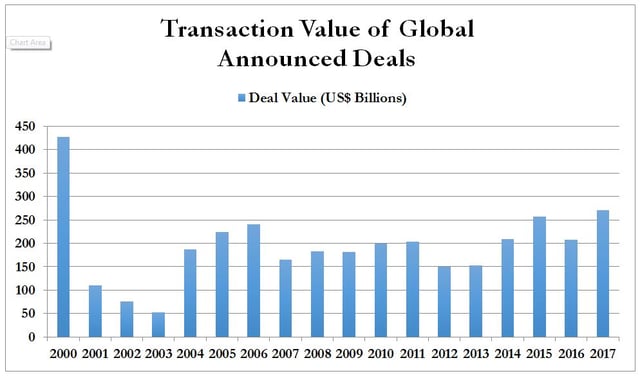
Under multiple stimuli, M&A activity in 2017 is off to an exceptionally strong start.  In fact, January’s M&A activity was the highest since 2000.  Almost 4,700 individual transactions were announced.

 
Bar chart of global M&A deal transaction values from 2000 to 2017
 

Spurred by a global positive sentiment, increased credit availability, and pent-up demand from 2016, companies sprang into action in January with the goal of getting deals closed quickly.  In excess of US$270 billion in worldwide mergers and acquisitions were announced in the month of January, which was an increase of 30% from the US$207 billion announced in January of 2016.

The M&A activity of early 2017 was bolstered by the healthcare and energy sectors.  The value of healthcare transactions totaled US$58 billion and was led by Johnson & Johnson’s US$29 billion acquisition of Actelion Ltd and Mars Inc.’s US$9.1 billion acquisition of VCA Inc.  The Johnson & Johnson - Actelion deal ranked as Johnson & Johnson’s largest-ever acquisition and the third-largest ever U.S. acquisition of a foreign company.  The top energy sector M&A deal announced in January was DCP Midstream Operating, LP’s US$8.86 billion acquisition of substantially all of the remaining assets of DCP Midstream LLC, including assumed liabilities.

Mergers and acquisitions in the technology, media, and telecommunications (TMT) sector will continue to soar in 2017 due to a number of significant factors.  Companies in a wide array of industries, including retail, manufacturing, and financial services, will use M&A as a tool to improve efficiency in business processes, increase protection against cyber attacks, manage and analyze data better, etc.  This trend will translate into an increasing value of tech companies from an M&A perspective.  Valuations will also be driven up as strategic buyers and private equity firms race to compete for the best technology targets.

Speak Confidentially with Versailles Group

Versailles Group provides clients with both buy-side and sell-side M&A services and has been completing cross-border transactions since its founding in 1987. If you are considering selling or acquiring a company, we welcome the opportunity to discuss your objectives and offer a clear perspective on your options.

Request a Session >

Feb 07

2016 Global M&A - US Led the Way

Versailles Group February 7, 2017

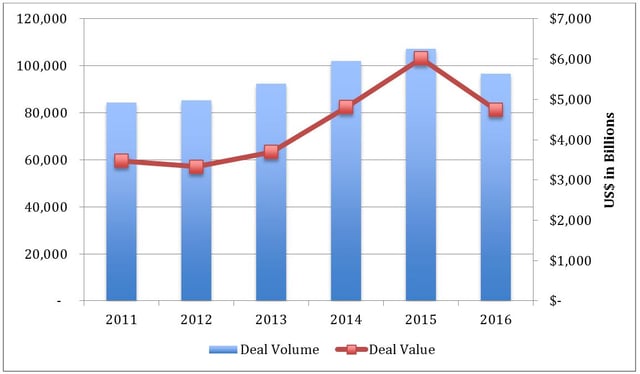
In 2016, there were 96,665 M&A transactions closed with an aggregate value of US$4,734 billion.  In terms of deal value, 2016 was the third best year since 2007, significantly higher than any other year and only slightly surpassed by 2014, the second best year when US$4,802 billion of transactions were completed.  That being said, 2016’s M&A activity was definitely lower than 2015's.


Global M&A Activity by Volume and Value

Bar and line chart of 2016 global M&A activity by volume and value


In 2016, the US once again topped the rankings by both volume and value.  Specifically in terms of deal value, US$1,617 billion of transactions were closed during the year.  Some of this activity can be attributed to the burst of mega deals led by Time Warner’s US$109 billion acquisition by AT&T, which was the largest transaction in the US, the second largest M&A deal globally, and one of the only two global deals worth over US$100 billion during the year.

Following the US’s leading position, China was second with a value of US$789 billion. The largest deal by value involving Chinese targets was the transaction between China National Petroleum Corporation and Jinan Diesel Engine in a reverse takeover worth US$11 billion in December.  Chinese companies completed ten of the top 20 deals in Asia-Pacific in 2016.

The UK was third with US$420 billion of transactions. The largest deal by value in the UK involved Anheuser-Busch InBev’s US$124 billion acquisition of SABMiller, which was also the largest globally.

With strong M&A performance in the US, China, the UK, and other countries, combined with an environment that is conducive to M&A, sellers or buyers should have the confidence to embark on a transaction in 2017.

Candidly, now is the best time to make plans to complete a transaction in 2017.  Sellers should act before buyers/investors’ investment plans and funds have been devoted to other transactions.  Buyers should take advantage by identifying the highest quality targets and moving on them quickly to avoid competitive bidding situations.

Speak Confidentially with Versailles Group

Versailles Group provides clients with both buy-side and sell-side M&A services and has been completing cross-border transactions since its founding in 1987. If you are considering selling or acquiring a company, we welcome the opportunity to discuss your objectives and offer a clear perspective on your options.

Request a Session >>

Jan 13

Drivers Behind a Record Year in 2017 Middle-Market M&A

Donald Grava January 13, 2017

M&A in 2017, for a number of reasons, is projected to be robust and will probably be a record year for several reasons, including:

►  In 2016, private equity firms raised almost US$250 billion for acquisitions, which is now available.

►  Large corporates worldwide are still "sitting" on very large amounts of cash that they need to deploy.

►  The new US President is expected to make some fundamental changes that will be business-friendly.

►  Buyers and sellers are expected to take advantage of current market conditions.

►  The low-growth economy encourages the use of M&A as a tool to grow a company, acquire technology or R&D, etc.

►  Interest rates are still low, but are expected to increase over time - motivating buyers to move sooner rather than later.

►  Looming economic uncertainty is motivating buyers and sellers to complete transactions.

► Sellers' worries about valuations, which were an impediment in 2016, have been alleviated.  Now, sellers are becoming worried that if they don't complete a transaction in the near term, they may miss the "window."

Speak Confidentially with Versailles Group

Versailles Group provides clients with both buy-side and sell-side M&A services and has been completing cross-border transactions since its founding in 1987.

If you are considering selling or acquiring a company, we welcome the opportunity to discuss your objectives and offer a clear perspective on your options.

Request a Session >

Jan 11

2016 Financial Recap

Donald Grava January 11, 2017

2016 financial recap and outlook

As we leap into 2017 and begin to look at the future ahead, we must also look at some of the most impactful events that occurred in 2016.  While a full narrative of 2016 could fill a book, this is just a brief overview.  The exciting part is that 2016 has set the stage for robust M&A activity in 2017.

2016 began with Wall Street indices declining a record 10% in the first two weeks of trading, which marked the worst two-week start for the stock market in history.  This downward spiral could be attributed to China’s slowing economy and depreciating currency.  As the stock market continued to plunge, oil followed suit, dropping to below US$30/barrel early in 2016.  The amalgamation of falling stock prices and a huge oil oversupply was the driving force behind the massive drop from the 2014 fourth quarter price of approximately US$100 per barrel.  Throughout the year, we saw a rebound in not only stocks but oil as well, primarily due to the supply rebalancing and various OPEC agreements limiting production in 2017. 

The next major event came in June, when we saw the UK vote to leave the European Union, causing massive unrest regarding the future of markets and international trade.  US markets fell in the days following Brexit, but rebounded in a rally that erased the initial decline. 

As a whole, 2016 was the worst year the US has seen for IPOs since 2003, with capital raised from new issues down 40% from 2015.  According to Jonathan Gertler, CEO and managing partner of Back Bay Life Sciences Advisors, there is no debate on whether the IPO market is softer than in recent years, and he believes it to be mainly due to volatility in the US economy and “an exuberant market that drove valuations exceedingly high,” in the biotech industry specifically.  He went on to say that in the current market, there is an abundance of uncertainty, which does not bode well for high-risk stocks, specifically newly public companies.

A portion of this uncertainty that Gertler spoke about can be attributed to the surprise election of Donald Trump, as many firms and businesses prepared for an economy with Hillary Clinton in the Oval Office.  On November 8th, we saw the markets being agitated as the polling numbers continued to pour in favoring Trump, but this rally continued to build upon itself through the holidays.  Major indices saw gains of between six and twelve percent through the end of the year as many traders continued to bid up stocks as they “saw” deregulation, lower taxes, and increased infrastructure spending in the near future. 

As the markets have improved since the Nov. 8 election, the Federal Reserve decided to raise interest rates by 25 points in December.  Many believe the rate hike was a product of higher home prices, decreased unemployment, and improved confidence in the market that led to the Nov-Dec rally following the election.  Traders currently expect around two or three additional rate hikes for 2017, and according to the December Fed meeting minutes, rate hikes may be higher than previously expected in order to better control the growth of the economy. 

In the final days of 2016, markets hit record highs, with the Dow coming ever so close to the 20,000 mark, which many investors believe is simply a psychological barrier.  While 2016 had many quick turns and shocks (Brexit, Trump, etc.), the market and economy as a whole were able to come out on top in terms of growth and prosperity.  

The stock market exuded great resiliency in 2016, which began with a record-setting worst market performance in history to finish at record highs and prepare the US for a prosperous 2017.  

With regard to M&A activity, 2016 was the third-best year ever; however, M&A decreased between 16 and 20 percent from 2015 levels.  M&A activity is expected to be exceptionally strong over the next two or three years, but will peak in 2017.  Therefore, people interested in completing a transaction should execute now.

Speak Confidentially with Versailles Group

Versailles Group provides clients with both buy-side and sell-side M&A services and has been completing cross-border transactions since its founding in 1987. If you are considering selling or acquiring a company, we welcome the opportunity to discuss your objectives and offer a clear perspective on your options.

Request a Session >

Dec 15

M&A Outlook For 2017

Donald Grava December 15, 2016

M&A activity in 2017 is expected to pick up dramatically for four reasons.  First, the strong equity markets are generating optimism as they are usually a leading indicator.  Second, in a recent survey, an unprecedented number of business owners or executives claimed they are planning an M&A transaction in the next 12 months. Third, many domestic and European companies have accumulated large cash balances that are available for acquiring new businesses.  Fourth, private equity firms are sitting on a record US$1.1 trillion in uninvested capital and are expected to boost the number of completed transactions globally.

It’s expected that the North American M&A market will be strong for the next three years, particularly in the US.  However, M&A transactions in the US will peak at US$1.5 trillion in 2017. 

Logically, sellers should take advantage of 2017’s robust forecast.

On a global scale, US$2.7 trillion of M&A transactions were completed in 2015.  It’s been forecasted that US$3 trillion of M&A transactions will be closed in 2016.  In 2017, it is expected to increase again, to US$3.4 trillion.

With regard to the European market, inbound M&A transactions, by US companies taking advantage of a stronger US dollar, are expected to increase.  The UK, Germany, and Spain are the most attractive investment destinations, while France and Italy remain less interesting.

On the other side of the world, the re-emergence of Asia as one of the world’s most dynamic growth stories is steady and striking.  China Yuan’s depreciation and the bursting asset bubble have spurred increasing outbound activities by Chinese buyers into neighboring Asian countries as well as developed countries.  At the same time, the Chinese Government is starting to control this outbound activity, which may alter some of this activity.

Lastly, the African and Middle Eastern markets are worth paying attention to as oil prices rebounded after OPEC announced production cuts. A recovery in oil prices will enable more available funding, which subsequently may boost deal-making activities in the region.

Founded in 1987, Versailles Group is a boutique investment bank that specializes in international mergers, acquisitions, and divestitures. Versailles Group’s skill, flexibility, and experience have enabled it to successfully close M&A transactions for companies in the middle and lower-middle market. Versailles Group has closed transactions in all economic environments, literally around the world.

Versailles Group provides clients with both buy-side and sell-side M&A services and has been completing cross-border transactions since its founding in 1987.

Nov 15

Record M&A deals in October 2016

Donald Grava November 15, 2016

Record October for M&A Deals - Reflects Current Market Conditions

The US M&A market is on a roll, which is good news for both sellers and buyers in the middle market.  

A series of high-profile deals announced in October makes it the biggest month ever for M&A transactions and even surpassed the epic deal-making surge in January 2000. Mega deals are driving activity and are almost too numerous to count, e.g., the oil-and-gas business combination of General Electric and Baker Hughes, the telecom tie-up of CenturyLink and Level 3, and AT&T’s acquisition of Time Warner, etc.

Another good example in the global semiconductor sector is Qualcomm’s US$47 billion acquisition of NXP Semiconductors, which notched the biggest semiconductor-targeted M&A deal on record globally.

Top 5 Global Tech Targeted M&A Deals on Record

Top 5 Global Tech M&A Deals Chart 

So far this year, US$1.6 trillion of M&A transactions have been announced in the domestic market.  It reflects easy financing conditions, more confidence in the economic and business outlook, and keen foresight on the part of management teams.

The current economic environment of low interest rates and high stock prices has encouraged deal-making.  Cheap borrowing costs make it easy to finance deals, while high stock prices provide companies with higher valuations.  

With unprecedented economic conditions, owners of middle-market businesses, in particular, have a continued incentive to start or keep doing deals.


Versailles Group, Ltd.

Founded in 1987, Versailles Group is a boutique investment bank that specializes in international mergers, acquisitions, and divestitures. Versailles Group’s skill, flexibility, and experience have enabled it to successfully close M&A transactions for companies in the middle and lower-middle market. Versailles Group has closed transactions in all economic environments, literally around the world.

Versailles Group provides clients with both buy-side and sell-side M&A services and has been completing cross-border transactions since its founding in 1987.


November 15, 2016

Nov 01

Global M&A Rebounds in Q3 2016

Donald Grava November 1, 2016

Global M&A Rebounds With Newfound - Attractiveness in Europe

With mega deals leading the market, the global M&A market showed signs of rebounding in Q3.  Compared to US$1.0 trillion in Q1 and US$1.1 trillion in Q2, the value of global M&A increased to US$1.2 trillion in Q3, marking the second consecutive quarterly improvement.  In all, there were 19,416 transactions announced during Q3 and 11 transactions valued at more than US$10 billion each.

Regarding deal value, the US led the market, followed by the UK, China, Canada, and India.  US companies remain top attractions for global investors as US$416 billion of deals were completed with US targets in Q3.  These US transactions accounted for 40% of the global market and were more than double the deal value of either the UK or China.  

The chart below shows the top five global target countries by deal value.

Pie chart showing the top five global target countries by deal value

In terms of volume, most of the M&A deals were concentrated in the US, followed by China, the UK, Canada, and Germany, continuing the trend for the first half of 2016. 

Pie chart showing the top five global target countries by deal volume

It is worth noting that M&A activities in Germany have remained resilient in the face of slower growth and tremendous volatility in the global market, with both the volume and value of transactions remaining close to the 2015 peak level.  What made Germany stand out in the global M&A market rankings is the giant US$132 billion deal between SABMiller and AB InBev, which is the largest deal by value in Q3 worldwide.

Interestingly, the ever-increasing deal value in the UK is bucking the trend in the global M&A market.  Since the Brexit vote, there have been rumors that the level of mergers and acquisitions activities across Europe would be threatened; however, the positive M&A data in Q3 2016 signaled the newfound attractiveness of European M&A.


Versailles Group, Ltd.

Founded in 1987, Versailles Group is a boutique investment bank that specializes in international mergers, acquisitions, and divestitures. Versailles Group’s skill, flexibility, and experience have enabled it to successfully close M&A transactions for companies in the middle and lower-middle market. Versailles Group has closed transactions in all economic environments, literally around the world.

Versailles Group provides clients with both buy-side and sell-side M&A services and has been completing cross-border transactions since its founding in 1987.