


Jul 12

M&A Activity in Asia Grows - Led by China

Donald Grava July 12, 2016

Versailles Group - China update

M&A Activity in Asia Grows

While global M&A activity in Q1 2016 was lower than the record-breaking deal volume witnessed in Q1 2015, one bright spot has emerged amid volatile markets and political uncertainty: China.  In Q1 2016, China claimed its largest quarterly share of global mergers and acquisitions on record.  According to Thomson Reuters, roughly US$110 billion in M&A deals, or 15 percent of global deal value, involved Chinese buyers. 

The chart below depicts deal value in China across the past five years, 2012 - 2016. The value of outbound Chinese deals in Q1 2016 ($110 billion) surpassed China’s previous annual record of $109 billion over the whole of 2015.
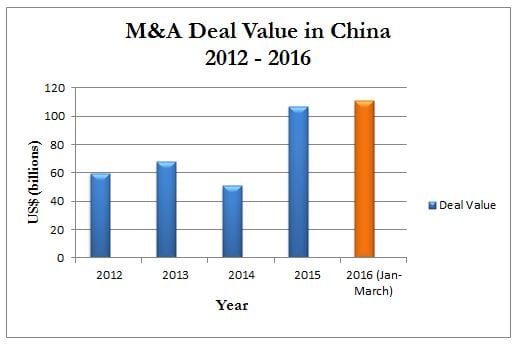
Bar chart of M&A deal values in China from 2012 to 2016

Overall, M&A activity in Q1 2016 throughout Asia increased by 9 percent compared to Q1 2015.  Last year, the region reached a deal value of US$275 billion, accounting for almost 40% of global deal value (US$699 billion).  When analyzing the activity by country, China played a significant role in M&A activity across the continent.  Mega deal activity, characterized by deals that have a value greater than $5 billion, contributed to China’s M&A prowess, as the top ten deals in Asia all had either a Chinese company as an acquirer or a seller.  The largest deal in Q1 2016 was China National Chemical Corp’s acquisition of the Swiss company Syngenta, which amounted to a $46 billion transaction and marked China’s biggest takeover of a foreign company. 

Recently, China has exhibited a strong appetite for foreign acquisitions, particularly in the U.S.  O’Melveny law firm’s 2016 investment study suggests that Chinese business owners’ investment in the U.S. will be higher in 2016 than in previous years.  The study mentioned the U.S. as a key target nation for Chinese acquirers, as Chinese buyers are looking for growth at a time when their home markets are facing a relative slowdown.  Overall, China’s cross-border deal value has increased over the past year, including both inbound and outbound acquisitions.  Specifically, China’s cross-border deal value totaled $95.1 billion in Q1 2016, representing an increase of 136 percent compared to Q1 2015.  

Chinese companies have emerged as a dynamic force in deal-making in a number of sectors.  China’s increased M&A activity highlights its attempt to serve its growing consumer class, as the nation copes with sharp declines in its stock market and less domestic economic growth prospects.  According to Barclay’s Head of Americas M&A, Larry Hamdan, we should “expect China outbound M&A to continue as they seek to bring leading international brands and technologies to their home market and to drive growth by expanding into new geographies.”  Gilberto Pozzi, co-head of global M&A at Goldman Sachs, agrees that China is attempting to drive growth through cross-border acquisitions, asserting that “robust Chinese M&A activity was primarily driven by a combination of decelerating growth in China, leading companies to diversify across geographies, and government support on foreign strategic acquisitions.” 

In the future, we can expect China’s remarkable amount of outbound M&A activity to continue. According to Pozzi, decelerating growth and the government’s encouragement of foreign acquisitions are both “strong tailwinds which direct towards continued outbound Chinese M&A activity for the rest of 2016 and beyond.”  As more Chinese buyers have recently begun to hire advisers very early in the deal-making process, we have seen more and more successful transactions.

Founded in 1987, Versailles Group is a boutique investment bank that specializes in international mergers, acquisitions, and divestitures. Versailles Group’s skill, flexibility, and experience have enabled it to successfully close M&A transactions for companies in the middle and lower-middle market. Versailles Group has closed transactions in all economic environments, literally around the world.

Versailles Group provides clients with both buy-side and sell-side M&A services and has been completing cross-border transactions since its founding in 1987.


Jul 06

Impact of Brexit on U.S. Middle Market M&A and Opportunities

Donald Grava July 6, 2016

Brexit with the UK flag in the background

Brexit Middle Market M&A

U.S. middle-market M&A is, for the most part, shielded from the Brexit volatility, according to Franklin Square’s senior economist, Lara Rhame.  In 2015, U.S. middle-market companies generated 87 percent of their revenues from domestic sales.  Of the 13 percent of the middle-market revenues generated outside the U.S., only 3 percent came from Europe.  Thus, M&A in the U.S. should not be drastically impacted by Britain’s exit from the EU, as U.S. companies have placed a greater emphasis on buying and selling both domestically and outside of Europe. 

Nevertheless, the post-referendum weakening of the British Pound relative to the U.S. dollar could potentially have significant implications for M&A activity between Britain and the U.S.  As the exchange rate between the Pound and the Dollar fluctuates, so do sales between the two countries – this phenomenon is known as the substitution effect.  As the Pound strengthens against the Dollar, Pound denominated goods and services become more expensive, meaning that Dollar denominated goods and services become more attractive.  Hence, U.S. sales to Britain increase, and British sales to the U.S. decrease.  In contrast, when the Pound weakens, Pound denominated goods and services become less expensive, resulting in Dollar denominated goods and services becoming less attractive.  Thus, U.S. sales to Britain decrease, and British sales to the U.S. increase. 

Ultimately, this substitution is rooted in the notion that as prices rise, consumers will replace more expensive items with less costly alternatives.  In recent years, the exchange rate of the British Pound to the U.S. Dollar has averaged about US$1.60.  This rate declined a bit throughout the start of 2016, and dropped to roughly US$1.36 immediately after the Brexit vote.  Overall, this low exchange rate puts the Pound near a multi-decade low relative to the U.S. Dollar.  One possible effect of this record-low exchange rate is substitution; in terms of M&A, this substitution could potentially lead to U.S. companies buying more companies in the U.K. 

Studies have repeatedly suggested that U.S. middle market companies should consider expanding outside the U.S.; these companies should either buy or sell overseas, or potentially establish overseas operations.  Hence, the decision to expand generally comes down to the choice of either building or buying.  In the most basic terms, a target company in the U.K. that is selling will cost about 15 percent lower in U.S. Dollar terms compared to two or three years ago.  This reduction is very beneficial for U.S. companies looking to buy British companies.  Consequently, some private equity firms have argued that the Brexit economic uncertainty will bring prices on potential U.K. acquisitions down to more reasonable levels, which could spur cross-border M&A activity.

A good M&A advisor with cross-border transaction experience should be able to assist in acquiring a company in the UK.  As always, it’s important to have several targets in mind so that the very best acquisition is completed.

Founded in 1987, Versailles Group is a boutique investment bank that specializes in international mergers, acquisitions, and divestitures. Versailles Group’s skill, flexibility, and experience have enabled it to successfully close M&A transactions for companies in the middle and lower-middle market. Versailles Group has closed transactions in all economic environments, literally around the world.

Versailles Group provides clients with both buy-side and sell-side M&A services and has been completing cross-border transactions since its founding in 1987.
Jun 26

Tech M&A Q1 2016: Record-Breaking Deals and Future Predictions

Donald Grava June 26, 2016

speed-power-1920-1080-.jpg

Q1 2016 Tech M&A Update

While the tech industry may not repeat the same record-breaking deal volume it experienced in 2015, the consensus is that 2016 will be a very active year for technology M&A.  

According to prominent venture capitalist, Marc Andreessen, Microsoft’s planned acquisition of LinkedIn is indicative of an imminent increase in M&A across the tech sector.  Andreessen predicts there will be many deals through the remainder of 2016 and the entirety of 2017, asserting that there are numerous deals that should have already happened, but have not occurred yet.  “Most of the big tech companies have done very well over the past five years, they’ve piled up lots of cash, and they have to go shopping,” affirmed Andreessen on Tuesday, June 14, 2016.

Tech M&A is also on the rise globally, accounting for roughly 14% of M&A deals worldwide in Q1 2015, which was the most of any industry.  The chart below depicts tech deal volume and value in Q1 for the past five years.  Overall, global Tech M&A deal volume peaked this past quarter (Q1). 

Just recently, Microsoft Corp announced its planned acquisition of LinkedIn Corp in an all-cash transaction deal valued at US$26.2 billion.  According to Mergermarket’s records, the deal is the third highest valued deal within the US technology sector since 2001 and has consequently given a much needed boost to the sector’s current M&A activity.

Thus, despite a slow start to the year and a lack of momentum, M&A activity in the US tech sector is back on track to match last year’s record.  833 deals worth US$254.7 billion were struck in 2015, which overshadowed 2014’s record value by 94.7%.  According to Thomson Reuters, US$209 billion in tech transactions have been announced so far this year and these deals are expected to close by year end.


Versailles Group 

Founded in 1987, Versailles Group is a boutique investment bank that specializes in international mergers, acquisitions, and divestitures. Versailles Group’s skill, flexibility, and experience have enabled it to successfully close M&A transactions for companies in the middle and lower-middle market. Versailles Group has closed transactions in all economic environments, literally around the world.

Versailles Group provides clients with both buy-side and sell-side M&A services and has been completing cross-border transactions since its founding in 1987.
 

For additional information, please contact

Donald Grava

Founder and President

+1 617-449-3325

May 23

Q1 2016 Private Equity M&A: Global Slowdown

Donald Grava May 23, 2016

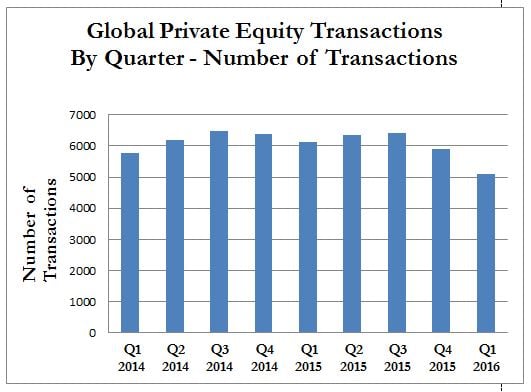
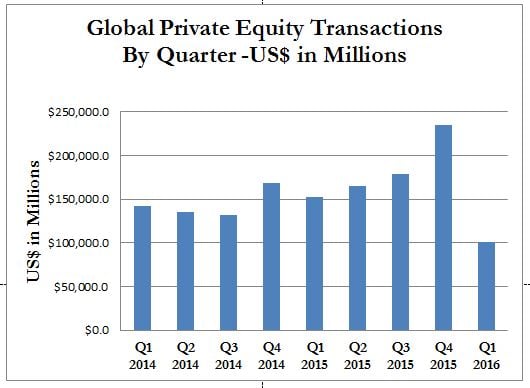
Globally, both the volume and value of M&A transactions slowed in the first quarter of 2016.  Private Equity transactions were not exempt from this slowdown, which is being caused by tightening credit to finance transactions, election uncertainty, and lower confidence in the economy.

With regard to the volume of Private Equity transactions, the following chart depicts the Q1 2016 slowdown.  More specifically, Q1 2016 was almost 17 percent lower than Q1 2015.

Versailles Group - M&A Quarterly Comparison 

With regard to the value of Private Equity transactions in the first quarter, the slump in the number of completed transactions was even more apparent.  The value of transactions in Q1 2016 versus Q1 2015 decreased by 34 percent.  The major factor contributing to this was the simple fact that there was a dramatic slowing of very large transactions.

 Versailles Group - Quarterly M&A Comparison


Private Equity buyers still have plenty of “dry powder” and continue to look for transactions across all sectors.  Their investors are always looking for good returns, which can only happen if the Private Equity firm is invested.  In addition, while Private Equity buyers frequently don’t outbid strategic buyers, they do offer competitive valuations.  Furthermore, they provide business owners that are selling a very viable alternative with lots of other benefits.

The key to closing a successful transaction, particularly if the goal is to do that in 2016 is to explore the topic and develop definitive objectives.  Many sellers wait too long or have this fuzzy notion that a qualified buyer will seek them out.  Neither scenario achieves the best value.  

Founded in 1987, Versailles Group is a boutique investment bank that specializes in international mergers, acquisitions, and divestitures. Versailles Group’s skill, flexibility, and experience have enabled it to successfully close M&A transactions for companies in the middle and lower-middle market. Versailles Group has closed transactions in all economic environments, literally around the world.

Versailles Group provides clients with both buy-side and sell-side M&A services and has been completing cross-border transactions since its founding in 1987.
Apr 20

Q1 2016 Sees Decline in Global M&A Activity Compared to Previous Years

Donald Grava April 20, 2016

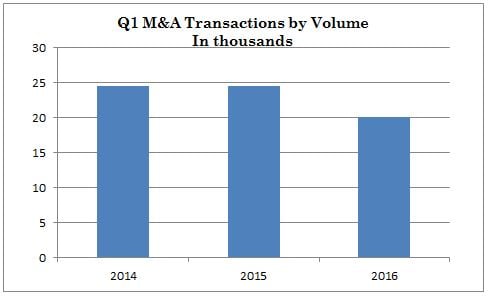
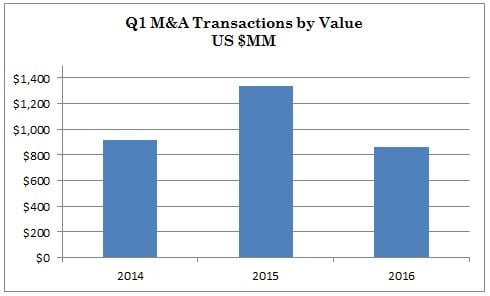
Global M&A activity in the first quarter of 2016 was lower than both Q1 2015 and Q1 2014.  Typically, the first quarter is slower than the fourth quarter and this year was no exception.  In terms of volume, Q1 2016 was about 21 percent lower than Q4 2015.  By comparison, Q1 2015 was only 7 percent lower than Q4 2014.

As depicted in the graph below, in terms of volume, Q1 2016 was about 18 percent slower than both Q1 2015 and Q1 2014.

Q1 2016 m&a activity 

In terms of value, Q1 2016 was dramatically lower than Q1 2015 and about 8 percent lower than Q1 2014. 

Q1 2016 m&a activity

M&A in the US and cross-border transaction activity remain strong; however, not exempt from this slowing.  Sellers should move quickly to complete transactions while buyers should start to prepare to make acquisitions as valuations will surely drop if this trend continues.

 
Feb 23

January 2016 - Middle-Market M&A Hits Decade Low in Volume and Value

Donald Grava February 23, 2016


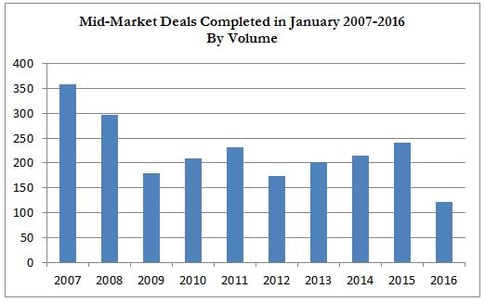
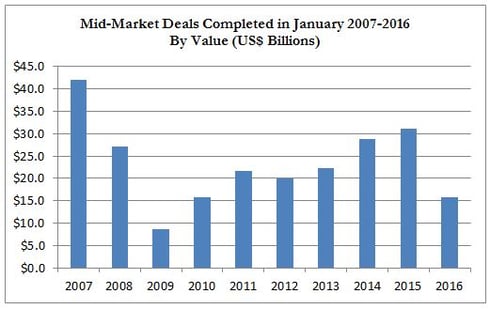
Middle-market M&A activity, as measured by volume, was the lowest that it has been in 10 years.  By value, M&A activity in January was the lowest since 2009. 

A bar chart illustrating the number of deals completed in January from 2007 to 2016

A bar chart displays the value of deals completed in January from 2007 to 2016.


There are many theories about why this is happening, for example, a volatile stock market, declining energy prices, rising interest rates, the slowing of China’s economy, and uncertainty caused by the US election process.  We would not deem this to be a trend unless we see this continue for a few months.

For sellers, multiples seem to be dodging this lower level of activity.  And, in the lower middle market, that is, companies with less than US$100 million in revenues, there seems to be plenty of interest, activity, and definitely no degradation of multiples.

As we’ve all noted, the Fed may not be able to raise interest rates, energy prices can’t fall much more, and an election won’t stop people from completing synergistic or opportunistic transactions.  Thus, there are plenty of good opportunities on both the sell and buy side.

If you’re interested in completing a transaction in 2016, either buy-side or sell-side, now is a good time to explore and develop objectives.


Founded in 1987, Versailles Group is a Boston-based investment banking firm specializing in mergers, acquisitions, divestitures, and cross-border middle-market transactions.  Versailles Group has closed transactions in all economic environments, literally around the world.  Versailles Group provides clients with both buy-side and sell-side M&A services, and has been completing cross-border transactions since its founding in 1987.

If you are interested in discussing your M&A objectives, please do not hesitate to contact us. 

Donald Grava
Founder and President
+1 617-449-3325 (Direct)


Jul 10

Why should you sell your business to an overseas buyer?

Donald Grava July 10, 2015

Sweden

If you’re an entrepreneur interested in selling your business, it is now more important than ever to consider overseas buyers. Due to the progressive globalization of the world economy, virtually any company interested in M&A stands to gain from participating in the international market, regardless of that company’s size.

For overseas buyers, acquiring an American business is often an attractive option because it allows them easy and strategic access into the lucrative American market. International buyers might also want to acquire an American company because they consider the United States to be a relatively safe haven from more volatile foreign markets. Buyers may even be motivated by the desire to gain an investment visa through such a transaction.

The high demand among overseas buyers plays directly in favor of the sellers. When it comes to selling your business, the more options you have, the better. For instance, you could sell your company to an overseas party if no domestic parties make a reasonable offer. In another scenario, the presence of a possible overseas buyer(s) for your company could even spur other prospective buyers to make more aggressive bids and push an auction to even greater heights for valuations.

This is the primary reason why all American entrepreneurs should keep overseas buyers in mind. The international market will open new doors for both you and your company. For instance, say that you’re trying to sell your company to domestic buyers, and your best offer is US $20 million. If you’ve only bothered to search domestically, you’ll have no choice but to accept that offer. However, imagine that you had searched for buyers in the international market as well. Perhaps you would’ve found a buyer in Brazil also willing to pay US $20 million, forcing your American buyer to increase its bid to $22 million. Or maybe you would’ve found a buyer in South Africa willing to pay US $30 million! It has certainly happened before, and it can certainly happen again.

Founded in 1987, Versailles Group is a boutique investment bank that specializes in international mergers, acquisitions, and divestitures. Versailles Group’s skill, flexibility, and experience have enabled it to successfully close M&A transactions for companies in the middle and lower-middle market. Versailles Group has closed transactions in all economic environments, literally around the world.

Versailles Group provides clients with both buy-side and sell-side M&A services and has been completing cross-border transactions since its founding in 1987.
For more information, please contact

Donald Grava
Founder and President
617-449-3325

Jul 02

Technology Sector M&A Activity

Donald Grava July 2, 2015

technology sector M&A activity

Across all sectors, M&A activity, for the twelve months ending May 31, 2015, has increased relative to the same time period last year. Both strategic and financial buyers are completing more acquisitions because of the recovering US economy, the impending interest rate hike, and other factors. The data above illustrates the increase in M&A deal volume in the middle market.

The technology sector has accounted for most of the increase in deal volume. In the last three months (March-May 2015), there were 526 deals completed in technology services-- more than any other sector. That number is up from 477 technology services deals completed from March to May of 2014.

The need to innovate, grow, and keep pace with the changing technological landscape is fueling M&A volume in the technology sector. Technology companies are increasing their IT capabilities via M&A strategies to scale their operations, develop domain expertise, or pursue growth prospects.

The rationale for acquisitions in the technology sector is strong: internet data traffic is expected to triple from 2014 to 2019. In addition, 50% of this internet traffic is expected to come from devices other than traditional desktops. Technology companies are acquiring businesses that enable them to ensure growth through the development of new technologies or to penetrate new markets.

Whether it's a tech company or not, if you are interested in completing an M&A transaction, there is no better time than now. The looming interest rate increases, possible change of political party, world events, etc., are driving people to complete deals before it's too late.

Founded in 1987, Versailles Group is an independent, middle-market boutique M&A firm and offers its clients access to buyers and sellers worldwide. The firm provides its clients with a high level of personal attention coupled with cross-border transaction experience. Clients benefit from world-class advice, broad expertise, and flawless execution.

As one of the leading middle market investment banking firms in Boston, the firm’s focus is on obtaining superior results for its clients. That’s the primary reason why Versailles Group has done more repeat business than any other middle market firm. The net result for our clients is a superior transaction, whether it is on the buy or sell side.

If you are interested in buying or selling a business, please contact us for a free consultation.

Donald Grava
Founder and President
Versailles Group, Ltd.
617-449-3325

Jun 27

When to Sell Your Business

Donald Grava June 27, 2015

The best time to sell a business is usually before the owner has to.

This principle is especially important in the lower middle market and middle market, where a company’s value often depends not only on earnings, but also on preparation, management depth, customer relationships, and the owner’s role in the business. Market conditions matter. Buyer demand matters. But the best time to sell is usually when a company is performing well, buyers can see a credible path for future growth, and the owner still has the flexibility to choose among several alternatives.

For many business owners, selling a company is a personal, strategic, and often emotional decision. A sale may be driven by retirement planning, succession issues, family considerations, a desire to reduce personal risk, or the recognition that the company may need additional capital, management depth, or strategic resources to reach its next stage of growth.

Still, timing can have a meaningful impact on value.

When M&A conditions in the middle market are favorable, buyers are more active, financing is more available, and valuations may be stronger. As a result of robust demand, valuations can be driven higher in many sectors. However, even in strong markets, sellers often hesitate when it comes to the sale of their companies.

Some owners are unwilling to sell because they believe demand and valuations may reach even greater heights in the future. Others are simply not ready to begin a process. Some have not prepared their financial information, strengthened their management team, or considered how the business would perform without their daily involvement.

Yet timing the market is always difficult.

A decrease in demand from buyers, a change in financing conditions, weaker company performance, or an increase in the number of sellers can reduce valuations as demand falls and supply increases. For sellers trying to receive the most consideration for their companies, the key is to be ahead of this shift, not reacting after conditions have changed.

The decision to sell should begin with a practical assessment of the business.

A company may be well positioned for a sale when revenue and earnings are stable or growing, margins are defensible, customer relationships are strong, and buyers can understand the company’s future opportunity. Clean financial statements, a capable management team, limited customer concentration, and a clear growth story can all improve buyer confidence.

By contrast, it may be better to wait if the company is facing short-term operational issues, declining performance, unresolved legal or accounting matters, or heavy dependence on the owner. Uncertainty often reduces value, slows diligence, or creates more difficult deal terms.

Preparation can also influence timing.

Owners who are not ready to sell immediately can still benefit from preparing early. Reviewing financial reporting, addressing customer concentration, strengthening management, documenting recurring revenue, and clarifying growth opportunities can make a future process more efficient and competitive. In many cases, the work done before a company goes to market can have a meaningful effect on the outcome.

The owner’s readiness is equally important.

Business owners should consider whether they are prepared for the demands of a sale process, the disclosure required during due diligence, and the potential transition after closing. In many lower middle-market and middle-market transactions, buyers want the owner to remain involved for a period of time to help preserve relationships, customer confidence, and operational continuity. That transition should be considered before a process begins.

The right time to sell, therefore, is not simply when the market appears strong. It is when company performance, market conditions, and the owner’s objectives are aligned.

For some owners, that may mean beginning a sale process. For others, it may mean preparing the business over the next several years so the company is stronger when the time comes. In either case, waiting too long can reduce optionality. Selling from a position of strength generally gives owners more choices than selling under pressure.

If you are considering buying or selling a lower middle-market or middle-market business, or if you would like to understand whether your company is ready for a sale, please contact Versailles Group for a confidential consultation.

Request a Session >>

Jun 06

Consumer Products M&A Update - June 2015

Donald Grava June 6, 2015

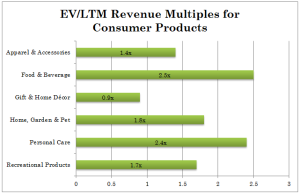
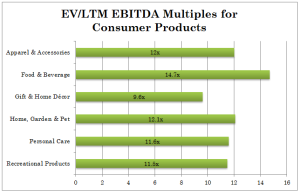
With regard to consumer products multiples, it’s interesting to observe the differences in valuations between the various segments. Whether the metric is enterprise value divided by last twelve months’ revenue (“LTM”) or enterprise value divided by last twelve months EBITDA, Food and Beverage commands the highest multiples. (We explain why below.)


Gift & Home Décor seems to garner the lowest valuations in this sector. But “low” doesn’t mean bad in this case. A multiple of 9.6 times EBITDA is very respectable for this niche.

Consumer Products M&A Update


Consumer Products M&A Update


In the consumer space, strategic acquisitions are a relatively quick way for buyers to keep pace with emerging consumer trends. For example, there are a number of soft drink companies that have acquired water companies, sports and energy drink companies, etc. The purpose of these acquisitions was to respond very quickly to customer demand. This heightened demand and competition for companies in this niche translate into higher multiples and values as depicted in the charts above.

Founded in 1987, Versailles Group is a boutique investment bank that specializes in international mergers, acquisitions, and divestitures. Versailles Group’s skill, flexibility, and experience have enabled it to successfully close M&A transactions for companies in the middle and lower-middle market. Versailles Group has closed transactions in all economic environments, literally around the world.

Versailles Group provides clients with both buy-side and sell-side M&A services and has been completing cross-border transactions since its founding in 1987.